Love and Existential Horror

I started reading a webnovel yesterday (I’ve been trying to explore new media frontiers and my trip into the world of Webtoons and the app Tapas has proved to be full of all kinds of semi-familiar culture objects), and I think I’m finally starting to really understand the “cozy horror” trope.

I’ve spent the last few years being deeply perplexed by the people who seem to be interested in the topics most traditionally associated with the horror genre (ghosts, magic, eternity, death, life, suffering, despair, helplessness, hopelessness, etc) but also seemed perturbed by the tone or outcome of stories which make up the usual style of the genre. (The word I’m talking around here is the often pejorative “tenderqueer” — those who seem to want access to the monstrousness and outsider territory of horror and specifically queer horror, but are unwilling to engage with the moments when identification with monstrousness can take a darker turn, or when the experience of sorrow or suffering is expressed in ways that are disinterested in fairness or justice or moral rectitude.)

But I’m reading this webnovel and I’m enjoying it quite thoroughly, but I keep being somewhat charmingly surprised by the way that what I would consider a somewhat “slice-of-life” slow-burn queer romance story keeps folding in these elements which are so familiar to me from my other literary pursuits. Tangling with issues of what it is like to be separated from the corporeal world, loneliness in the face of eternity, the violence we do to ourselves and others when we cannot see a way out, loss, grief, etc.

It’s true—unlike in a true horror novel, there is functionally no violence “on screen,” and while there is suspense over where the narrative will go and how the problems or issues will be resolved, I do not have the real fear, which I associate with a scary story, that terrible things will happen to these people I’m reading about. There is no real threat, as there is in even books which get close to promising that things will “mostly work out” that these characters will suffer horrible damage as a result of experiencing their reality. (I think in this moment of Stephen Graham Jones’ The Lake Witch trilogy, which has a high body count, and some real tragedies, but the core of the novels is often in celebrating the strength it takes to survive the unimaginable, which is very often part of our mundane reality, which is not, strictly speaking, an entirely happy thing.)

But to come back around to the nominal title of this post, the experience has reminded me how often and how deeply “love” is often the guiding force, the primary motivation, within a horror novel. Whether the horror is embedded within the love itself, or if the love is something more like a co-morbid condition with the horror, rarely is love entirely absent from tales of terror.

Now, I’m using “love” rather broadly at the moment, “love” can mean “romance” (when romance goes wrong, horror is almost always the direct result), but “love” can also be the more all-encompassing “agape” — when the desire to keep others from suffering, or even merely the recognition of the suffering of others, be they close friends or complete strangers becomes an unbearable weight, for example, horror can result — and “love” can also be the relationships we have with others, or with ourselves, the ways in which our hearts and our minds can be at odds with one another, which is almost always in evidence in a horror story.

Robert Heinlein wrote a number of good books and stories, and some real big “yikes” ones, and was probably kind of a jerk, but he gets credited with one of the better definitions of love that I’ve ever come across, in Stranger in a Strange Land: “Love is that condition in which the happiness of another person is essential to your own.”

One reason I like this quote is that, technically, it doesn’t actually make any differentiation between “healthy” and “unhealthy” types of love. Furthermore, it is structured in such a way that its inverse is also true: “Love is that condition in which the unhappiness of another person is also your own.”

Within this quote we get two version of the horrors of love.

The first is when love is what we might call “misplaced” — most of us have had some version of a relationship with another person where we loved them, and we desired for them to be happy, but the price of their happiness was our own. Many of us have loved something enough to want to break ourselves upon it, and when we have tried — done all we can to change the shape of ourselves so that it might match with the shape of the one we love — we have realized that some transformations can be impossible. (Or at least, it is the kind of transformation where no meaningful trace of the original remains.) I’m not actually saying that none of us should ever change for love, because I do believe that love in its best and most elevated form is transformative — but it makes us more ourselves in a way that allows us to grow and flourish.

The second “inverted” version of the quote serves to bring attention to “failed” or even “rotten” love. The failures here are ones which I tend to associate with parents and friendship, personally. Those moments when (often through inaction) grave harm is perpetrated against someone whom we love and their pain and their suffering becomes something we feel ourselves, and even for which we are responsible. (Lampshade here the longer complex conversation I’m not going to engage with about when its appropriate to feel a trauma which occurred to someone else as your own, and what exactly the process and nature of forgiveness can and do and might look like for different people in different situations.)

But the truth is, if we do not love someone, their pain cannot have true meaning to us. If we don’t care about someone, their pain is meaningless. At best it’s an abstraction, and at worst it’s a curiosity. (And yes, I suppose I am saying that I believe that the core of the human experience and existence is love, because empathy and love are extensions of one another, so when we feel sorrow for the troubles of a stranger, it is because on some level we love this stranger.)

All this is really just to say, I guess, that in my experience there is no horror from which love is absent. (Though we would have to debate the cases where the absence of love is the horror in question, but I’m pretty confident it’s there too, I just haven’t gotten that far quite yet.)

It’s what love makes us do that scares us.

Things Haven’t Gotten Better: Moral Outrage and Eric LaRocca’s THINGS HAVE GOTTEN WORSE SINCE WE LAST SPOKE

The most important part of Eric LaRocca’s Things Have Gotten Worse Since We Last Spoke is the Author’s Note which opens the novel.

This Author’s Note is not, as far as I can tell, from LaRocca themself, because this is a diegetic author’s note, it is part-and-parcel of the novella itself. I have no idea if those who took such umbrage online with the work took the time to read this critical framing device and understand its purpose.

I. This book exploits queer women

Though it pains me to do so, let’s put aside the rampant anti-queer and non-binary-phobic nature of the rhetoric which equates LaRocca’s work with something written about queer people or lesbians who is also a cishet man. (And even then, the interest expressed would have to be exceedingly prurient for me to start really coming down on a cis heterosexual man for daring to engage the topic. Writing it isn’t the problem, how you write it is.)

One thing I saw a lot online was the accusation that while the work is presented as being a queer relationship between two women, given that the entire thing takes place online, and therefore we have no assurance that either of the protagonists (but especially the “Zoe” character) is who they say they are. People were very quick to suggest that “Zoe” could well be some man pretending to be something he isn’t (queer, a woman, honest, etc.).

[Actually, we do need to take a moment to talk about the exclusionary queer rhetoric and transphobic/non-binary-phobic tone of this criticism:
Intentionally misidentifying and excluding LaRocca from “Queerness,” including misgendering them, while accusing the novel of portraying a character who is not what they “claim” to be—specifically a queer person and female identified in Zoe’s case… You might be able to see where the intersection of these accusations begin to uncomfortably display an inherent prejudice on the part of the so-called “critic” making them.
These individuals are unwilling to recognize LaRocca as a member of the queer community (because of their background, identity, presentation, I don’t know and I don’t care), and justify that prejudice by sublimating it into their “analysis” of the work itself. The accusation that LaRocca is somehow an impostor or fraudulent queer person is transferred onto the narrative of the novella as a means of obfuscating its true purpose: to exclude LaRocca, and propagate personal prejudice.]

“Because the litigation surrounding Zoe Cross’s case remains open at the time of this publication, certain elements of their [Agnes and Zoe’s] communication have been redacted or censored at the behest of the Henley’s Edge Police Department.”

p. 9 (Things Have Gotten Worse… Weird Punk Books, 1st edition)

With this simple statement, LaRocca’s fictional author puts to rest (at the very beginning!) any possibility that Zoe Cross is not who she says she is. We can state, with some degree of confidence, that within the world of the novella, a person exists whose legal name is “Zoe Cross”. Now, it’s true that no personal pronouns are ever used within the Author’s Note to refer exclusively to Zoe Cross, so I cannot say that Zoe for sure uses “she/her” pronouns or would be recognized as a woman by the organs of the state.

At the same time, the whole novella (including the Author’s Note) hail from the turn of the millenium… That’s 2000-2001. For those too young to know or remember those years, it is unlikely that police and judicial records or press coverage of that time would willingly use an individual’s chosen name rather than their legal name (no, it’s not so different now, but it was worse then, I promise). We must, therefore, assume that if Zoe Cross is being identified by police and judicial records as such, that she is, in fact, a woman insofar as the stringent requirements of the legal framework of 20 years ago is concerned. (You want to accuse transwomen of being predators and violators of lesbian spaces, by all means please see yourself to your local TERF assembly and do let the door hit you on the way out.)

So, from a purely formal level, we can lay to rest accusations that somehow Zoe Cross is a mask for some abusive man online, taking advantage of a poor, lonely queer woman who couldn’t have known better.

II. This book is immoral, and LaRocca is a pervert for having written it

Very simply, Things Have Gotten Worse Since We Last Spoke is not an im-moral book. It is an a-moral one. (And even that is a somewhat dubious contention, because I believe LaRocca to have plenty to say about abuse, irresponsibility, victimhood and victimization, violence, control via the medium of this work. But we’re getting ahead of ourselves.)

We are told from the outset that this is a case still under litigation, and is being covered in the media. As many high-profile cases have made exceptionally clear in the last few years, one of the stickier parts of the American legal process has to do with the selection of a jury. Juries need to be “impartial” (not influenced by information not presented in the courtroom), making any, even remotely, sensational case extremely difficult to handle.

Also, the author of this publication requests that the reader be cognizant of the fact that the author is in no way affiliated with either Zoe Cross’s legal counsel or Agnes Petrella’s surviving family. The author remains a nonpartisan entity and instead patiently waits for the balances of justice to trip in favor of the truth.

p. 10 (Things Have Gotten Worse… Weird Punk Books, 1st edition)

The reader is, in this final paragraph of the Author’s Note, placed in the position of juror.

When I say that Things Have Gotten Worse… is an a-moral book, I do not mean that it is disinterested in evaluating the moral responsibilities and failures of the characters or the actions they have taken. I mean that it is not a book which will provide the audience with a pre-determined, tidy, pat moral conclusion to the narrative it presents.

The book demands, clearly and pointedly, at the outset, that the reader prepare themselves to decide if Zoe Cross is guilty, and if so… Of what, exactly?

This is not an easy task.

It is not meant to be.

The most discomfiting part of Things Have Gotten Worse… is that it doesn’t ask the reader to merely agree or disagree with its proposed thesis. It presents a complex, possibly intractable, situation and asks “What do you make of all this?”

The book does not presume guilt or innocence on the part of either of its protagonists. Indeed, the power of the narrative emerges from the several reversals which take place within it. We know something terrible is going to happen, and we know which of the two of our protagonists is going to die, and we know who is considered “responsible” in some manner or degree for that death. We begin the narrative inclined to sympathize with Agnes, and to be mistrustful of Zoe. As their relationship evolves, that mistrust seems justified. But it doesn’t stay that way.

Without getting into too many details for those who have yet to read the novella; assigning power and agency (or lack thereof) to either character quickly begins to feel like thrashing in a pit of quicksand, the more you try to find the answer, the deeper you sink into the quagmire. This sense of who is the “driving” force in their relationship undergoes at least 3 major reversals, each one pulling further and further away from the usual metrics by which these things are measured.


I try to avoid blaming any particular cultural movement or moment for what I perceive as failings in the critical or philosophical skills of those who were most impacted by it. Youth, especially, is idealistic, and that’s sweet. (I’m almost 30, so I’m basically ancient, you know. A walking corpse, really.) But I do believe we’ve ended up in a particularly simplistic and reactionary moment. Perhaps this is because the uncertainty which pervades every aspect of the current human experience (economic, political, social, environmental, occupational, physical, etc) makes it exhausting to deal with extra uncertainty for the purpose of intellectual stimulation. Sometimes it’s nice to say “these are the good guys, these are the bad guys” and leave it at that. (To quote a show by a now disgraced writer-producer: “The good guys are always stalwart and true, the bad guys are easily distinguished by their pointy horns or black hats, and, uh, we always defeat them and save the day. No one ever dies, and everybody lives happily ever after.” To which, of course, the response is: “Liar.”)

Just because we’re hoping for to build a better and more beautiful world, and just because we need hope to do so, doesn’t mean that we can or should or will eradicate pain, suffering, harm, and hurt. These things do not arise merely out of “evil” or “bad” behaviors/actions/ideas… In many ways they are the foundational elements of human existence and while we can try to minimize their impact, and we can strive to act in ways which limit, avoid, or avert those outcomes… We also cannot control each other, ourselves, or reality. We can be better… But we’re never going to be perfect.

Things Have Gotten Worse Since We Last Spoke is a book in the grand tradition of horror writing which promises that no matter how hard we try, no matter how good we are, no matter how just or kind or true, no matter how deserving, no matter how careful we are, we will fail and bad things will happen. This is not a story everyone needs to hear, nor a lesson everyone needs to learn, all too many people know from hideous personal experience that these things are true. But I rarely see those people who already know trying to tell others not to tell these stories. In fact, my experience has often been that the people who know these lessons best of all are usually the ones who are writing these stories.

No one has to read a book that will hurt their feelings or cause them distress or harm. But, as LaRocca’s novella has the temerity to suggest, we retain a degree of personal responsibility for the things we do to ourselves, even when other people are involved.

To borrow from the introduction by the publisher to a different book which would undoubtedly also raise hackles and fists (Todd Keisling’s Scanlines): “Please, please leave the room if this will… if this will affect you.”


III. Not enough build-up, just violence (Do you have Sade?)

This is a special mention for an unexpected conversation I had about Eric LaRocca’s Things Have Gotten Worse Since We Last Spoke.

Someone came into my job asking for the book, because they “need it to make fun of it online”. Points for honesty, I guess? I couldn’t let it slide, because I love making fun of books as much as the next person, but I try not to get my hot takes directly from tumblr posts or twitter discourse. They hadn’t read the book, so I asked them what they thought was going to be wrong with it. I’d actually read it, I pointed out, and therefore my suggestion that it packs a lot into a small number of pages might actually have real merit. (I’ve also read, you know, other stuff. Which might also help.)

We covered the bits that I mentioned above. But then this person said they’d heard that it just… Went too far, and didn’t have enough philosophical complexity or what-have-you to justify the violence within its pages. Shocking for its own sake.

I pointed out that it’s not a Carlton Mellick III novella and therefore, we might have to make sure we’re using the same scale of “shock value” to measure the violence-to-philosophy ratio. I’m not really a fan of splatterpunk, the more outre elements of bizarro fiction, or even mundane horror (which is usually rooted in some kind of physical violence).

Ultimately, my description of Mellick’s The Exercise Bike was dismissed as unappealing, because I couldn’t confirm how much of the book actually dealt with the surgical process of transforming a human being into a stationary bike. In my defense, most of my attention had been eaten up on the bit where a woman is forced to ride the willingly-transformed bike-man for his sexual gratification; that’s where the real horror lay for me.

Ultimately, the discussion came around to the Marquis De Sade.

I felt somewhat offended on LaRocca’s behalf that they were coming up short in comparison to Justine. Sure, 200 Days of Sodom has some moral-philosophical-political criticism embedded in it, because it’s ostensibly a take down of the bishops and other unelected leadership of 18th century France. It’s also a book whose primary goal is to come up with the most depraved acts it can think of… Just because.

LaRocca’s novella is not a celebration of depravity. It’s not a joyful study in perversion. It’s not a titillating narrative of physical degradation and debasement. It’s a book about desire, about obsession, about power—over others, over ourselves, over our experiences—and it’s about the things we think we are, and the things we think we love, and what we think we need to be happy.

It is a book of questions, and it whispers in your ear that maybe, just maybe, the answers will be a bit harder to find than we might like.

dailies (july)

july has been a busy month. i worked a lot, and didn’t write as much as i would have liked to. (before yesterday my last journal entry was from the 17th.)

i put together a guide regarding what “weird fiction” could be, if we limited ourselves to lovecraft’s outline of the genre as its laid out in “Notes on Weird Fiction” (printed in the joshi edited “Collected Essays Vol. 2: Literary Criticism” from hippocampus press). check out the PDF of that below. (all “editorial” notes are my own.)


Read:

  • Nghi Vo’s The Chosen and The Beautiful
  • Julian K. Jarboe’s Everyone on the Moon is Essential Personnel
  • Elizabeth Bear’s Machine
  • bits of Foreign Affairs Vol. 101 Nº3
  • started re-reading Umberto Eco’s Foucault’s Pendulum

Watched:

  • Knife+Heart
  • (almost all of) Sorry to Bother You
  • a bunch of Stargate: SG-1 (Season 8)
  • first 2 episodes of Paper Girls
  • Cowboy Bebop

i really really really enjoyed Elizabeth Bear’s Machine. at work there has been a lot of (very serious) joking around about who among us enjoys “fun” in their reading material and who does not. i have had to conclude that while i don’t think i have much patience of “fun” in my horror reading (the more esoteric, philosophical, and convoluted the better), in the realm of science fiction a little bit of light-heartedness goes a long way. which isn’t to say that Machine didn’t make me cry, because it did. (not an altogether uncommon result of an enjoyable science fiction experience for me, actually.) but i liked the characters and more than that, there was a degree of real and genuine excitement i felt for the world that Bear has created in the White Space stories. (i first encountered the future within which Machine takes place in the short story “The Wreck of the Charles Dexter Ward” by Bear and Sarah Monette which was included in the Dreams From the Witch House anthology edited by Lynne Jamneck—read my review here.)

Nghi Vo has been on my radar for a little while, but i hadn’t gotten my act together to read any of her work just yet. thankfully, i’m getting much better at using the interlibrary loan system from the public libraries and have been able to expand my horizons a bit. The Chosen and The Beautiful is not as light-hearted as one might imagine a magically infused re-telling of The Great Gatsby to be. i was also working through it while everyone on twitter was losing their minds over whether it was necessary or not to have read the original (in some form) of a work if one is to write some kind of meta-fiction of it. Vo’s book is a perfect example of exactly why an intimate familiarity with the original work is a fine requirement to impose upon metafictional projects. i haven’t read The Great Gatsby since high school (2010, junior year, TA’s english class, focus on american literature), and Vo’s book made me want to go back and read it over again and turn it upside down and shake out all the little extra details that i know i either missed or have since forgotten.

The Chosen and The Beautiful is able, specifically, to interact exquisitely with the bizarre shallowness which pervades fitzgerald’s novel. the original novel is composed of set pieces and characters being played by people we never really get a good look at, and Vo digs into that exact element, not merely giving depth to the characters by creating histories for them, whole cloth, but by finding ways to bring a peculiar, mystical life to the shallowness itself. the book as a whole is both a love letter and a careful dissection, affection and fond of the original, but also chiding, demanding a little more. what more could you ask for?

Jarboe’s Everyone on the Moon… took a little while for me to get into. i persisted through the collection out of curiosity (rather than pure stubbornness) and i do feel like i was rewarded for it. (in particular “I Am a Beautiful Bug!” towards the end of the collection is funny, heartbreaking, delightful.) i found myself thinking of what Gretchen Felker-Martin said when i spoke with her for a piece that went up on the LASC website (see here), to take in “queer art made by real queer people.” if, as a queer person, the aesthetic products of other individuals’ personal experiences of queerness make you uncomfortable, it is imperative to sit with that feeling, to work through it, to try to better understand oneself and one another through and despite and within that feeling of discomfort. i’m not sure what i learned about myself just yet from reading Jarboe’s work, but i do know that i think it’s worth reading and thinking about and talking about, so you should do that.

every time i start re-reading Foucault’s Pendulum i think “surely i must have imagined how good this was” and each time it’s perfect and beautiful and majestic and it makes me feel like every thought and feeling and disdain and passion is possible. that’s it. i love it so much.


i’ll be honest with you guys, it’s 9am. i have been up since 7am. i was woken up at 4am this morning because of intense pain in my knee and, as it turned out, in my shoulder (likely the result of lying too long in one position while asleep, in an effort to avoid moving my knee), which necessitated getting out of bed and taking advil and figuring out how to fall back asleep in a hopefully-better position. i’m too tired to have good complex articulate thoughts about the movies and tv that i’ve been watching. so that’ll just have to wait for another day.

good luck out there. (see you, space cowboy…)

reading history: censorship lessons

This is a true story:

In my youth I didn’t “get” cubism. It was fine and all, not my favorite because the abstraction often left me feeling a little overwhelmed in a way that was boring (as opposed to the sensory overload of something more post modern where the cacophony of colors and textures starts to feel like it’s moving at the speed of my own millennial anxiety). Picasso felt like a “great man” myth; a justification for some shift in european ideals, a way to insure and assure the tastes and investments of the elite.

“Midnight in Paris” came out around this time (the last Woody Allen movie I would ever watch), as well. I was very impressed by the pitch perfect inclusion of Owen Wilson in that film as the most irritating white guy. I particularly enjoyed Adrian Brody’s Dalí, and Corey Stoll’s Hemingway (“Have you ever wrestled a tiger???”). Most importantly it really introduced me to the figure of Gertrude Stein. I had heard her name and sort of-kind of knew a bit about her, but I was deeply and intensely interested in this titanic dyke of modernism. The woman that Picasso and Hemingway sought to impress, who held the moment and the movement in her salons and her hands and her words.

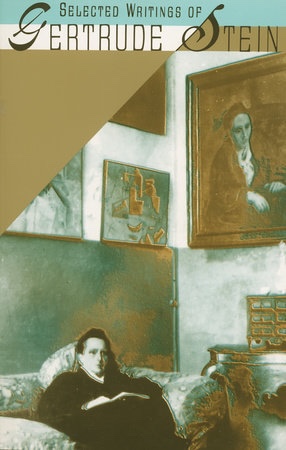
Vintage’s “The Selected Writings of Gertrude Stein”

I bought a copy of Vintage’s “Selected Writings of Gertrude Stein” from Symposium Books, back when they still had a storefront on Thayer Street in Providence. (At the same time I added Anaïs Nin to my “to read” list, and began my shallow but impassioned affair with James Joyce.)

Now, I didn’t really enjoy the writing of Gertrude Stein. I didn’t “get” it either, but she, at least, was using a medium which I had an easier time parsing than that of the painters. Her sentences were long, convoluted, often purposefully devoid of proper signifiers and disconnected from traditional structures of meaning.

I spent a lot of time just reading one word after another and hoping that I would make sense at some point. (It didn’t, entirely, but…)

Then I said to myself this time it will be different and I began. I did not begin again I just began. […] Naturally I would begin again. I would begin again I would naturally begin. I did naturally begin. This brings me to a great deal that has been begun.”

—Gertrude Stein. p. 518-9.

It was while reading The Autobiography of Alice B. Toklas that i realized two incredibly important things.

First, through Stein’s descriptions of the unease people felt looking at the works of Picasso and Matisse, the abrupt confrontation with a painting that demanded something from them, I had managed to really feel and understand, for the first time, why Picasso’s paintings were so important and significant in the evolution of art into the modern period.

Second, Gertrude Stein was a horrific chauvinist, exactly as inclined to dismiss the woman who shared her life in the same manner that the men around her dismissed their own female companions, lovers, and muses.

Indeed, the very title of Stein’s “autobiography” is redolent with this particular form of femme focused misogyny. After all, why should Gertrude retain the right to speak for Alice in such a manner when she could just as easily and just as well tell the story through her own person and presence which already figures (and presumably informs) the narrative? I made it about half-way through what was included of the novel in my volume of Stein’s works and then decided I’d had enough of the impenetrability, the disregard for female and feminine agency (Gertrude having aligned herself firmly with the masculine/male energy and expression of her male contemporaries), and historical time period which I found curious at best and sort of irritatingly self-involved at worst.

Stein herself was a disappointment, and largely confirmed my distaste for the masculinist and chauvinist writing of the time period (I still look with grave suspicion and distaste on anyone who eagerly explains to me how Hemingway has informed their writing practice), and—with the exception of a persistent interest in “The Rhinoceros” and the Modernist application of “plasticity” to literary material—I moved on to the somehow less galling, if no less obnoxious, male chauvinism of the Beat poets.

Why am I telling you this story? Why does it matter that at 15 or 16 I read some literary fiction didn’t like it very much? In a sense, it doesn’t. The process of my personal intellectual development and edification, auto-didactic as it has been in many ways, isn’t of exceptional interest to you, who may not know me. It probably isn’t of great interest to a number of people who do know me, either. But we find ourselves in the strange moment where it seems that the impressive oversight in the American, or perhaps even English-speaking, educational realm has come to a head (one hydra head of many, ever ready to split again into new horrific fractions upon its emancipation from the body of our cultural nightmare) in the form of fantastic re-imaginings of the intention, impact, and reception of—in particular, abstract—art during the interwar period.

I offer this brief excursion into my own past to try and get to a greater point about how we come to understand history and culture and literature and art as a cumulative and interconnected process. I was willing to believe those people who told me that Picasso’s artwork was “revolutionary” in some capacity, a break with the previous sensibilities of aesthetic value, but that much was obvious by comparing Cubism to its representational forebears and contemporaries. What I wasn’t able to grasp without help, was the emotional and affective aspect of that rupture with tradition. It was not possible to access that information via a history of Picasso’s work, or an analysis of the impact of Cubism, not at the start. Anything written after Picasso’s inclusion in the Western canon was established serves merely as justification, post facto, of that inclusion.

Stein gave me something else: she gave me the immediacy of a semi-synchronous description of Picasso’s artwork, the process he underwent in bringing his vision to life, the socio-cultural factors he and the other modernist painters were responding to, the uncertainty of the times everyone was living in. And, perhaps most importantly, a look directly into the face of the conservative reaction and rejection of something new, something they felt was out of place, out of line, out of joint, their desire to shuffle it out of sight and return to the placidity of the values with which they were most familiar and most comfortable.

Some combination of my accidental concentration on the global history of genocide and systematized political mass violence (which always starts with censorship and (violent) exclusion of “undesirables”), and the love I carry for the outré, the perverse, everything pulpy and defiant of tradition, has meant that from the response to Picasso to the banning of Ulysses to the court case around Ginsberg’s Howl to the repeated attempts to shut down and limit access to queer art and literature online in the 90s, the 00s, the 10s, I return again and again to the question, not so much of what is “allowable” or “permissible” or “acceptable” in art and aesthetics, but why it is that every generation thinks that they are the ones who have discovered the “true” rules of Good Art?

In this case, history teaches us not so much where previous censorship fell short or failed to achieve some new horizon of enlightenment, but that every censorial iteration has been forced to admit defeat and then been castigated as—at best—foolish, or—with much greater frequency—as actively immoral, harmful, and destructive.

Time and again, those who emerge from history wreathed in the ever-fading light of timeless moral rectitude are not those who call for the abolition of this or that artistic or aesthetic mode, but those who speak, write, and interrogate that which they find morally, aesthetically, or intellectually impoverished, and who speak with clarity, passion, and fearlessness in favor of that which they believe to inspire to new heights and new horizons the breadth and wealth of the human spirit.

(edited January 2023 to remove an unnecessary paragraph which mis-attributed Steinbeck’s Tortilla Flats to Hemingway. I haven’t read either of them.)

New Tricks: on extinction and not finishing things

Some day (soon, hopefully) I’ll get better at updating again. It’s been tough to remember that regardless of whether or not anything I have to say is “important” or “worthwhile” … This is my own damn blog and my own damn website and I can say whatever I want.

Yesterday I had to make a very difficult and unfamiliar decision: I deliberately chose to stop reading the book I had been (trying) to read. Generally any book which gets shunted into the “unfinished” pile is there as a result of my tendency to get distracted, so it’s theoretically “In Progress” rather than “Abandoned”. However, this time, I got the book out of the library, so I can’t just quietly leave it lying around while I get back to something else and “accidentally” “forget” about it. It has to return to the library before the end of the month.

I rarely actually abandon a book after I’ve started it. It’s a mix of things: a sense of obligation to the author, to the book, to the story, to my integrity as a critic, as a well-rounded human being, and so on. I feel that “I’m not enjoying it” is an insufficient excuse or explanation for leaving something unfinished or undone. Maybe because not all things are meant to be “enjoyed,” maybe because there’s something wrong with me and unless I can say (and providing supporting evidence) that something is causing me actual harm, I consider any other negative emotion insufficient justification to “give up” or “throw in the towel.”

But it seems that I need to reexamine my categories. I’ll read a book that I really hate all the way through to the end. Perhaps because it’s totally engaging to hate something. I tell myself that it’s because I’m trying to give the author the chance, the opportunity, to turn it around; I don’t want to hate something because I didn’t see it all the way through to the end, where it justified itself. All too often I see reviews or comments about movies or books that I really enjoyed where the person says “I gave up half-way through” and I think to myself, “What authority have you, then, to pass judgement on this work?”

In art we are given the chance to do that which is impossible in life: we can see the story in its totality, and we can judge it, weigh its heart against a feather after all is said and done and decide whether or not the story is true and good, or whether its heavy with malice. It is, no doubt, telling that I view the art critic as having the same responsibilities as the moral philosopher. But stories make up the world, and we must do everything we can to understand what our stories really say and do in the world, how else are we supposed to do the work of telling and learning and repeating responsible stories about ourselves and about history if we haven’t done the work in the laboratory of fiction?

The truth is, however, that Jeff Vandermeer’s Hummingbird Salamander was getting in the way. I was toting it around because I felt that obligation to see the journey through, and yet… My current excuse is that I do believe that it is a thriller (if the blurbs on the back are to be believed) rather than almost any other genre, which is one which has never really gotten its hooks in me. It’s always nice to encounter the exceptions to the rule: the book, the movie, the song which proves that there can be an instantiation of a given genre or style which does, actually, appeal to you. Unfortunately for me, we do not seem to have managed that in this particular instance.

Moreover, there is a degree to which the book’s particular subject matter—species extinction in the Anthropocene, and the ravages of humanity upon the natural world—illustrated as they are—through a person who is becoming aware of them intimately, for the first time, rather than merely a theoretical fact about life—is not a lesson I need, nor which I can sustain for the length of a novel. I don’t know if it’s the result of what a psych evaluation some time ago described as “features of OCD?” but I walk the knife’s edge of pervasive anxiety about my impact on the world. A few too many classes in university about the politics of food and its production and I have at many times felt the noose around my neck tighten as I think of all the ways my entire existence is predicated on the exploitation and destruction of every living thing on this planet. (See: I told you I would need to provide evidence of harm to justify putting the book down.)

I did a report about salmon in my seventh grade science class. I still find myself asking if salmon I purchase has been farmed, and if so which ocean it was farmed in. We only farm Atlantic salmon, which all belong to one species, however, people also farm Atlantic salmon in the Pacific Ocean, and it is quite common for them to break containment and end up breeding with the locals, which has had a significant impact on the biodiversity among Pacific salmon, of which there are seven separate species. (And from my junior year in college, I think the less we say about feeding farmed fish corn because we overproduce it and as a result have decided to use it for literally everything the better.)

A book which wants me to care about its protagonist’s inability to be a responsible steward of her interpersonal relationships (she cheats on her husband), while we’re discussing the extinction of entire life forms might be asking for a greater range of feeling than I am capable of maintaining in a single context. She may be able to contain multitudes, but unfortunately, when it comes to the unimaginable scale of human and animal and ecological suffering which we face as we look into the future, I have room only for impotent rage, unbearable grief, and an overwhelming, gibbering terror.

Rats on a sinking ship made out of rats, crewed by rats.

All this to say: I think we owe it to others to give them space to say their piece and to listen and pay attention all the way through, but I’m learning that maybe I’m allowed to give myself space, and not-do things for the simple reason of “not wanting to,” which still feels very new.