On Thomas Ligotti

A follow up on my review of The Grimscribe’s Puppets:

I have now read Thomas Ligotti.

It changed my life.

Processed with VSCOcam with c1 preset

Thomas Ligotti can paint tableaus with his adjectives that repulse me. He can fill my head with images that burden me as they burden his protagonists. But no one has ever made me want to draw the way Thomas Ligotti does.

Justin Steele’s comment that Ligotti is not for everyone feels unavoidable, but nevertheless, I think everyone should read Thomas Ligotti. The things that make him difficult are, like with all good authors, the things that make him enchanting. His stories are immersed in an almost academic rhetoric that pushes the mind beyond quotidian engagement with the universe. In contrast to other kinds of contemporary fiction, he strays from the traditional depiction of the everyman. What makes his protagonists ordinary is their tendency towards base emotion: curiosity, irritation, selfishness, egotism.

More than all that, Ligotti is a Transcendentalist.

He follows in the footsteps of Walt Whitman and Henry David Thoreau, exploring the possibility of an interconnected universe. He leaves no doubt; his universe is interconnected. There is a higher knowledge, a greater understanding, and sits just beyond our usual sphere of perception.

But unlike Whitman or Thoreau or New Age prophets, his interconnected universe is not nearly so pleasant. Ligotti writes of a world where higher knowledge, undeniably satisfying to achieve, is always a burden. The existential project is a fruitless one, to understand the universe is to destroy the self. When you can see the cardboard trees for what they are, when you understand—truly understand—how the universe is all strung together, and what things exist, just beyond the blue sky – you might wish you hadn’t.

The Expendables: death and gender on TV Tropes

TV Tropes could easily place amongst the greatest contemporary tools of media criticism, especially with regards to portrayals of sex, gender, and sexuality. After all, TV Tropes is the place to go for a quick summary of ambiguously gay or hide your lesbians (or even the old favorite heterosexual life partners). But the combination of crowdsourcing, obsessive fan behavior, and the increasing prevalence and acceptance of media criticism as both academic and entertainment practice have banded together to identify any number of tropes and catalogued examples across media (literature, film and television, graphic novels, videogames, et. al.). It is the collective documentation of the nagging suspicions and memetic discoveries that plague any regular consumer of narrative media.

Generally, TV Tropes has felt like a haven of good humored, progressive commentary in a sexist, and heteronormative (as well as increasingly violent and vitriolic) media culture. At their best, discussions or critical engagement with representations of gender and sexuality in film and television (the bread and butter of TV Tropes, as one might guess from the website title) are sent into the void. At their worst, in the course of addressing these questions, women–and only women–are chased out of their jobs and their homes by threats of violence, stalking, and public smear campaigns. Meanwhile, possibly due to TV Tropes’ public and semi-anonymous set up (by no means a neutral or objective system, as shown by WIKIPEDIA), has allowed the identification and dissemination of critical tools for addressing the stilted gender representations pervasive throughout the media industries.

On a recent visit, after an unnecessary character death on Hawaii Five-0, I was searching for the article on stuffed into the fridge to send to a friend. This particular trope is close to my heart. It refers to the death or assault of a (usually female) character for the sole purpose of motivating another (usually male) character. It may seem like an unnecessary term, after all, everything in a story happens to motivate the characters so that the narrative can move forward and evolve. But, as the article explains, this particular form of plot development is so easy as to be considered “lazy writing”. Or, in a more political context, it can be considered “institutionalized sexism.” The characters being victimized are usually female and, for the trope to be applied, are not developed enough for the audience to feel pain on their behalf, instead, the audience is empathizing with the impact the event has had on a more developed, more central, usually male, character.
We do not mourn because the victims are dead or violated. We mourn because their death or violation has caused emotional distress to their husband/brother/boyfriend/uncle/male associate.

All of this sets the stage for the disappointment I felt in seeing the link to Men are the expendable gender. The gist of the entry was that, actually, the death of female characters (prominent, recurring, anonymous, or otherwise) is played for emotional effect. Male characters, especially the nameless and often faceless ones, get their tickets punched more often and to less emotional effect, therefore proving that male lives are valued less female ones.

There is nothing, superficially, wrong with this argument; with only the facts presented above, the conclusion is not unreasonable.

Unfortunately, the argument is an outgrowth of the sexist logic that already governs our commercial narrative media. First, because of statistics. Second, because of the implicit sexist assumptions. Third, because of the explicitly sexist arguments put forward.
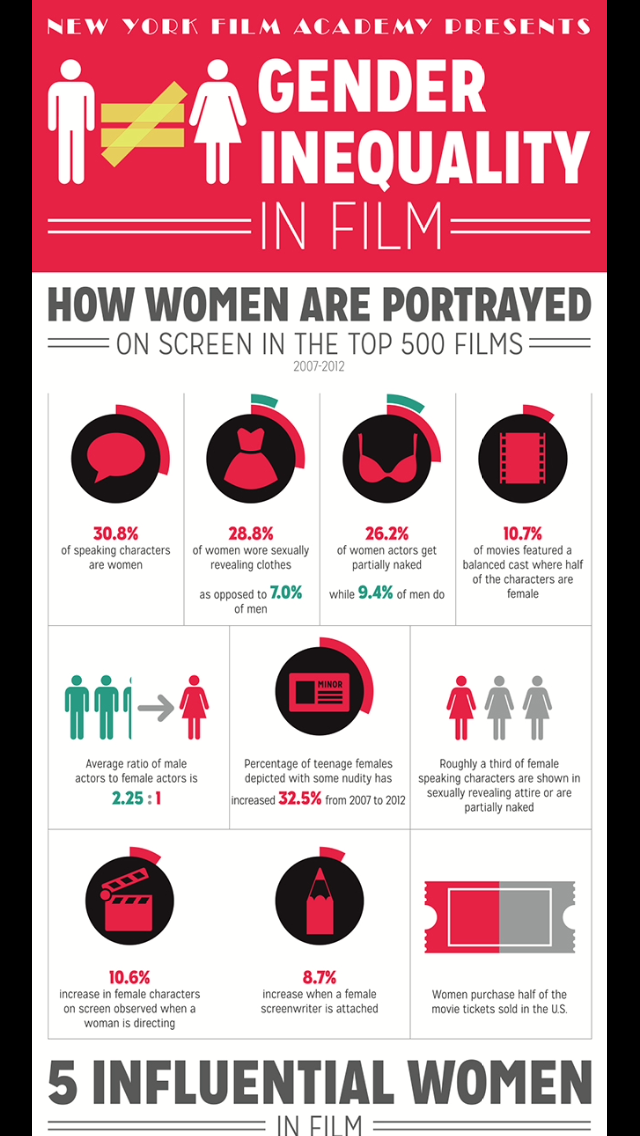
Statistically speaking, of course there would be more male deaths on television, and in film, because there are more men on television and in film.

image

From the New York Film Academy blog, November 2013.

It is impossible to make a value equivalency between the genders when they are not equally represented. In terms of pure visibility, male lives are valued more highly, because they are represented as existing in all capacities (as captains, doctors, engineers, plumbers, heroes, villains, extras, red shirts, science officers, Pirates, etc). Meanwhile women can only be found when the lack of diversity would be otherwise overwhelming, or when someone needs to die, so that the hero can go kick some bad guy ass. It matters more when you kill a woman, because there are so many fewer of them (about 1 to every 2.25 men, according to the New York Film Academy). It is, in fact, possible to make films that barely feature women at all (see: The Eagle, a film of which I am actually quite fond).

However, the actions of the film industry operate on an implicitly sexist logic, one unaddressed by the author(s) of the expendable gender entry. Men are the human “default”. Women are cosidered a deviation from the norm. When male extras die, the audience is seeing the death of “people”. They are undistinguished, and undifferentiated, it is true, but we are seeing large scale violence, not the interpersonal kind. The emotional impact of those deaths depends entirely on how you, as an individual, view the redshirts or the henchmen, and if the death of innumerable, anonymous people is something you find affecting.

The death of a woman, by contrast, is the death of the Other, the death of something we treat as different from the death of “people”. (See: Men are generic, women are special.) At this point, the author(s)’s argument takes an explicitly sexist turn. Furthermore, the choice of evidence–or, more accurately, assumptions–is more pernicious than willful ignorance of pure statistical probability. It concerns what the difference between the male “default” and the female “Other” is determined to be.

The author(s) argue that the value of female human existence comes from their ability to produce offspring. “In purely biological terms, men are more expendable than women because in the event of near-extinction, one male and ten females can produce ten times the offspring of one female and ten males.” This argument is part of the sexist philosophy prevalent in many internet communities, and has encouraged the violent reactions to female critics.

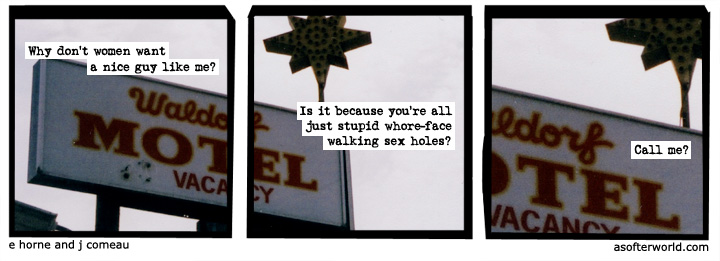
You may be familiar with its kissing cousin: “There are no girls on the Internet” (here on TV Tropes, or Know Your Meme). Though it hails from the early days of the internet, it was 4chan, a undisputed bastion of incivility and child pornography, that codified it for the present generation. Many would argue that any major association with 4chan so fundamentally undermines legitimacy that it neither bears repeating nor address. However, the cross pollination of 4chan with more legitimate communities, like reddit or imgur, mean that it has participated in the codification of cultural and social norms and behaviors online. “No girls on the internet” (or “Tits or GTFO”) appears without fail when a unique female perspective is articulated in an Internet forum, comment section, or message board.

At its most fundamental level “No girls on the Internet” asserts that women are accustomed to receiving preferential treatment in social and intellectual arenas because of their sex. Specifically: because people (read: men) wish to sleep with them, women are given undue respect, attention, or concurrence in social situations.

In an ironic twist, the people who say that sex appeal is a means of getting others to submit to your opinions, are often the very same ones who will threaten to come to a woman’s house and rape her for daring to express an opinion with which they disagree, or if she wins in a video game.

image

(a softer world: 914)

To say that female lives are more valuable because of their ability to produce offspring is to reduce the woman, as a social, political, or narrative actor, to a walking uterus, perhaps with some caregiving abilities. (Nevertheless, more sympathy or nobility is bestowed on single fathers than single mothers.) The argument attempts to naturalize the view of women as sex objects by tracing their “Otherness” and their social value to their reproductive abilities, while simultaneously, couching the assumption in biological/evolutionary, and therefore presumably “scientific” or “objective,” terminology.

The larger effect of the argument is how it undercuts the potential for women to be seen as rational, independent agents, particularly with regards to public political and/or social transformation. It supports a reductive view where “women’s issues” are limited to topics like birth control (or not), abortion (or not), child support (or not), rape, and domestic violence. This largely ignores that women also have a stake in how poverty, access to healthcare, the rising price of college tuition, the stock market, fair trade goods, the second amendment, the price of oil, and the deaths of family members and beloved family pets are addressed. (It performs a further occlusion of male investment in “women’s issues,” by implying that men have no stake in the debates about BC/abortion/child support/rape/domestic violence, et. al.)

Most disappointing is that of course we know men are the expendable gender, there was a major motion picture about it. It starred Sylvester Stalone, Arnold Schwarzenegger, Jet Li,  Dolph Lundgren, Jason Statham, Terry Crews, Mickey Rourke, Bruce Willis, and Randy Couture. The second one had a slightly different cast, the third another different one again. Yet, all of these men can be “expendable” and we will still know their names. But the girl who is raped or killed at the beginning of the Criminal Minds, or Law and Order (any of them), or CSI (any of them), or the death of the girlfriend or wife or sister or mother that propels the hero into action, can be nameless, and faceless, and the actress will be quickly or easily forgotten.

Which leaves the question less about who is or isn’t expendable, but who will be mourned by the audience, and who will be remembered for their participation.

(This essay is limited to a binary gender system, but there is so much more to be said on the propagation and reification of the gender binary by the media establishment.)

Hustle: a eulogy for well-reasoned madness


image

how much loyalty do you owe a short-term employer?


It is difficult to think about labor precarity – the way in which the new “unshackled” working class has been liberated from regular hours, job security, benefits, and solidarity, in the name of flexibility – when I don’t pay rent, buy my own food, or retain sole responsibility for paying back my student loans. I have a job, and the potential for advancement with the organization that has employed me. I have access to healthcare through my mother’s employer, and eventually through my own. For the moment, whatever money I make goes towards my savings or coffee and pastries.  

And yet, I return to the idea. I watch my friends find paying work. Some of them have regular hours and the expectation of career advancement with their given employer or in their field. They already take on new responsibilities, they become more involved. Other friends drift through the employment landscape applying whatever skills they have to whatever work finds them, regardless of fulfillment, enjoyment, or faith in the work they are doing.
image

what’s your side hustle? etsy? journalism?

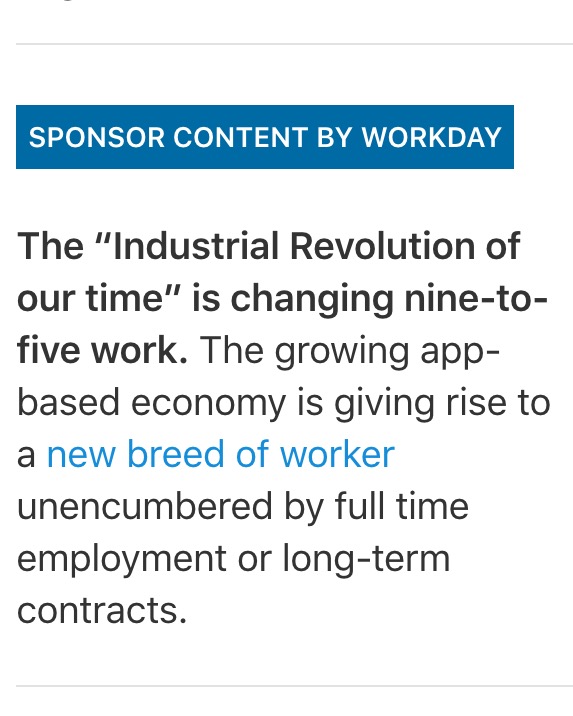
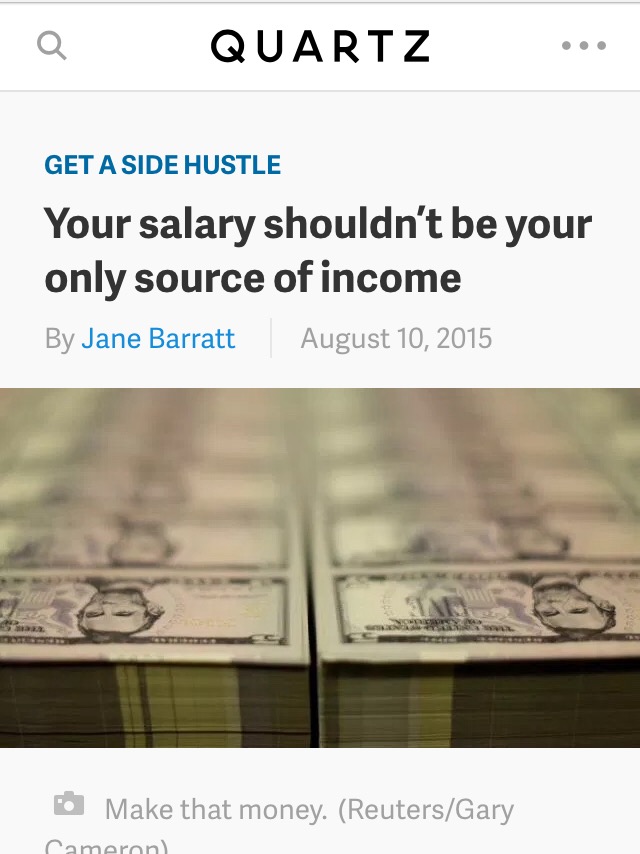
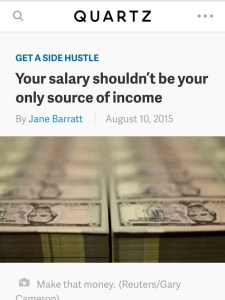
But some of the unease comes from watching the junkies at the bus depot hustle people for money, time, or acknowledgement. Because it’s not just the junkies anymore. Everybody hustles these days. I find headlines in my inbox about how a “side hustle” is both healthy and integral to the modern worker’s lifestyle. From all sides, incoming workers, especially in semi-creative industries, but also far too many others, are expected to perform hope labor; unpaid labor done with the expectation that it will attract paid labor.
For example: this blog, promotional photography done for friends and acquaintances, or the physical and mental labor done for a retail start up.

Locally – in the flesh – I get paid in trade. Usually food, drink, or artwork; but never a monetary equivalency, never contractual, rather a semi-valuable expression of gratitude. In the wider world my work, such as the words you read right now, is done for nothing. If time is money, then my time is literally without worth. A penny for your thoughts? Instead, tell me what you’re thinking and, if I like it, maybe I’ll give you something next time.

With some disappointment, I’ve discovered I know how to hustle. I know how to tell people what they should do for themselves, that benefits me. I can look you in the eye and tell you that not only do I know how to do what you need, but I can do it better, and more besides.

I’ve started to hustle my friends, not secretly, not covertly, but hustle all the same.
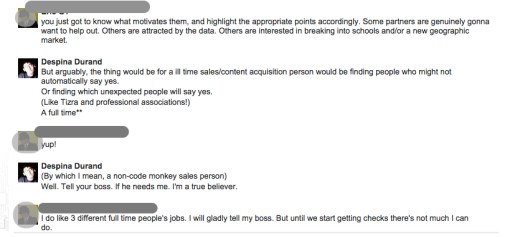
hustle-- chatThe hustle is carrying business cards, even when you don’t have a business. It’s constantly thinking over which organizations you are connected to, which business owners or capital holders you know, and which movers and shakers you have access to.

I’ve never enjoyed sports or board games. Both require a competitive edge, a desire to get one over on the other guy, that has never really appealed to me. Even if I know how to hustle, I don’t think I’m going to be making myself into a shark tank capitalist any time soon. My knee-jerk reaction to people who need to get a foot in the door, or an edge, or at the very least, a seat at the table (I don’t know that I can help anyone get skin in the game, yet), is to see if my hustle can get them there. A co-worker is looking for an internship? I might know some local business owners who would be interested in the extra help, but let’s see if the local women’s networking group – “networking,” in other words, organized hustle – might have some better opportunities. I know some people, I can get us an invitation.

The hustle is a hard game. No one hustles if they can help it. You hustle when you need to get ahead, or need to catch a break and you don’t have any other way of getting it. The hustle means every relationship can be a means to an end. I hustle my close friends. I hustle old bosses, and friendly acquaintances. I hustle at parties and in bars.

The hustle is the long arm of free market capitalism. Our present capitalism believes in “human capital,” or the ability of the worker to exploit themselves, and has made the demand that workers be ready, at any moment, to start the hustle. The magic of the “side hustle” (perhaps meant to be “side” to your job, if you have steady employment, but maybe it’s the “side” to your main hustle, the hustle that feeds and houses you for the moment, without guarantee) is that it gets you used to hustling.

Hustling isn’t new. People have always had to hustle, some more than others. Artists, anyone in sales, journalists, writers, freelancers of all types, academics – just to name a few – have always had to hustle for attention, for patronage, for customers, for publication, for funding, for airtime and column space. We like to believe that the fastest growing sectors are in technology, an employment avenue with job security and benefits, liberated from the hustle, but in fact, the sectors adding the most jobs are almost entirely in service industries. (See the numbers from the US Bureau of Labor Statistics.) We are getting more food service workers, more home aides, more nurses, more retail associates, and more customer service reps, far many more than we are getting new code monkeys.

The service industry is institutionalized hustle. Your barista, sales person, home aide, or babysitter are paid to care. They remember your name, your order, your birthday because feeling special will keep you coming back. You pay them, not for the product (the coffee, the clothing, the medicine) or even their expertise, but for the service experience they provide. You pay them to smile, to ask how you are, to remember your milk preference, and offer gift wrapping. With home aides and nannies, you pay them to take time and care away from their own loved ones and tend to yours in your stead.

Through all this capitalism doesn’t just shape our social and political circumstances, but reaches all the way inside us and plays around with the way we think.

Mid-March of 2015 found me in retreat from the shared social reality; I listened exclusively to mid-2000s pop-punk, and wrote over 3,000 words on the topic of Fall Out Boy as a social phenomenon, as well as their potential role in promoting the acceptability of Lesbian Gay & Bisexual (of LGBT) politics. I stopped going to class, and eventually stopped leaving my room.

After the semester ended, I started seeing three separate doctors whose job is to make sure my brain is functioning “normally” or “better” or some other inescapably normative adjective, and was ultimately prescribed three different types of drugs to regulate various aspects of my neuro-psychological well-being. Migraines [brain lesions, disordered speech, sensory overload, nausea, headaches, … ], depression [anhedonia, disordered sleep patterns, listlessness, irritability, emotional outbursts, … ], anxiety [panic attacks, social dysfunction, antisocial behavior, performance issues, … ], ADHD [executive function disorder, irritability, mood swings, … ].

By November, I could do things that would have been unthinkable in April. Now, I can talk to strangers. I can sell you objects I am sure were made under criminally dangerous and unregulated working conditions in the Global South. I can talk about the uncertainty of the future of my generation; a planet facing global war, a climate changing faster than we can adapt to it, the increased likelihood that the middle class will wink out of existence, and a political system that threatens to grind to a complete halt. I can even meet people from online dating websites.

As a result I stand for 8 hours a day, I make small talk with strangers, I make new friends, and I will sell anything I think you might be willing to invest in, be it $70 champagne-related wall ornament or the joys of Lovecraftian and other Weird fiction.

I am medicated so that I can get out of bed in the morning. More than that, however, I am medicated to perform better in a capitalist society. My mood is artificially enhanced (I don’t stick on the grim predictions that swim through my head) and I am more shallow – not as desperate to peer into everyone’s soul, more able to move beyond “acceptable losses” – than I am naturally. I can still feel echoes of my old anxieties (what if people don’t like me? what if they think I sound crazy? what if they keep participating in the exploitation of the third world? what if they don’t start caring about politics? what if I never find the right words to explain how this all fits together?), but I can swallow them down and bluff or lie or bluster my way through.

It comes down to this: I can smile more easily, I can be thinner and more energetic, I can laugh at your jokes even if they aren’t funny, or compliment your hair. Most of all, when I hustle you, I can make it look like honesty.

Watching this transformation has left me with a very important question: at what point does what we do become who we are? Two decades of outsized empathy, unendurable anxiety, nightmares, and self-consciousness can’t be overwritten. And yet, from inside my own head, I see someone new; a cardboard cutout of a person I don’t trust, who has my name and meets my eyes in the mirror with a smile.

The cardboard cut-out has taught me a very valuable lesson: my inner self isn’t good enough. In fact, the only way to be my best self, is through a medical regimen that alters my perceptions and reactions to help them conform to a construct we call reality. After all, one of the most common complaints addressed to individuals who are promoting the linguistic and social adjustments labeled (derogatorily) “politically correct” is that they need to face up to “reality” or “the real world”. The word “reality” in this context, and in the context of social and economic performance, could be replaced with the term “status quo”. I might see clearly, anxious as I am about labor precarity, social dysfunction introduced when friends become means to an economic end, human capital, and mounting college debt. I might be right when I entertain nightmares of a violent and barren future. But “paranoia” and “anxiety disorder” are much easier problems to fix.

Maybe my kind are just as easily found in bus stops telling you how they found Jesus and asking for spare change, as they are pitching in board rooms and on sales floors. Maybe we all just need anti-anxiety meds and amphetamines, to make sure that we can be relaxed and happy. After all, capital is only concerned with end results – did you surpass the year-to-date sales? – seekers after truth, or at least those seeking respite from the roar of sadness and fear in their heads, get picked up by LEOs for vagrancy and illegal narcotics use, and, if I stop leaving my bed, I’ll probably find myself with them at the psychiatric facility.

But as long as I sleep deeply, after a long day of hustling to pay for my drugs that make life bearable, I won’t have time for nightmares.

(Many many thanks to Sam, Joey, and Eric for proofing this piece, letting me rant, and killing my over abundance of semicolons.)


Book Review: The Grimscribe’s Puppets, Joseph S. Pulver, Sr. ED. Miskatonic River Press, 2013

“I don’t really want to see a ghost, but if someone said, ‘Do you want to go to a haunted house and see a ghost?’ I would say, ‘Yes’.”  — Kelly Link. Oct. 6, 2015. Brown University

A review of The Grimscribe’s Puppets by Justin Steele on arkhamdigest.com said, “Thomas Ligotti, one of the finest horror authors, can be a tough pill to swallow. […] His work is definitely not for everyone though, casual horror readers would most likely be turned off by this particular brand of philosophical horror, yet everyone should read Ligotti at least once.” Though I have never read Ligotti, I can easily (and eagerly) imagine his desolate cityscapes, and agonized protagonists who lurch through them, revolted by the existential truths they have uncovered. Their miserable voices call to me saying, “We are all connected. None of us is alone.”

Book photo from MIskatonic River Press

Pulver’s collection here is (according to Wikipedia) award-winning and rightfully so. The stories in it bring a range of voices, both narratively and creatively, together in a dizzying rush through the darkened, greedy corners of our universe. I started the book in the middle, with Jon Padgett’s 20 Simple Steps to Ventriloquism, and from there explored outwards from the center of the book, devouring the stories and letting the thread, whatever Ligottian impulse Pulver had called forth from them for this collection, which bound them together, thread its way through me and draw me in, another puppet for the Grimscribe, or whatever else is hiding out past the blue veneer of the sky.

Of extra special note are Livia Llewellyn’s Furnace, Kaaron Warren’s The Human Moth, Robin Spiggs The Xenambulist, and Gemma Files’s Obliette (which I didn’t save for last, and highly recommend you take the editor’s implicit recommendation and let it be the last morsel of this collection you savor to end the experience). The Human Moth left me feeling like Ms. Link, now that I know stories like it exist, though I might prefer to have eschewed that knowledge, I must seek them out.

ORIGINALLY APPEARING IN PRINT AS THE FIRST STAFF PICK 
AT THE LOVECRAFT ARTS & SCIENCES COUNCIL

An unexpected triumph: Jupiter Ascending, the most feminist sci-fi film of the year

Jupiter Ascending got wrecked on the critical shores. The most recent film from the Watchowski siblings (who brought you The Matrix), is a critique of capitalism, disguised as a space opera romance. I can see some of you shaking your heads, thinking, “She’s both drastically overselling this film” and “Come on, sure, the Matrix had some philosophical undercurrents, but this is a film about Channing Tatum helping Mila Kunis become a space princess.”

Give me a moment to sell this movie to you again.

Your average hard sci-fi fan will find a lot to complain about with Jupiter Ascending. But we need to take a moment and remember that most hard sci-fi fans will complain about Star Wars, too. And everyone is about to fall over in excitement for the JJ Abrams Star Wars sequel set, so I’m not sure “It’s not hard SF” is enough to pronounce this film DOA.
Let me be entirely clear: Jupiter Ascending is a space romance. It’s primary function is to serve up two beautiful people who fall in spectacular love with one another, while elevating Mila Kunis’ Jupiter from a life as a toilet scrubbing illegal immigrant. But in the process it does a number of surprisingly lovely things.
For example, it doesn’t take itself too seriously.
The monotony of free-falling action sequences, explosions, space battles, and beautiful CGI alien worlds is broken up with moments of foot-in-mouth humor, and a bureaucratic scene unlike anything we’ve seen since Douglas Adams and the Hitchhiker’s Guide to the Galaxy.

Buried underneath the verbal faux pas of Kunis’ and Tatum’s courtship is the plot that drives the film forward, throwing the characters together in life-or-death situations to help them fall in love. It is a plot that relies on rather well-developed world building that draws the more indulgent viewer into the politics of a genetically-driven economy.
In fact, the hand-wavey science of genetics undergirds the entire world Jupiter (and the viewers) are thrown into. (I remind you again, that the Force is basically magic. And that a decent number of people sat through the scientifically unteneble Limitless and Lucy. So demanding a strict adherence to “real science” seems somewhat excessive.) With sufficiently advanced technology, the film argues, we will no longer be slave to our natural genetic code (with various characters having been genetically engineered before birth as soldiers, Tatum among them), and not even to time itself, but at a cost.
Ultimately, the film seems to say, it is not the science that produces real evil, but the economic structure with its commitment to profit, and product, that will play out the real evil. There are literal human costs to this system, which uses raw genetic material to produce longevity. Kunis’ Jupiter has been drawn into a battle between the siblings of a corporate empire by virtue of her particular genetic code.

But what of the romantic genre itself? In the quest for better female representation in popular media, Romance as often been called upon to come to the rescue. After all, girls like love and having their social station elevated to grant them access to more finely made clothes, right?
I posted a number of months ago about the Bechdel Test, and asked you to think back on how many films had female characters interacting with each other (an order so tall that even with all the weight of Disney behind it, Marvel has only managed to pull it off on the small screen). Jupiter Ascending succeeds without any huge fanfare. The primary exposition for the film takes place when Tuppence Middleton shuffles Kunis into a vague understanding of her new station. In the words of my father, “What? Exposition between two women? But that’s ridiculous, everyone knows women don’t know anything!” Jupiter also has a relationship with her mother and her aunt, one of the women she keeps house for, and the lady captain of a space police ship.
Walking the tightrope of hyperbole, I would be willing to suggest that this is the most feminist science fiction film you’ll see this year. Certainly by this time this year.

I promised you social commentary on the nature of capitalism and I feel I should deliver. The film is split into a few factions: you have the Egiss who are a regulatory body, they are referred to at least once in the film as “space cops” and they serve as the instrumental power of the state, essentially to try and curb the greed of the ruling semi-aristocratic class who will lie, and murder without compunction to achieve their ends of growing their profit margins. Then you have the “Entitled,” who are a sort of landed gentry. They own planets, which they harvest to create a product that essentially renders people immortal. Bureaucracy makes its appearance as a hinderance, but also a neutral entity that can be used or abused pretty much entirely due to one’s familiarity with the process.
After that, violence is a commodity that can be bought, much as in our world. Bounty hunters abound, and can be made instruments for the Entitled in their battle to get their hands on the best source.

It is not a complex film. If you follow the surface plot, it’s a rag-to-riches, harlequin romance, complete with a handsome and loyal soldier for the romantic lead. If you fall to the second level, it’s a simple parable cursing the rich and their greedy, thoughtless practices, with a coming of age plot about reassessing your place in the world and making the best of your new station.
It also has lovely computer generated sets, that create a lush backdrop for the slightly humorous costume choices (space society is big on corsets). While it is not a film set to win any awards, it should neither be thrust in the category of “completely unremarkable” nor should it be cast out as “foolish” or worse “confusing” (that last one has left me perplexed, as there did not really appear to be anything that actually needed explaining, any “science” working as a large scale plot device devoid of anything resembling math or biology).

If spectacle, a dash of romance, and having a good laugh when space capitalists fail to produce offspring competent in hand-to-hand combat are things you enjoy give Jupiter Ascending a shot. It is, in the honor of a particular science fiction tradition, a damn good time..