Tag Archives: politics

2016.11.16 : Unity not complacency. Fight, not despair.

There are many important things that have occupied my thoughts lately, but at the moment where I set fingers to keyboard to try and sort them out, they disappear. 


I have an extreme backlog of reading (I shudder to think of how many browser tabs I currently have open) and plan to spend the day making my way through as many of them as I can.


I recall what I wanted to say:

Much talk has been bandied about lately about who needs to do which work, and what work needs to be done. What do we do with the legitimization of racism, sexism, homophobia, xenophobia, Islamophobia, misogyny, cronyism, violence, and impotent rage? Who is responsible for this outcome? How do we make sure the impact is minimized and the people who now have targets on their backs get through this with as little damage as possible?

Many people feel that speaking to, listening to, engaging with the people who put us here––with this President elect preparing to take office––is not only to ask for something that is impossible, but that is actively destructive. 

We don’t need to speak to these people, they say. These people want us dead. 

The easiest example is the back and forth argument about whether being a Trump supporter makes you racist or not. I am inclined to believe that it makes you a racist, in that his language did not immediately mark him as an illegitimate candidate. I do not think it means that you want to degrade and subjugate the people he spoke against. 

Such a distinction is trivial ultimately. 

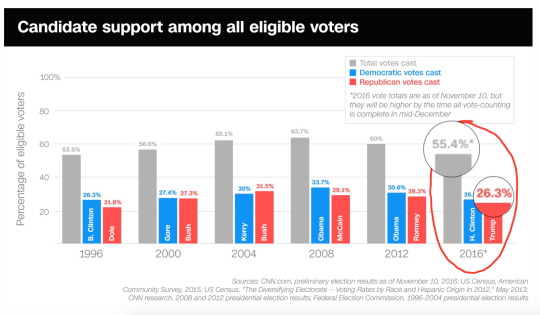
I do believe––strongly––that to denounce and vilify the quarter of the population who voted for Donald Trump would be a cataclysmic error. 

image

(graph from CNN, November 11.)

First, they are not necessarily a majority. They are a quarter of the population. One of our biggest concerns should be connecting with the other half the population, that did not feel it was necessary, important, or were unable to vote in this election. We need to determine what kept them from getting to the polls, and take action to remedy those inhibitors (be it voter suppression, political apathy, economic lack of access, whatever). If we believe that democracy and political freedom are important, we need to secure the rights necessary for those outcomes for the entire population, regardless of their political affiliation. 

Second, we need to connect with that other half of the population and determine how many of them share our concerns about the direction of the country under Donald Trump. He may be determined to turn this country into a demagogic kleptocracy on par with Russia (taking the future of the planet with it; environmentally, politically, and economically), but, at the expense of sounding like the Right and far too many member of the GOP lately, we do still have the Constitution, and this is still a country founded on the principle: By the people, for the people. 

Anyone who wants to point out that we have never lived up to that ideal is welcome to do so now. We still need to use every tool at our disposal. More importantly, we need to take action to make that ideal a reality. To borrow another slogan from the other side: freedom isn’t free. If we want a government for the people, by the people, we’re going to have to hold up our end of the bargain, and push for it. By the people

Third, we need to bridge the gap––social, economic, political––between the coasts and the middle of the country. The political response and the rhetorical and ideological alignments that Trump supporters have chosen to express their grievances are hostile and reprehensible. That does not mean that all of their grievances are baseless or based in racial anxiety. 

The social and economic dislocation that is occurring in the empty stretches of land between our borders is not all that different from the social and economic dislocation being experienced around the world as modernity and globalization fundamentally reshape and restructure our lives and livelihoods. This extremist wave is the backlash we saw once already when modernity and globalization first crept across the borders of Europe and the West, bringing to life fascism, futurism, nazism, and the first and second world wars. We are seeing it now on a larger scale in a more totalizing form. 

That dislocation must be addressed. It cannot be allowed to progress unfettered, and it is not a specter conjured in the minds of people with something to lose. It is a reality of people who are already losing what they cannot afford to do without.

That does not mean that everyone must shoulder that burden equally. This is the moment where the white citizens of America, who have lived with privilege that far outweighs their right, must prove themselves patriots, and true allies and fellow soldiers in the war for equality and community. 

We cannot allow the burden of speaking out against this hatred, and the work of building the bridges that will bring us, the majority, the disenfranchised, the precarious, together that we can aim our anger upward towards the targets deserving of it. 

We cannot afford to atomize and balkanize. To fall into pieces will be a death sentence and leave us at the doors of annihilation. Our only hope is to succeed where all our ancestors have failed, and build the coalition which sees us as dependent on one another and responsible for each other. 

We can only succeed together.

Articulate in the face of Absurdity

In 2011, I heard Billy Collins read a poem about the word like, it was called “What She Said”. This, at the Dodge Poetry Festival in Newark, NJ, was after I had heard Michael Cirelli, a Rhode Island native, read “Dead Ass” about discovering new slag. The contrast between the tones—superior and celebratory, respectively—couldn’t have been more different.

Lately, I’ve wondered about the phrase I can’t even. Which is more appropriate? Mockery or consideration?

It is fair to criticize its abrupt construction, which robs it of both specificity and substance, means that it functions through familiarity; its meaning is contextually and idiosyncratically imparted.

Having emerged from the unreliable and overwhelmingly multifaceted depths of the internet, it is met with distrust by grammarians and the other vanguards of the English language. Whatever inherent meaning might have existed within the aborted structure was further eroded by use in the regressively repetitive reblog threads on tumblr.

But we live in a world dominated by the absurd.

In the country boasting the strongest economy and largest military force on the planet, a reality TV star is running for president against a former Secretary of State and First Lady, after after the two of them beat out an avowed Democratic Socialist, and a man so fundamentally lacking in charisma that a large swath of the public is willing to believe his is the Zodiac Killer, regardless of temporal impossibility. Meanwhile, policemen with military grade equipment shoot unarmed citizens in the streets. While children and families go hungry, Congress shuts down the government out of spite, and the people drown in debt after bailing out bankers facing no new regulation despite nearly creating a financial apocalypse.

Meanwhile, globally, the field is dominated by radicalism, terror, slowing economic growth, and environmental disaster. In a new era of demagoguery, the death of nuance seems both inevitable and potentially absolute. Our political discourse is reduced to emotion rooted in personal truths and we have accepted the dissolution of a collectively structured reality. With the banishment of facts, concensus reality is abolished and events already past can be re-imagined out of existence (Vladimir Putin will not invade Crimea).

A system without rationality can hardly be called a system. It becomes difficult to rely on language, which is a system, composed of atomized concepts and consistent rules, as a means of expression. We resort to other means. Our subjectivity—the production of the self—is given over to the front-facing camera. We situate ourselves within the social, physical, and political world through selfies taken on vacations, with friends, at rallies, and in the presence of our heroes and idols. The camera lens and the portable screen eloquently communicate where we stand on issues, with which candidates, in which cities, and in front of which works of art.

Yet we cannot avoid words: you open the newspaper, or a browser window, or an app and read that the government is refusing to do their constitutionally mandated job, and that, furthermore this comes as no surprise, and that a nation produced a vote which not even the politicians who lobbied for it can support, and that we cannot get the data to know how many people are killed each year by cops, or how many firearms are sold in the country, or how much money is secreted away in off-shore accounts. The words are concrete and undeniable (except by the newly greased escape hatch out of concensus reality) and finding a word to respond, one that encapsulates the emotional state developed under long term absurdity, can feel impossible.

Perhaps one exists within those linguistic traditions which survived the Soviet empire. But even there concensus reality existed, two of them, in parallel. The reality of the state and the reality of the people, spoken and whispered. English—the language of empire, of capitalism, of finance—lacks the appropriate philosophical and linguistic tools.

Beyond its near impossibility, it feels like defeat to attempt to express the entire cycle of horror-distress-incomprehention-frustration-disappointment-anger—and ultimately—complete lack of surprise, never mind cobbling together a framework of rationalized acceptance.

Instead, I reach for the only tool developed to express the whole of our collective emotional disorder: I can’t even.

Brexit, globalization, nationalism, xenophobia

My natural reaction, when trying to formulate a counterargument to the blatant racism, xenophobia, and blind populist nationalism peddled in Britain in favor of the (successful) Brexit, is to reach for something equally totalizing and outrageous.

I’m not going to crawl into the muck with Boris Johnson (or, on this side of the Atlantic, Donald Trump) and justify his arguments based on some fantastic imagining of the “British People” or some other similar fever dream of historic, national and/or cultural purity.

This is the same government that last year wouldn’t allow the Scots to leave the UK, despite their concerns and desires to remain a part of the EU regardless of whether the Brits made the choice to exit the economic union or not. “There is no history of Scotland acting independently of the rest of Britain” people responded then.

So I have no qualms about reaching into history and saying that the British have no philosophical leg to stand on in their fears about open borders when they made it their policy to forcibly pry open the borders of nations and cultures around the globe in the name of their “British Empire”.

But it comes down to not wanting to crawl through the filth on my belly, like a worm, because to try and argue with the xenophobic, racist, nationalist rhetoric is to justify its existence, is to make some game out of acknowledging its validity. It is not valid, it is not reasonable, and more than all of that, it is not something that can be met or answered with rationality, logic, or consideration. It is fear mongering, and it is lies.

So I’m sorry if history seems irrelevant, if the past is not dictum for the future, if people have no interest or consideration for how the choices made before them might weigh on the choices they face now. I’m not going to address your concerns about people who have no interest in assimilating, in becoming British or European or Western coming and working in your restaurants, and your homes, and your country, until I’m met with equal consideration of the plight of economic migrants and economic refugees and solutions to keep children in the Global South from starving. Making an exception only for refugees of war is to fail to address the cause of which mass migration and the open borders of globalization are merely a symptom.

We will all come to regret where we are finding ourselves. The populists will take us for all we’re worth, and the rich will pluck what little we have left from our unhappy, clenched fists.

Hustle: a eulogy for well-reasoned madness


image

how much loyalty do you owe a short-term employer?


It is difficult to think about labor precarity – the way in which the new “unshackled” working class has been liberated from regular hours, job security, benefits, and solidarity, in the name of flexibility – when I don’t pay rent, buy my own food, or retain sole responsibility for paying back my student loans. I have a job, and the potential for advancement with the organization that has employed me. I have access to healthcare through my mother’s employer, and eventually through my own. For the moment, whatever money I make goes towards my savings or coffee and pastries.  

And yet, I return to the idea. I watch my friends find paying work. Some of them have regular hours and the expectation of career advancement with their given employer or in their field. They already take on new responsibilities, they become more involved. Other friends drift through the employment landscape applying whatever skills they have to whatever work finds them, regardless of fulfillment, enjoyment, or faith in the work they are doing.
image

what’s your side hustle? etsy? journalism?

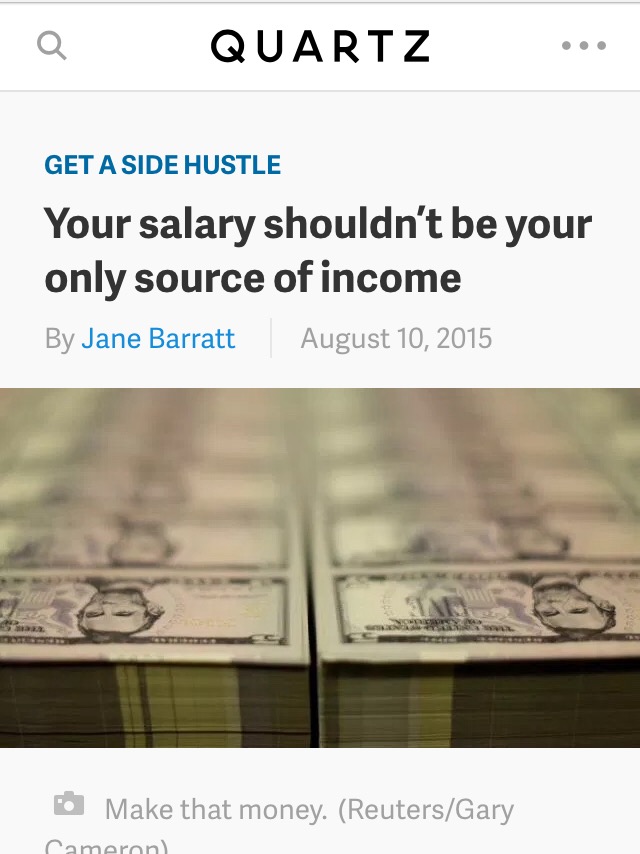
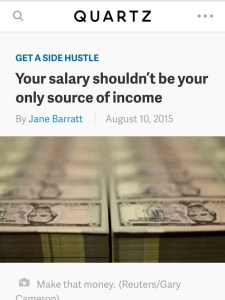
But some of the unease comes from watching the junkies at the bus depot hustle people for money, time, or acknowledgement. Because it’s not just the junkies anymore. Everybody hustles these days. I find headlines in my inbox about how a “side hustle” is both healthy and integral to the modern worker’s lifestyle. From all sides, incoming workers, especially in semi-creative industries, but also far too many others, are expected to perform hope labor; unpaid labor done with the expectation that it will attract paid labor.
For example: this blog, promotional photography done for friends and acquaintances, or the physical and mental labor done for a retail start up.

Locally – in the flesh – I get paid in trade. Usually food, drink, or artwork; but never a monetary equivalency, never contractual, rather a semi-valuable expression of gratitude. In the wider world my work, such as the words you read right now, is done for nothing. If time is money, then my time is literally without worth. A penny for your thoughts? Instead, tell me what you’re thinking and, if I like it, maybe I’ll give you something next time.

With some disappointment, I’ve discovered I know how to hustle. I know how to tell people what they should do for themselves, that benefits me. I can look you in the eye and tell you that not only do I know how to do what you need, but I can do it better, and more besides.

I’ve started to hustle my friends, not secretly, not covertly, but hustle all the same.
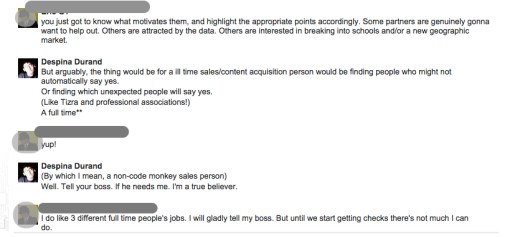
hustle-- chatThe hustle is carrying business cards, even when you don’t have a business. It’s constantly thinking over which organizations you are connected to, which business owners or capital holders you know, and which movers and shakers you have access to.

I’ve never enjoyed sports or board games. Both require a competitive edge, a desire to get one over on the other guy, that has never really appealed to me. Even if I know how to hustle, I don’t think I’m going to be making myself into a shark tank capitalist any time soon. My knee-jerk reaction to people who need to get a foot in the door, or an edge, or at the very least, a seat at the table (I don’t know that I can help anyone get skin in the game, yet), is to see if my hustle can get them there. A co-worker is looking for an internship? I might know some local business owners who would be interested in the extra help, but let’s see if the local women’s networking group – “networking,” in other words, organized hustle – might have some better opportunities. I know some people, I can get us an invitation.

The hustle is a hard game. No one hustles if they can help it. You hustle when you need to get ahead, or need to catch a break and you don’t have any other way of getting it. The hustle means every relationship can be a means to an end. I hustle my close friends. I hustle old bosses, and friendly acquaintances. I hustle at parties and in bars.

The hustle is the long arm of free market capitalism. Our present capitalism believes in “human capital,” or the ability of the worker to exploit themselves, and has made the demand that workers be ready, at any moment, to start the hustle. The magic of the “side hustle” (perhaps meant to be “side” to your job, if you have steady employment, but maybe it’s the “side” to your main hustle, the hustle that feeds and houses you for the moment, without guarantee) is that it gets you used to hustling.

Hustling isn’t new. People have always had to hustle, some more than others. Artists, anyone in sales, journalists, writers, freelancers of all types, academics – just to name a few – have always had to hustle for attention, for patronage, for customers, for publication, for funding, for airtime and column space. We like to believe that the fastest growing sectors are in technology, an employment avenue with job security and benefits, liberated from the hustle, but in fact, the sectors adding the most jobs are almost entirely in service industries. (See the numbers from the US Bureau of Labor Statistics.) We are getting more food service workers, more home aides, more nurses, more retail associates, and more customer service reps, far many more than we are getting new code monkeys.

The service industry is institutionalized hustle. Your barista, sales person, home aide, or babysitter are paid to care. They remember your name, your order, your birthday because feeling special will keep you coming back. You pay them, not for the product (the coffee, the clothing, the medicine) or even their expertise, but for the service experience they provide. You pay them to smile, to ask how you are, to remember your milk preference, and offer gift wrapping. With home aides and nannies, you pay them to take time and care away from their own loved ones and tend to yours in your stead.

Through all this capitalism doesn’t just shape our social and political circumstances, but reaches all the way inside us and plays around with the way we think.

Mid-March of 2015 found me in retreat from the shared social reality; I listened exclusively to mid-2000s pop-punk, and wrote over 3,000 words on the topic of Fall Out Boy as a social phenomenon, as well as their potential role in promoting the acceptability of Lesbian Gay & Bisexual (of LGBT) politics. I stopped going to class, and eventually stopped leaving my room.

After the semester ended, I started seeing three separate doctors whose job is to make sure my brain is functioning “normally” or “better” or some other inescapably normative adjective, and was ultimately prescribed three different types of drugs to regulate various aspects of my neuro-psychological well-being. Migraines [brain lesions, disordered speech, sensory overload, nausea, headaches, … ], depression [anhedonia, disordered sleep patterns, listlessness, irritability, emotional outbursts, … ], anxiety [panic attacks, social dysfunction, antisocial behavior, performance issues, … ], ADHD [executive function disorder, irritability, mood swings, … ].

By November, I could do things that would have been unthinkable in April. Now, I can talk to strangers. I can sell you objects I am sure were made under criminally dangerous and unregulated working conditions in the Global South. I can talk about the uncertainty of the future of my generation; a planet facing global war, a climate changing faster than we can adapt to it, the increased likelihood that the middle class will wink out of existence, and a political system that threatens to grind to a complete halt. I can even meet people from online dating websites.

As a result I stand for 8 hours a day, I make small talk with strangers, I make new friends, and I will sell anything I think you might be willing to invest in, be it $70 champagne-related wall ornament or the joys of Lovecraftian and other Weird fiction.

I am medicated so that I can get out of bed in the morning. More than that, however, I am medicated to perform better in a capitalist society. My mood is artificially enhanced (I don’t stick on the grim predictions that swim through my head) and I am more shallow – not as desperate to peer into everyone’s soul, more able to move beyond “acceptable losses” – than I am naturally. I can still feel echoes of my old anxieties (what if people don’t like me? what if they think I sound crazy? what if they keep participating in the exploitation of the third world? what if they don’t start caring about politics? what if I never find the right words to explain how this all fits together?), but I can swallow them down and bluff or lie or bluster my way through.

It comes down to this: I can smile more easily, I can be thinner and more energetic, I can laugh at your jokes even if they aren’t funny, or compliment your hair. Most of all, when I hustle you, I can make it look like honesty.

Watching this transformation has left me with a very important question: at what point does what we do become who we are? Two decades of outsized empathy, unendurable anxiety, nightmares, and self-consciousness can’t be overwritten. And yet, from inside my own head, I see someone new; a cardboard cutout of a person I don’t trust, who has my name and meets my eyes in the mirror with a smile.

The cardboard cut-out has taught me a very valuable lesson: my inner self isn’t good enough. In fact, the only way to be my best self, is through a medical regimen that alters my perceptions and reactions to help them conform to a construct we call reality. After all, one of the most common complaints addressed to individuals who are promoting the linguistic and social adjustments labeled (derogatorily) “politically correct” is that they need to face up to “reality” or “the real world”. The word “reality” in this context, and in the context of social and economic performance, could be replaced with the term “status quo”. I might see clearly, anxious as I am about labor precarity, social dysfunction introduced when friends become means to an economic end, human capital, and mounting college debt. I might be right when I entertain nightmares of a violent and barren future. But “paranoia” and “anxiety disorder” are much easier problems to fix.

Maybe my kind are just as easily found in bus stops telling you how they found Jesus and asking for spare change, as they are pitching in board rooms and on sales floors. Maybe we all just need anti-anxiety meds and amphetamines, to make sure that we can be relaxed and happy. After all, capital is only concerned with end results – did you surpass the year-to-date sales? – seekers after truth, or at least those seeking respite from the roar of sadness and fear in their heads, get picked up by LEOs for vagrancy and illegal narcotics use, and, if I stop leaving my bed, I’ll probably find myself with them at the psychiatric facility.

But as long as I sleep deeply, after a long day of hustling to pay for my drugs that make life bearable, I won’t have time for nightmares.

(Many many thanks to Sam, Joey, and Eric for proofing this piece, letting me rant, and killing my over abundance of semicolons.)