Some Thoughts on Catalonia

An intentional complication

There are 4 major areas to consider regarding the current situation in Spain, where the region of Catalonia recently held a referendum on a declaration of independence:

  1. the economic reasons for Spain’s insistence on retaining Catalonia,
  2. the questions arising from a newly independent Catalonia with regards to the European Union, with an eye towards the freedom of movement of goods, people, and money,
  3. the fascist history of the country and, specifically, Catalonia’s still fresh memories of life under Franco, in particular the condemnation of the present Spanish government as fascist without a meditation on the fascist history which continue to resonate in the present,
  4. finally, with the emboldening of racisms across the Western world, immediately embracing ethnonationalist separatist movements seems premature.

These are a series of spitball thoughts, I do not seek to present myself as an authority on the subject. Nor do I want to appear for or against Catalan independence. Ultimately, I believe many of my points might be justifiably used to support the arguement for independence. Equally, however, a geopolitically conservative and globalist thread in some of my points will be of little interest to certain progressive groups, and the hard left anti-imperialists who see globalism as a direct descendent and scion of colonial imperialism. (A position I am not, strictly speaking, willing to refute.)

1. Wealth and federalism

Spain, like most nations, is made up of regions with their own local governments and governance. Along with the political distinctions, these states create economic zones, which in turn feed into a larger national economy, with some wealth redistribution happening courtesy of the national government.

Barcelona and Catalonia more generally are among the few regions in the Spanish economy which are flourishing, despite the economic crisis which developed in Europe after the 2008 US financial crash. That prosperity is a strong motivator for the national government of Spain to maintain a hold on the region. Spain continuese to be strapped for cash, even having put into effect the austerity measures and the economic restructuring demanded by international creditors.

It bears remembering that the issue of Catalan independence, while not entirely new, did not have anything nearing its current prominence before the economic crash. It was only as the screws were put on and Spain began to feel the crush of its debt that Catalonia started its legislative saber rattling and invigorated the call for independence.

2. European Unity and the economy

The biggest question regarding secession from a European nation is how the new border and the new government will be integrated (or not) into the European project. Regardless of whether Europe welcomes a newly independent Catalonia into the European Union or not, that accession will have to be negotiated (or renegotiated, depending on your perspective). One can only presume that the Spanish representation in the European government will do their utmost to make life difficult for the new nation. It is unclear if they are likely to have allies who fear similar sucessions within their borders. (With Britain making its own European exit, the Spaniards are down an anti-Independence ally.)

Most importantly, Catalan independence means more uncertainty for the European Union, an already struggling and beleagured project. Until the details of Catalonia’s status within the bloc are worked out, there will be many people in limbo; European citizens who live and/or work in Barcelona or the region, who may or may not be allowed to remain. The fate of Spanish citizens who wish to retain that status yet continue live and work in Catalonia will also need to be negotiated.

Ultimately, Europe has created a region of porous borders which has greatly benefited workers who are able to travel across national boundaries in search of work. Additionally, as we are learning from Brexit, the porous borders of the EU have built an interconnected and interdependent infrastructure system. Renegotiating those contracts creates seemingly impossible quandaries in which the average citizen is left uncertain as to their future.

(New borders and new governments mean that all of the agreements and systems which undergird modern life will need to be examined and repartitioned to meet the requirements of the new government, and the limits of the new borders. This is an unenviable position to leave anyone; I invite you to explore the questions that Brexit has raised for the shared power grids bridging the border between Northern Ireland and the Republic of Ireland.)

3. History (Fascism)

Reaching back into the misty past and the heyday of the Spanish empire is superfluous for understanding the roots of this conflict. The most pressing history is that of the 20th century. It is a history which is still vivid in the minds of Catalans.

Under the fascist regime of Francisco Franco, Catalonia was violently repressed, and much was done to strip them of their cultural and linguistic identity. An acquaintance told the story of how after Franco’s death in 1975 and the return to democratic governance, she had to put in the paper work for an official name change, so that her government documents would reflect the name her parents gave her, a Catalan name, which she was prohibited from carrying under the Franco regime. Her experience was not unique.

Many people who have visited Barcelona are familiar with the habit of Catalans to prefer English over Spanish when encountering someone who does not speak Catalan. Use of the language was banned under Franco, and these little “regional quirks” are the markers of the scars the fascist regime left on the people.

I am uninterested in defending the actions of the Spanish government. The choices they have made are abominable, in addition to making the government look terrible.

The vivid memory of fascism should have served as a reminder for the Spanish government to avoid violent suppression and the suspension of Catalonia’s limited independence. Nevertheless, those outside the country should be careful of invoking the imagery unless they are prepared to hold up the current government against past fascist regimes. Though the actions of the Spanish government are reprehensible, they have not reached the heights of dictatorship. We must urge them to remember their own history, and the respect they owe their Catalan bretheren, and furthermore, we must hope they have learned something from dealing with the Basque Separatist movement.

4. Ethnonationalism

Much of the Western world is preparing to do battle with nationalists of a variety of sorts. Ethnonationalists pose a unique quandary for those who seek equality. Self-determination is a noble goal, but it can create as many problems as it might purport to solve.

Thankfully, Catalonia is positioned in such a way to avoid the quandaries which have plagued the self-determination of the Jewish people. Hopefully, if they do achieve independence, the freedom of movement within Europe will been maintained even across these new borders and there will be no need for the “bloodless genocides” which plagued the establishment of a Greek nation-state and Turkey which saw the exchange of Greek Muslims and Greek Orthodox Turks. We can only hope that prosperity will forestall the possibility which resulted in the Bosnian genocide, and the continued unease in the region. Perhaps it we will avoid armed conflict, but the possibility of avoiding all political tension is a fantasy.

The consolidation of ethnic identities into nation states has left a number of wounds in the developed world. They are implictly tied to the history of empire, colonialism, and imperialism. There are no good answers, never mind any easy ones.

Personally, I have ever stronger reservations about the logic of ethnonationalist self determination. Mostly because it feels like an excuse for those who have to abandon those who have not, and those who have not to justify power moves which lead to greater pain down the line. Here I undoubtedly split with any anti-globalists, who see porous borders and rampant capitalist internationalism as the great evils plaguing all nations and peoples. Nevertheless, I stand with those who see globalization as a reality with which must contend and should make our decisions with an eye towards justice and equality when it comes to crossing borders and making opportunities for all people on our planet. Ethnonationalism seems to invite divisiveness and trouble.


Speech and Life: thoughts on security in the Internet age

reading: the Hill

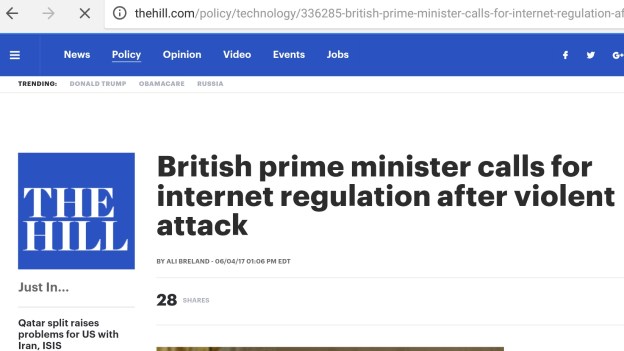
The recent terror attacks in London are disturbing and dreadful crimes. But hearing that British PM Theresa May feels that there appropriate response is greater regulation of the Internet makes me worry about where this well-meaning concern (or misplaced hysteria) will lead us.
This past semester I read Lawrence Lessig’s Code 2.0, for my class, “Media, Technology, and Culture” (for an overview of the book’s basic argument checkout my podcast). Towards the end of the book – in the section where he examines “latent ambiguities” where code and law either don’t quite meet or leave some room for interpretation – he says of the United States:

We have exported to the world, through the architecture of the Internet, a First Amendment more extreme in code than our own First Amendment in law.

(p. 257)

As the global society attempts to manage a world where extremism and linked violent action become more prevalent and more visible, we must realize that it is the legacy of the First Amendment and of American democratic values that allow it. The right to freedom of expression is enshrined into the current structure of the internet in a way it would be impossible (certainly for equal reach) to achieve in “real life”.

There is a lot to be said for making the gap between legal speech and the speech that is possible on the Internet. In recent years, we have had a crash course in the negative outcomes that complete freedom can generate. From Gamergate and doxxing, to the radicalization of men and women by neo-Nazi ideologues and extremist jihadi ideologies. The links between the things we read and see and what we do are becoming starkly visible.

But does that linkage justify a limiting of free speech by government and corporate/commercial entities?

The most obvious question is: how does one determine what constitutes an extremist ideology?

It might seem easy to say it’s to cut down on neo-Nazi rhetoric or propaganda from the Islamic State. But where do radical Leftists and Libertarians who argue for the toppling of the State fall? How do we decide what counts as “humor” and what constitutes a real threat? (see: Kathy Griffin) If we’re seeking to destroy propaganda or misinformation, which debates remain open and which are closed? The Holocaust? Global warming?

It is never easy to walk the line between liberty and security. In today’s world, one which feels ever more dangerous, we in the West are hardpressed to choose between our way of life, and the lives of our fellow citizens. 

All arguments for liberty are “slippery slope” arguments, and as such I wish to avoid them. All I can hope is that we seriously consider whose interests are best met through regulation of our online speech.

The Panopticon Writings: democratic surveillance

Jeremy Bentham’s Inspection House plan, later known as the Panopticon Inspection House, and ultimately merely as the Panopticon was primed, through its meticulous planning and relegation to the imaginary, to transform into metaphor. In our evermore connected and documented way of life, it has only grown in both power and popularity in the imaginations of those who worry about surveillance. But that metaphor is a boogeyman, a monster under the bed, because it fails to preserve a few crucial elements of Bentham’s original vision. Those omitted details are the one’s which transform the Inspection House from a regime of surveillance into a radical democratization of power through visibility.
Bentham’s Inspection House operates on the premise that visibility constitutes a form of coersive power. He envisions a re/formative setting where, through the expectation of constant surveillance, those placed under inspection (be they prisoners or school children) modify their behavior to align with societal norms. Simultaneously, he envisioned a system whereby the jailer would be rendered as visible to society as those in the cells of the Inspection House are to him. He presents two forms of visibility in his letters to which the manager of the Panopticon would be subject; one direct, and the other indirect.

The first – the direct – form of visibility emerges through what one might imagine as “drop-in” visits. However, rather than limiting them to some form of official inspection, he presents a radical vision of openness regarding public buildings. He declares that the doors of the Inspection House should be open

“as […] the doors of all public establishments ought to be, […] to the body of the curious at large – the great open committee of the tribunal of the world.” 1

Here he is imagining a world where anyone can satisfy their curiosity about the treatment of the prisoners by visiting the prison, with no need for any reason, justification, or permission other than that curiosity. The scope of the statement is telling, because its implications extend beyond Bentham’s imagined establishment to the operation of all public institutions. While he acknowledges that the doors of public institutions are rarely found as inviting as he describes, he makes his implicit criticism explicit. He continues:

And who ever objects to such publicity, where it is practicable, but those whose motives for objection afford the strongest reasons for it? 2

Declaring that those in public office who wish to avoid visibility have something to hide is a bold declaration of a well-known truth.

Bentham’s second – indirect – form of visibility is through documentation. He states that the person contracted to operate the Inspection House, in return for all profit to be gained through its operation, should maintain and publish a full account of the prison’s operation.

I will then require him to disclose, and even to print and publish his accounts – the whole process and detail of his management – the whole history of the prison. 3

This publication is also to be available to all who desire to read it. This indirect form of visibility adds to the pressure for conformity to standards. Bentham also sees a productive outcome to this record keeping, for those unmoved by the moral argument. If full and complete records are kept, even a failed Inspection House becomes an opportunity for knowledge

From the information thus got from him, I derive this advantage. In the case of his ill success, I see the causes of it, and not only I, but every body else that pleases, may see the cause of it… 4

This, he explains, means that future ventures on the Inspection House model will have the chance to see and avoid the failures which beset their predecessors.

He makes two further demands on the warden which would be revolutionary in any prison system. The first is the existence of a ledger which documents all instances of punishment – not unreasonable, and a rule broadly applied. What is more telling is his vision for its usage.

A correction-book might be kept, in which every instance of chastisement, with the cause for which it was administered upon record: any the slightest act of punishment not entered to be considered as a lawless injury. 5

In the contemporary moment, when we are embroiled in a national debate regarding the use of force by law enforcement officers and other members of the security apparatus, the classification of violence on incarcerated and condemned bodies by agents of the state as illegal violence because of its indefinable or absent justification is truly radical.

His other requirement is a punitive measure to ensure the well-being of the prisoners. He says,

I would make him pay so much for ever one that died, without troubling myself whether any care of his could have kept the man alive. 6

He acknowledges that some of that cost would be covered in the original contract between the state and the private contractor running the prison. Nevertheless, this kind of broadly applied punitive measure is one which demands careful consideration. It declares, without exception, that all lives are valuable, and underwrites that assertion with a monetary value. Perhaps a distasteful premise, but one which might have enough sway to produce real change in the treatment of persons deemed inconsequential or less valuable in some social environments or interactions with the state.

At this juncture I invite you to imagine a prison whose doors are open, that “the great open committee of the tribunal of the world” may evaluate the treatment of its prisoners. One whose books and ledgers, the histories of an institution, are available to that same “body of the curious at large.” This is a vision where the state security apparatus watches its citizens, but where they watch back. In a world that recognizes the coersive power of visibility, looking upwards, demanding and seeking visibility of our public institutions is a radical democratic act. One which Jeremy Bentham was always pointing out to us.


  1. Bentham, J. The Panopticon Writings. Verso: London. 1995. p. 47-8. Letter IX 
  2. p. 48 
  3. p. 52. Letter IX 
  4. p. 53 
  5. p. 64. Letter XII 
  6. ibid

The name for the doing : a moment of narrative silence in Lucha Underground

In “Pops and Promos: speech and silence in Professional Wrestling,” Claire Warden1 examines the ways in which narrative context is established or disrupted, and power is negotiated through the inclusion or exclusion of speech.

In episode thirty-three of season one of Lucha Underground, we see another moment for the record books. Following an interruption of action weeks earlier, where Vampiro left his post at the commentary desk and entered the ring to keep Pentagon, Jr from breaking Sexy Star’s arm, Pentagon returns in this episode to call Vampiro out and challenge him to enter the ring again, to face him.

Vampiro stands up and while the crowd is going wild, chanting “Vampiro” and “Lucha! Lucha!” the usual steady presence for the audience at home from the commentary desk is silent. Obviously, Vampiro is not in a position to provide commentary, but Matt Striker is completely silent.

The experience is completely disorienting for the viewer once-removed from the action. As Warden says of the moment when Nexus embroiled themselves in a match between John Cena and CM Punk in a 2010 Viewer’s Choice match of Raw, “The absence of commentary is obvious and disconcerting. In fact, the silence compels the television spectator to heed sounds often masked by the narration – bodies slamming on the mat, incredulous boos from the crowd, wrestlers talking.”2 Between the two commentators, Striker is the one to provide a balanced perspective. He is the voice of (relative) calm and reason, and most committed to providing a play-by-play of the action, and grounding the visual in a coherent narrative sequence. Without Striker’s descriptive structure, the television viewer is left at the mercy of the tension between Vampiro and Pentagon, Jr and the crowd of “believers” in the Temple.

The question of kayfabe is largely at rest,  even interruptions are recognized as scripted; the commentators, even when surprised, are quick to adapt to them.

With Vampiro standing head-to-head (literally) with Pentagon, Jr, and Matt Striker completely silent, there is real uncertainty about what is going to happen next. The crowd suddenly seems to have real power: their chants of “Vampiro” move the commentator forward, bringing him closer to Pentagon, and to the ring.

The power structures of the league are suddenly thrown into question as the mediating force of commentary is made visible through its absence. Usually, Vampiro, through his excitement of the moment, parallels the fans, and Matt Striker’s narrative commentary creates expectations within the audience and guides their attention to various parts of the action.

Without those that guidance, suddenly it is the will of the crowd versus the management provided by referee. The silence makes it impossible to guess which of the two will win out.

In Warden’s description of the aftermath of the Nexus invasion of the Cena-CM Punk match, which saw the commentators become victims of the violence, she says, “The silence not only brings a distinct feeling of realism to the segment, but it also leaves the audience unanchored in a sea of violent, destructive images.”3 The destruction is absent in the (apparently) narrowly avoided clash between Vampiro and Pentagon, Jr. But when Vampiro sits backdown, and Matt Striker’s voice finally returns, he sounds shaken, calling for a cut to commercial – cutting the television audience out, forcing the gaze away from the action – and his final words before he pulls his headset off (the last image before the cut to commercial) is him asking Vampiro if he’s alright.

The sequence effectively creates that same “distinct feeling of realism” that Warden described. It underscores the real emotional engagement that can be generated for an audience removed from the spectacle, and the importance of the narrative commentary in shaping the action in (and out) of the squared circle.


  1. Broderick Chow, EEero Laine, and Claire Warden, Performance and professional wrestling (Milton Park, Abingdon, Oxon: Routledge, 2017), 17-25. 
  2. Ibid. 24. 
  3. Ibid. 24.