Category Archives: Essay

Deny their responsibility, rob them of their Power: stopping Daesh.

We have forgotten the true goal of terrorism. It can be difficult, especially in the aftermath of horrible events such as the one which occurred in Nice (or Dallas, or Orlando, or San Bernardino), as we prepared to bury the dead and do what we can to heal the wounded and care for all those who will never truly be whole again, that the goal of terrorism is not death. The goal of terrorism is in the name: terror; fear.

Every time we pick ourselves up and try and take stock of the damage and the pain, and allow ourselves to forget that what those who promote and execute these acts of violence are trying to generate is fear, we allow them to succeed.

Daesh would love to lay claim to the power to reach out and strike us there where it hurts the most. With every independent attack that is attributed to them, they have further proof that their reach is global, that they are able to infect our people with their poisons and use our people to hurt us. They take that power from our headlines, our speculating talking heads, our circumstantial analyses, and our political speeches.

Perhaps the man who struck out at the Queer Latinx community in Orlando justified his actions through the philosophy promoted by Daesh. Perhaps the man who drove a truck through a crowd in Nice came from Tunisia (where an overwhelming number of Daesh fighters hail from) and maybe he, too, justified his actions through their language.

That does not give Daesh the right to claim responsibility for their actions. Their power is not so great that they can reach across space and time and sow the seeds of their hate in the hearts of people who are thousands of miles away from them. These people are not molded by Daesh, they are molded at home, and their choices are their own, they can invoke Daesh in justification, but we do not have to believe them.

We can rob Daesh of their power. We have the power to make them lose the war abroad as they are losing the ground war in Syria and Iraq. Because when the perpetrators are dead—and they are all dead—there is no one left to speak for them. What we have to say about their origins and their motivations is as true as what Daesh has to say. When the Daeshi leadership learn about the attacks as we do, they are no more responsible for them than we are.

A generation of children already grew up with a boogeyman who lived in a cave in a desert most of them could not find on a map: his name was Osama bin-Laden. From September 2001 onward, children who were not yet old enough to comprehend what had happened in New York City and at the Pentagon knew his name and were afraid of him.

We can keep a new generation of children from knowing that fear. We can stop Daesh at the borders of their stolen territory, and their reach at the limits of their trained fighters and evil plots. We do not have to allow the words and tenets of their death cult to have the power of pandemic. We can acknowledge the violence it effects, and work to heal the wounds it leaves, and deny the infection a vector and the opportunity to spread.

After Orlando

There is very little to say about what happened in Orlando, FL.

There is so much to say about what happened in Orlando, FL.

The noise that emits from your TV and your radio, the words that appear on your Facebook feed, the rainbow flags, the rainbow profile pictures, the prayers, the moments of silence, the platitudes, it is just noise.

My only response to this nightmare—both the one we woke up to on Sunday morning, and the one being perpetuated by the politicians and the media—is to try and find the nuances I believe we all need.

First of all, we need to talk about who the victims are. If we do not understand who the victims are, we are easy prey for the machinations and manipulations of every person with an agenda.

A few broad statements are true: the victims were “American” in that they lived on American soil and engaged in activities made possible because of the political landscape of the geographic area known as “America”. The victims were members of the LGBT*Q*A*/Queer community, because they were in a space dedicated to that community.

But we have lost a particular specificity: these were Latinx Queer individuals.

Let me say that again:

THESE WERE LATINX QUEER INDIVIDUALS.

I cannot speak to the experiences of that community, I cannot speak for that community, I can neither know nor imagine how that community feels. It is not my community. And I will not add to the voices trying their best to do those things.

This massacre may not have been intended to target specifically Latinx LGBT*Q*A*/Queer identified individuals or their community at large. Neither I nor anyone else can tell you whether the perpetrator’s plan selected Saturday night because it was a Latin night at Pulse, maybe it was simply the best weekend for him to commit mass murder. I do not know if, when planning an action intended to inspire fear and grief, when planning to violently manifest hatred and prejudice, you stop to inspect the calendar of events for the sanctuary you are intent on violating. I do not know if this individual’s plan was to strip the LGBT*Q*A* community at large of their sense of safety, or specifically to wound the Latinx community in particular.

Ultimately, as we take time to think about the victims, the perpetrator’s intention does not matter. What matters is what he did: he stabbed a blade made of petrified hatred through the heart of the Latinx LGBT*Q*A* community. He robbed, not generally but specifically, the Latinx LGBT*Q*A* community of their sense of safety, and his act will reverberate most strongly through their community.

Second, we can begin to ask questions about what could bring a person to commit an act of violence so heinous it is the worst act of mass murder in American history. This is where we must be extra vigilant about the narratives promoted by people with an agenda.

We must take a moment here to discuss a specific kind of noise coming from your television, in the form of a debate about nomenclature, centered on “radical Islam”. An agenda is the only thing that could explain why, in the wake of the worst act of mass murder in American history, you have the time or the energy to quibble about whether or not any person is using the term “radical Islam” to describe the unknown motivations of a pathological, anti-social individual.

Specifically, I have two major points of contention with the argument that “radical Islam” is the clear source of this man’s actions, regardless of whether or not he called the police ahead of time and declared his allegiance to the Islamic State.

  1. I do not believe the man to have been stupid, unfortunately.
    Anyone who has lived in this country (or been aware of the politics of this country) for any number of the years following September 11, 2001 and during the subsequent, still ongoing wars in the Middle East, can tell you that if you want people to pay attention to what you’re doing, make it about “terrorism,” specifically “radical Islamic terrorism”.
    Our news media and politicians have proven that we will not care about anti-gay, or anti-woman, or anti-reproductive rights, or anti-Black, or anti-Islamic, or anti-government terrorism. If you shoot up an abortion clinic, you will not be labeled a terrorist, even though the label is appropriate.
    If this man wanted to insure that his act of anti-gay violence made headlines and stayed there, declaring allegiance to the Islamic State is a very easy way to do so.
  2. Even if he is really a “radical Islamist” he’s still pathological. No one decides to open fire on a roomful of unknown strangers (or even a roomful of friends/family/acquaintances) because they are of sound mind. Just as anyone who travels to Syria to decapitate “infidels” is unlikely to be deemed in full possession of their faculties.
    The tie between politics and individually perpetrated acts of excessive or mass violence is psychological imbalance, not religion or affiliation or identity.

This was not an act of violence undertaken against the whole of American society. This was an act of violence perpetrated against the LGBT*Q*A*/Queer community, and potentially the Latinx community within that community. To use it to promote a rhetoric of hatred against Muslims or immigrants or some other American minority, is to avoid the undeniable. Homophobia, violent homophobia, is alive and well in America, and we have more than enough “legitimate” anti-gay rhetorics and politics to incubate it.

Because I am not interested in becoming someone with an agenda, I will not look at the courts, or the filibusters, or the Constitutional debates. I will instead ask that we, as a society, consider the murder rates among trans*women of color, the assaults perpetrated against members of the LGBT*Q*A* community (hate crimes), and the bullying, the rates of homelessness among LGBT*Q*A* youth. We cannot deny that there is a precedent for violence against the LGBT*Q*A* community, and especially the minority communities within the LGBT*Q*A* community. To side step that precedent is to create a false image of reality, and to deny a reality composed not of individual experience but of statistical fact.

Third, and finally, we must ask ourselves about how to solve the problem of acts of mass violence perpetrated with guns. Living in a country where we have to even attempt to demarcate the importance of one act of mass violence, and furthermore have to spend time ranking them, is to live in some Twilight Zone reality.

Here we reach an impasse, because here our politics has ejected the means of objective quantitative reality. The NRA has ensured that collecting the necessary data to develop a statistical reality—that is, a reality which, even when compelled by emotion, is formulated within the bounds of consistent, universal standards, and is independently verifiable by anyone with access to the same data—is impossible. Without that basis of concrete, verifiable conclusions, any argument can be denounced as purely emotional/subjective/rhetorical.

With that in mind I can only repeat that which has been deemed un-Constitutional, weepy liberal bullshit, but which I can only defend as common sense: it is very hard to murder people, especially in large numbers, when your access to weapons and/or ammunition is limited and/or monitored. Though I am against a culture where people keep guns in their homes with the idea that they may well be used against other human beings (guns for “protection”), because I believe it promotes fear and violence, I would happily lose the philosophical battle to win the political war.

We have left behind a question of whether or not guns are a right, and we are faced with the absolute, undeniable, overwhelming, painful evidence that a society with open access to semi- or fully-automatic handguns and rifles, and other military grade equipment is one where its citizens are not safe. We allowed the massacre of school children to pass without action, and maybe it is time, if we will not change the law, to admit that we do not care that people will continue to die.

Without a change to the law, it is time to do away with the noise. Without a change to the law, we should do away with outrage, with moments of silence, with acts of solidarity, with open displays of grief, with a sense of community, with love, with empathy. Anyone who opposes changing the law should make it clear that they are as against civil society as the people who perpetrate these acts of violence, and that they are against us, and they are with the terrorists, whom they are happy to arm and enable.

The Expendables: death and gender on TV Tropes

TV Tropes could easily place amongst the greatest contemporary tools of media criticism, especially with regards to portrayals of sex, gender, and sexuality. After all, TV Tropes is the place to go for a quick summary of ambiguously gay or hide your lesbians (or even the old favorite heterosexual life partners). But the combination of crowdsourcing, obsessive fan behavior, and the increasing prevalence and acceptance of media criticism as both academic and entertainment practice have banded together to identify any number of tropes and catalogued examples across media (literature, film and television, graphic novels, videogames, et. al.). It is the collective documentation of the nagging suspicions and memetic discoveries that plague any regular consumer of narrative media.

Generally, TV Tropes has felt like a haven of good humored, progressive commentary in a sexist, and heteronormative (as well as increasingly violent and vitriolic) media culture. At their best, discussions or critical engagement with representations of gender and sexuality in film and television (the bread and butter of TV Tropes, as one might guess from the website title) are sent into the void. At their worst, in the course of addressing these questions, women–and only women–are chased out of their jobs and their homes by threats of violence, stalking, and public smear campaigns. Meanwhile, possibly due to TV Tropes’ public and semi-anonymous set up (by no means a neutral or objective system, as shown by WIKIPEDIA), has allowed the identification and dissemination of critical tools for addressing the stilted gender representations pervasive throughout the media industries.

On a recent visit, after an unnecessary character death on Hawaii Five-0, I was searching for the article on stuffed into the fridge to send to a friend. This particular trope is close to my heart. It refers to the death or assault of a (usually female) character for the sole purpose of motivating another (usually male) character. It may seem like an unnecessary term, after all, everything in a story happens to motivate the characters so that the narrative can move forward and evolve. But, as the article explains, this particular form of plot development is so easy as to be considered “lazy writing”. Or, in a more political context, it can be considered “institutionalized sexism.” The characters being victimized are usually female and, for the trope to be applied, are not developed enough for the audience to feel pain on their behalf, instead, the audience is empathizing with the impact the event has had on a more developed, more central, usually male, character.
We do not mourn because the victims are dead or violated. We mourn because their death or violation has caused emotional distress to their husband/brother/boyfriend/uncle/male associate.

All of this sets the stage for the disappointment I felt in seeing the link to Men are the expendable gender. The gist of the entry was that, actually, the death of female characters (prominent, recurring, anonymous, or otherwise) is played for emotional effect. Male characters, especially the nameless and often faceless ones, get their tickets punched more often and to less emotional effect, therefore proving that male lives are valued less female ones.

There is nothing, superficially, wrong with this argument; with only the facts presented above, the conclusion is not unreasonable.

Unfortunately, the argument is an outgrowth of the sexist logic that already governs our commercial narrative media. First, because of statistics. Second, because of the implicit sexist assumptions. Third, because of the explicitly sexist arguments put forward.
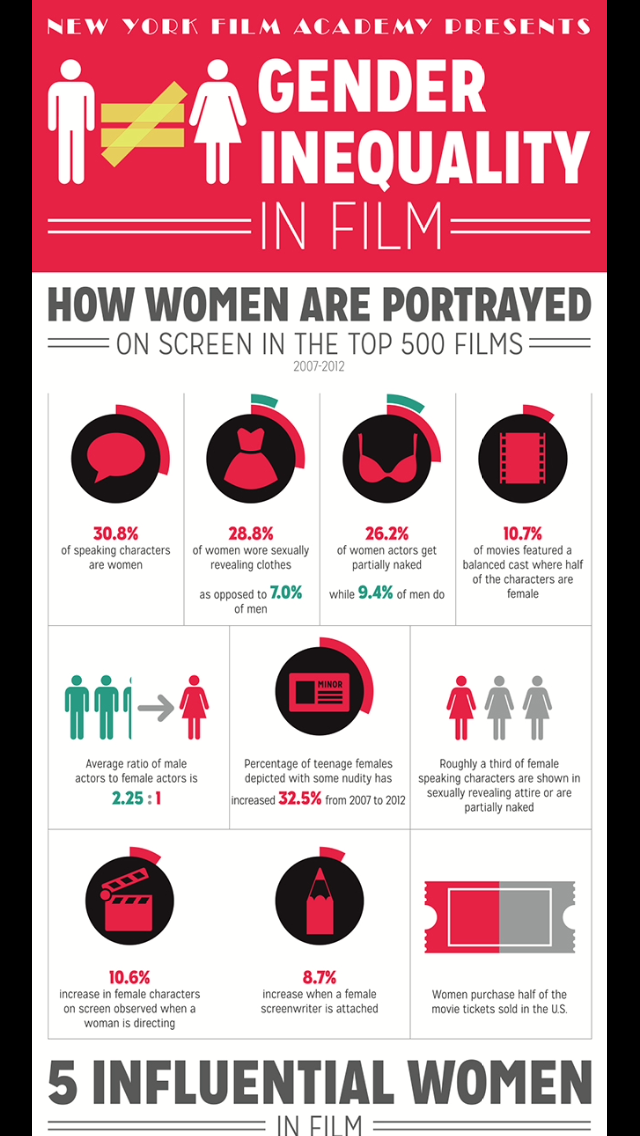
Statistically speaking, of course there would be more male deaths on television, and in film, because there are more men on television and in film.

image

From the New York Film Academy blog, November 2013.

It is impossible to make a value equivalency between the genders when they are not equally represented. In terms of pure visibility, male lives are valued more highly, because they are represented as existing in all capacities (as captains, doctors, engineers, plumbers, heroes, villains, extras, red shirts, science officers, Pirates, etc). Meanwhile women can only be found when the lack of diversity would be otherwise overwhelming, or when someone needs to die, so that the hero can go kick some bad guy ass. It matters more when you kill a woman, because there are so many fewer of them (about 1 to every 2.25 men, according to the New York Film Academy). It is, in fact, possible to make films that barely feature women at all (see: The Eagle, a film of which I am actually quite fond).

However, the actions of the film industry operate on an implicitly sexist logic, one unaddressed by the author(s) of the expendable gender entry. Men are the human “default”. Women are cosidered a deviation from the norm. When male extras die, the audience is seeing the death of “people”. They are undistinguished, and undifferentiated, it is true, but we are seeing large scale violence, not the interpersonal kind. The emotional impact of those deaths depends entirely on how you, as an individual, view the redshirts or the henchmen, and if the death of innumerable, anonymous people is something you find affecting.

The death of a woman, by contrast, is the death of the Other, the death of something we treat as different from the death of “people”. (See: Men are generic, women are special.) At this point, the author(s)’s argument takes an explicitly sexist turn. Furthermore, the choice of evidence–or, more accurately, assumptions–is more pernicious than willful ignorance of pure statistical probability. It concerns what the difference between the male “default” and the female “Other” is determined to be.

The author(s) argue that the value of female human existence comes from their ability to produce offspring. “In purely biological terms, men are more expendable than women because in the event of near-extinction, one male and ten females can produce ten times the offspring of one female and ten males.” This argument is part of the sexist philosophy prevalent in many internet communities, and has encouraged the violent reactions to female critics.

You may be familiar with its kissing cousin: “There are no girls on the Internet” (here on TV Tropes, or Know Your Meme). Though it hails from the early days of the internet, it was 4chan, a undisputed bastion of incivility and child pornography, that codified it for the present generation. Many would argue that any major association with 4chan so fundamentally undermines legitimacy that it neither bears repeating nor address. However, the cross pollination of 4chan with more legitimate communities, like reddit or imgur, mean that it has participated in the codification of cultural and social norms and behaviors online. “No girls on the internet” (or “Tits or GTFO”) appears without fail when a unique female perspective is articulated in an Internet forum, comment section, or message board.

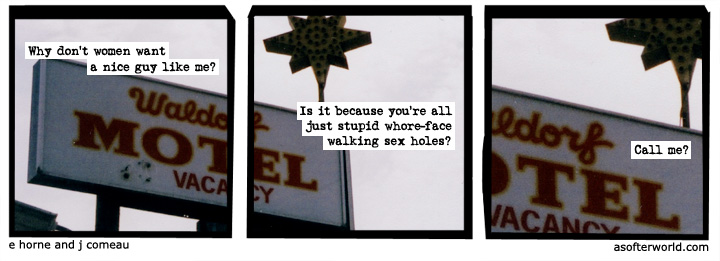
At its most fundamental level “No girls on the Internet” asserts that women are accustomed to receiving preferential treatment in social and intellectual arenas because of their sex. Specifically: because people (read: men) wish to sleep with them, women are given undue respect, attention, or concurrence in social situations.

In an ironic twist, the people who say that sex appeal is a means of getting others to submit to your opinions, are often the very same ones who will threaten to come to a woman’s house and rape her for daring to express an opinion with which they disagree, or if she wins in a video game.

image

(a softer world: 914)

To say that female lives are more valuable because of their ability to produce offspring is to reduce the woman, as a social, political, or narrative actor, to a walking uterus, perhaps with some caregiving abilities. (Nevertheless, more sympathy or nobility is bestowed on single fathers than single mothers.) The argument attempts to naturalize the view of women as sex objects by tracing their “Otherness” and their social value to their reproductive abilities, while simultaneously, couching the assumption in biological/evolutionary, and therefore presumably “scientific” or “objective,” terminology.

The larger effect of the argument is how it undercuts the potential for women to be seen as rational, independent agents, particularly with regards to public political and/or social transformation. It supports a reductive view where “women’s issues” are limited to topics like birth control (or not), abortion (or not), child support (or not), rape, and domestic violence. This largely ignores that women also have a stake in how poverty, access to healthcare, the rising price of college tuition, the stock market, fair trade goods, the second amendment, the price of oil, and the deaths of family members and beloved family pets are addressed. (It performs a further occlusion of male investment in “women’s issues,” by implying that men have no stake in the debates about BC/abortion/child support/rape/domestic violence, et. al.)

Most disappointing is that of course we know men are the expendable gender, there was a major motion picture about it. It starred Sylvester Stalone, Arnold Schwarzenegger, Jet Li,  Dolph Lundgren, Jason Statham, Terry Crews, Mickey Rourke, Bruce Willis, and Randy Couture. The second one had a slightly different cast, the third another different one again. Yet, all of these men can be “expendable” and we will still know their names. But the girl who is raped or killed at the beginning of the Criminal Minds, or Law and Order (any of them), or CSI (any of them), or the death of the girlfriend or wife or sister or mother that propels the hero into action, can be nameless, and faceless, and the actress will be quickly or easily forgotten.

Which leaves the question less about who is or isn’t expendable, but who will be mourned by the audience, and who will be remembered for their participation.

(This essay is limited to a binary gender system, but there is so much more to be said on the propagation and reification of the gender binary by the media establishment.)

Hustle: a eulogy for well-reasoned madness


image

how much loyalty do you owe a short-term employer?


It is difficult to think about labor precarity – the way in which the new “unshackled” working class has been liberated from regular hours, job security, benefits, and solidarity, in the name of flexibility – when I don’t pay rent, buy my own food, or retain sole responsibility for paying back my student loans. I have a job, and the potential for advancement with the organization that has employed me. I have access to healthcare through my mother’s employer, and eventually through my own. For the moment, whatever money I make goes towards my savings or coffee and pastries.  

And yet, I return to the idea. I watch my friends find paying work. Some of them have regular hours and the expectation of career advancement with their given employer or in their field. They already take on new responsibilities, they become more involved. Other friends drift through the employment landscape applying whatever skills they have to whatever work finds them, regardless of fulfillment, enjoyment, or faith in the work they are doing.
image

what’s your side hustle? etsy? journalism?

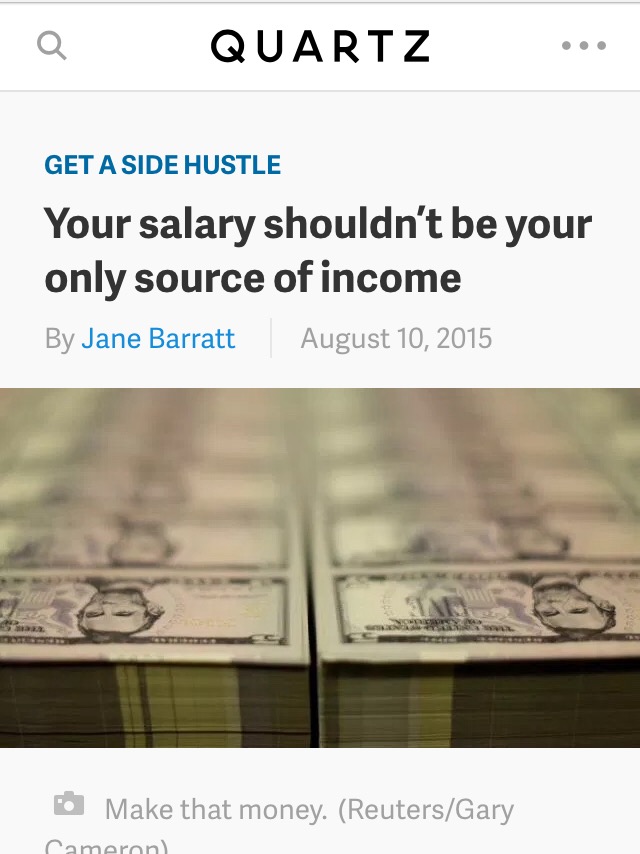
But some of the unease comes from watching the junkies at the bus depot hustle people for money, time, or acknowledgement. Because it’s not just the junkies anymore. Everybody hustles these days. I find headlines in my inbox about how a “side hustle” is both healthy and integral to the modern worker’s lifestyle. From all sides, incoming workers, especially in semi-creative industries, but also far too many others, are expected to perform hope labor; unpaid labor done with the expectation that it will attract paid labor.
For example: this blog, promotional photography done for friends and acquaintances, or the physical and mental labor done for a retail start up.

Locally – in the flesh – I get paid in trade. Usually food, drink, or artwork; but never a monetary equivalency, never contractual, rather a semi-valuable expression of gratitude. In the wider world my work, such as the words you read right now, is done for nothing. If time is money, then my time is literally without worth. A penny for your thoughts? Instead, tell me what you’re thinking and, if I like it, maybe I’ll give you something next time.

With some disappointment, I’ve discovered I know how to hustle. I know how to tell people what they should do for themselves, that benefits me. I can look you in the eye and tell you that not only do I know how to do what you need, but I can do it better, and more besides.

I’ve started to hustle my friends, not secretly, not covertly, but hustle all the same.
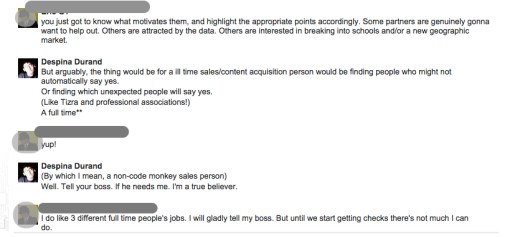
hustle-- chatThe hustle is carrying business cards, even when you don’t have a business. It’s constantly thinking over which organizations you are connected to, which business owners or capital holders you know, and which movers and shakers you have access to.

I’ve never enjoyed sports or board games. Both require a competitive edge, a desire to get one over on the other guy, that has never really appealed to me. Even if I know how to hustle, I don’t think I’m going to be making myself into a shark tank capitalist any time soon. My knee-jerk reaction to people who need to get a foot in the door, or an edge, or at the very least, a seat at the table (I don’t know that I can help anyone get skin in the game, yet), is to see if my hustle can get them there. A co-worker is looking for an internship? I might know some local business owners who would be interested in the extra help, but let’s see if the local women’s networking group – “networking,” in other words, organized hustle – might have some better opportunities. I know some people, I can get us an invitation.

The hustle is a hard game. No one hustles if they can help it. You hustle when you need to get ahead, or need to catch a break and you don’t have any other way of getting it. The hustle means every relationship can be a means to an end. I hustle my close friends. I hustle old bosses, and friendly acquaintances. I hustle at parties and in bars.

The hustle is the long arm of free market capitalism. Our present capitalism believes in “human capital,” or the ability of the worker to exploit themselves, and has made the demand that workers be ready, at any moment, to start the hustle. The magic of the “side hustle” (perhaps meant to be “side” to your job, if you have steady employment, but maybe it’s the “side” to your main hustle, the hustle that feeds and houses you for the moment, without guarantee) is that it gets you used to hustling.

Hustling isn’t new. People have always had to hustle, some more than others. Artists, anyone in sales, journalists, writers, freelancers of all types, academics – just to name a few – have always had to hustle for attention, for patronage, for customers, for publication, for funding, for airtime and column space. We like to believe that the fastest growing sectors are in technology, an employment avenue with job security and benefits, liberated from the hustle, but in fact, the sectors adding the most jobs are almost entirely in service industries. (See the numbers from the US Bureau of Labor Statistics.) We are getting more food service workers, more home aides, more nurses, more retail associates, and more customer service reps, far many more than we are getting new code monkeys.

The service industry is institutionalized hustle. Your barista, sales person, home aide, or babysitter are paid to care. They remember your name, your order, your birthday because feeling special will keep you coming back. You pay them, not for the product (the coffee, the clothing, the medicine) or even their expertise, but for the service experience they provide. You pay them to smile, to ask how you are, to remember your milk preference, and offer gift wrapping. With home aides and nannies, you pay them to take time and care away from their own loved ones and tend to yours in your stead.

Through all this capitalism doesn’t just shape our social and political circumstances, but reaches all the way inside us and plays around with the way we think.

Mid-March of 2015 found me in retreat from the shared social reality; I listened exclusively to mid-2000s pop-punk, and wrote over 3,000 words on the topic of Fall Out Boy as a social phenomenon, as well as their potential role in promoting the acceptability of Lesbian Gay & Bisexual (of LGBT) politics. I stopped going to class, and eventually stopped leaving my room.

After the semester ended, I started seeing three separate doctors whose job is to make sure my brain is functioning “normally” or “better” or some other inescapably normative adjective, and was ultimately prescribed three different types of drugs to regulate various aspects of my neuro-psychological well-being. Migraines [brain lesions, disordered speech, sensory overload, nausea, headaches, … ], depression [anhedonia, disordered sleep patterns, listlessness, irritability, emotional outbursts, … ], anxiety [panic attacks, social dysfunction, antisocial behavior, performance issues, … ], ADHD [executive function disorder, irritability, mood swings, … ].

By November, I could do things that would have been unthinkable in April. Now, I can talk to strangers. I can sell you objects I am sure were made under criminally dangerous and unregulated working conditions in the Global South. I can talk about the uncertainty of the future of my generation; a planet facing global war, a climate changing faster than we can adapt to it, the increased likelihood that the middle class will wink out of existence, and a political system that threatens to grind to a complete halt. I can even meet people from online dating websites.

As a result I stand for 8 hours a day, I make small talk with strangers, I make new friends, and I will sell anything I think you might be willing to invest in, be it $70 champagne-related wall ornament or the joys of Lovecraftian and other Weird fiction.

I am medicated so that I can get out of bed in the morning. More than that, however, I am medicated to perform better in a capitalist society. My mood is artificially enhanced (I don’t stick on the grim predictions that swim through my head) and I am more shallow – not as desperate to peer into everyone’s soul, more able to move beyond “acceptable losses” – than I am naturally. I can still feel echoes of my old anxieties (what if people don’t like me? what if they think I sound crazy? what if they keep participating in the exploitation of the third world? what if they don’t start caring about politics? what if I never find the right words to explain how this all fits together?), but I can swallow them down and bluff or lie or bluster my way through.

It comes down to this: I can smile more easily, I can be thinner and more energetic, I can laugh at your jokes even if they aren’t funny, or compliment your hair. Most of all, when I hustle you, I can make it look like honesty.

Watching this transformation has left me with a very important question: at what point does what we do become who we are? Two decades of outsized empathy, unendurable anxiety, nightmares, and self-consciousness can’t be overwritten. And yet, from inside my own head, I see someone new; a cardboard cutout of a person I don’t trust, who has my name and meets my eyes in the mirror with a smile.

The cardboard cut-out has taught me a very valuable lesson: my inner self isn’t good enough. In fact, the only way to be my best self, is through a medical regimen that alters my perceptions and reactions to help them conform to a construct we call reality. After all, one of the most common complaints addressed to individuals who are promoting the linguistic and social adjustments labeled (derogatorily) “politically correct” is that they need to face up to “reality” or “the real world”. The word “reality” in this context, and in the context of social and economic performance, could be replaced with the term “status quo”. I might see clearly, anxious as I am about labor precarity, social dysfunction introduced when friends become means to an economic end, human capital, and mounting college debt. I might be right when I entertain nightmares of a violent and barren future. But “paranoia” and “anxiety disorder” are much easier problems to fix.

Maybe my kind are just as easily found in bus stops telling you how they found Jesus and asking for spare change, as they are pitching in board rooms and on sales floors. Maybe we all just need anti-anxiety meds and amphetamines, to make sure that we can be relaxed and happy. After all, capital is only concerned with end results – did you surpass the year-to-date sales? – seekers after truth, or at least those seeking respite from the roar of sadness and fear in their heads, get picked up by LEOs for vagrancy and illegal narcotics use, and, if I stop leaving my bed, I’ll probably find myself with them at the psychiatric facility.

But as long as I sleep deeply, after a long day of hustling to pay for my drugs that make life bearable, I won’t have time for nightmares.

(Many many thanks to Sam, Joey, and Eric for proofing this piece, letting me rant, and killing my over abundance of semicolons.)

 

Starting with the Bechdel Test

Let’s start a conversation with the Bechdel Test. Now I might be beating a dead horse here, but I’ve recently realized that knowledge of the Bechdel Test is not as widespread as I thought it was. I’ll drop it into conversation and people will suddenly look confused and I’ll have to backtrack and explain what it is.

The Bechdel Test

The Bechdel Test, alternately called the Bechdel/Wallace Test, the Bechdel Rule, Bechdel’s Law, or the Mo Movie Measure, is a simple set of rules that creates a rudimentary set of standards for female representation in movies (personally, I apply it to television as well). It made it’s appearance in 1985 in Alison Bechdel’s comic Dykes to Watch Out For.

Dykes to Watch Out For, 1985.

It has three rules:

1. A movie must have 2 female characters

2. They must have a conversation.

3. About something other than a man.

In theory this shouldn’t be too difficult to achieve. I would like to invite you now to take a moment and think back on the last five movies you saw and see if they pass the Bechdel Test. Continue reading