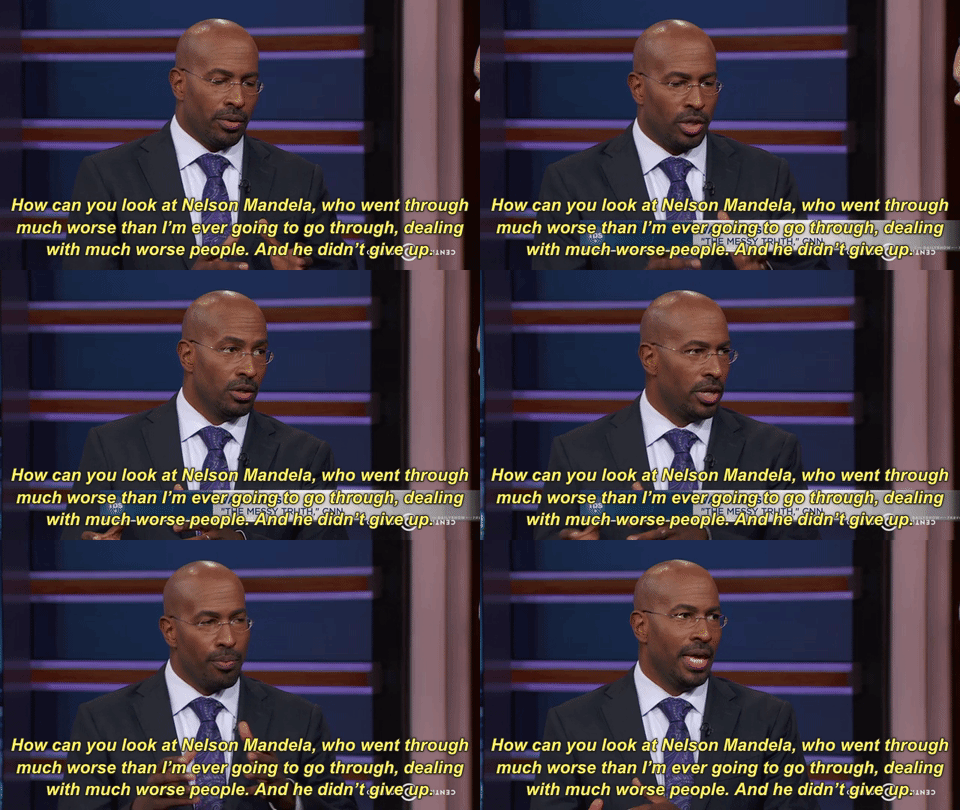
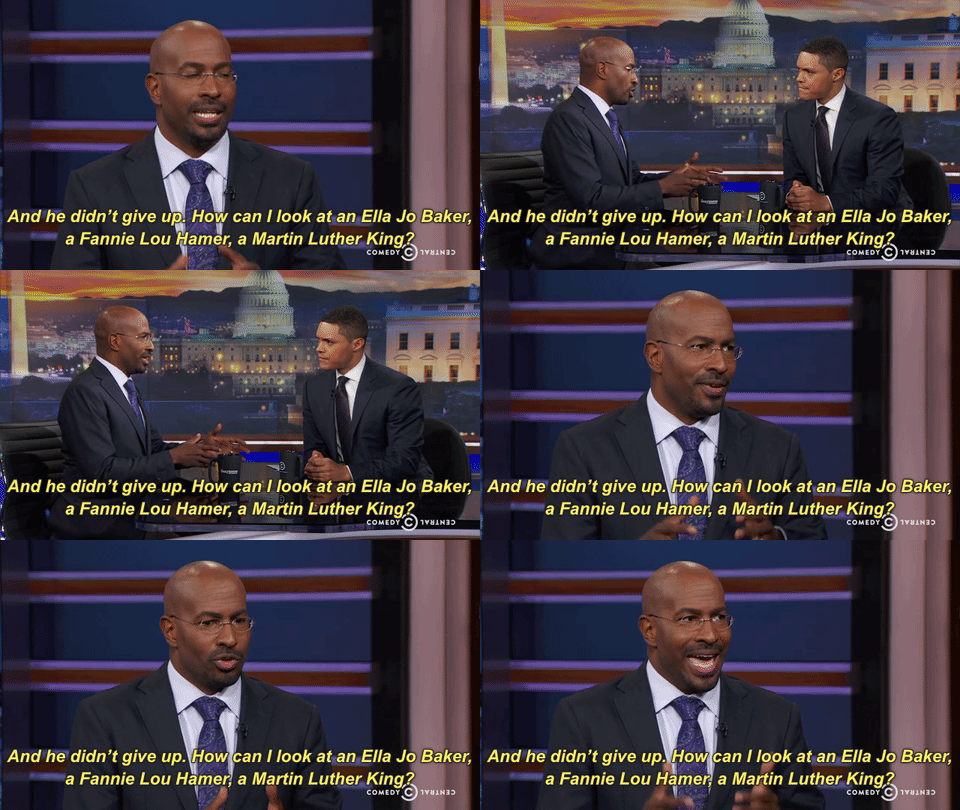
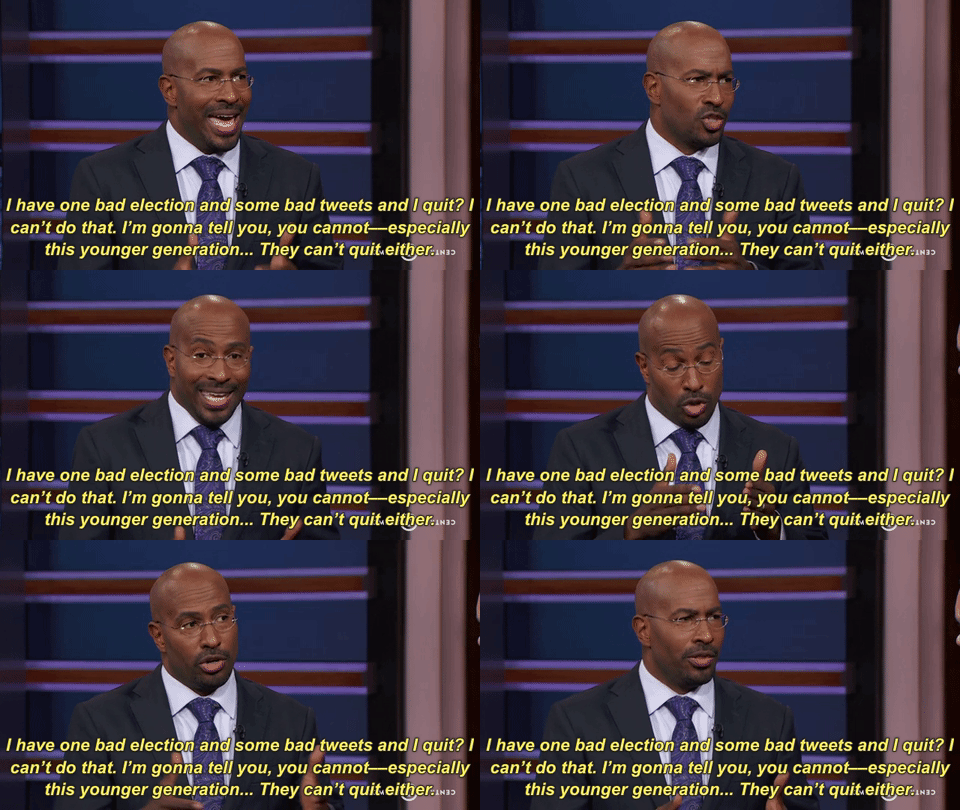

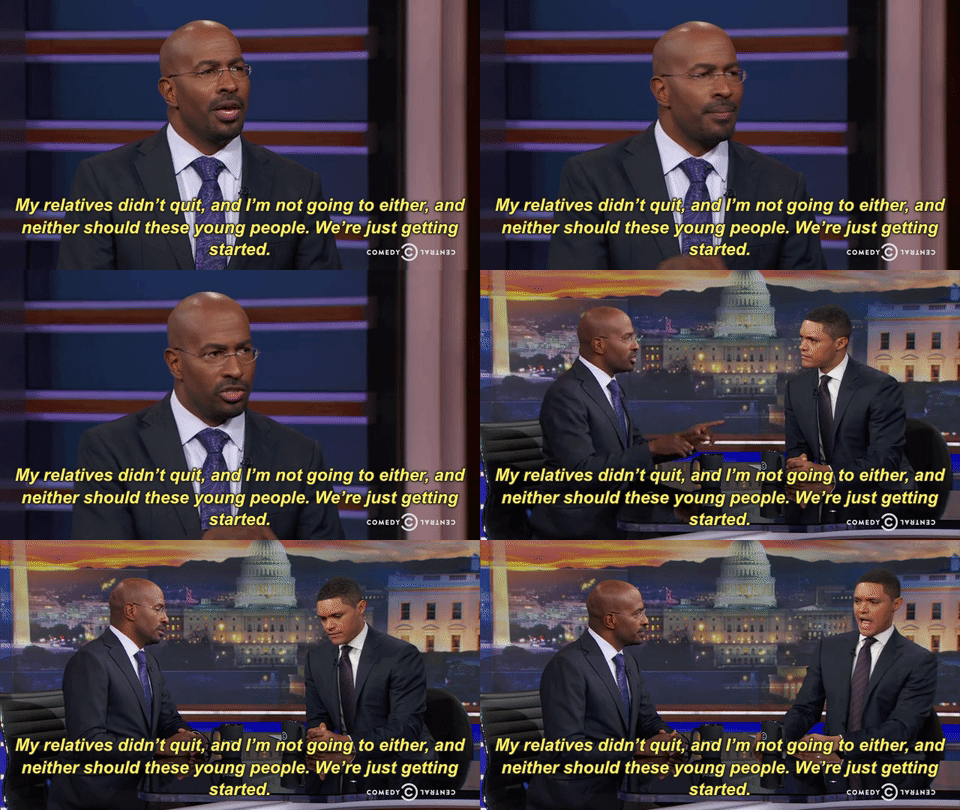
Van Jones, The Daily Show with Trevor Noah, 04 December, 2016.

Last night I watched Van Jones on The Daily Show with Trevor Noah. A few important things to know:
I said to my mother last night, “He’s got a bold taste in ties, he’s well-spoken, and he’s capable of articulating nuance. What more can we ask for?” And that is truly the basis of my strident appreciation of Mr. Jones. That capacity for nuance and his equal commitment to speaking unvarnished truth are desperately needed right now. He correctly challenged the notion that all Trump supporters are bigots, and doubled down by saying that the Left has failed to address the concerns of many of the people who, as he put it, held their noses and voted for Trump.
I was particularly impressed by his easy association between people who voted for Hillary as “the lesser of two evils” and those who did the same with Trump. And that doesn’t even touch on all the people who (as I’ve pointed out before) didn’t vote for anyone at all, either because they were unable to do so, or were unmotivated to do so.
I was especially moved by his answer to the question Trevor posed at the end of the broadcast portion of the interview, about how he can stand to keep extending a hand. It is something worth hearing (or reading) as we move forward and people ask themselves why they should have to continue to be the bigger person.
How can you look at Nelson Mandela, who went through much worse than I’m ever going to go through, dealing with much worse people. And he didn’t give up. How can I look at an Ella Jo Baker, a Fannie Lou Hamer, a Martin Luther King? They shot King in the face the year I was born because he was trying to fight for these ideals. I have one bad election and some bad tweets and I quit? I can’t do that. I’m gonna tell you, you cannot––especially this younger generation… They can’t quit either. I’m a ninth generation American. A ninth generation American. I’m the first one in my family born with all my rights. My relatives didn’t quit, and I’m not going to either, and neither should these young people. We’re just getting started.
–Van Jones, The Daily Show with Trevor Noah, 12 Dec 2016.
Long story short: Van Jones is my hero. And right now, we need all the heroes we can get.
American political culture suffers from a unique failure of binary systems. Politics everywhere fall into this particular trap, but something about the American mindset makes it particularly prone to this pitfall and historically predisposed to it.
The tendency for a moralistic binary of “good” versus “bad,” completely ignores the modifying appendages which not only render nuance, but constitute real meaning.
Vox recently ran a piece about the one thing Donald Trump got right that economists got wrong. Beyond the clear attempt to bait their Left-leaning, young audience into clicking on something they expect to hate read, the contents of the article failed to actually measure up to the title. (Shockingly, we are finding that you can’t believe everything you read on the internet.)
The sentence that caused me to lose faith in the direction of the piece came at the beginning of the third paragraph:
“For decades, experts have argued that freer trade is good for the US economy and downplayed the economic harms that trade can cause.”
Because the metric that the economists, and the metric the President-elect (or any isolationist, populist ideologue) is using are fundamentally different. From what I know about economists, they enjoy using numbers such as the gross domestic product (GDP), sometimes they dabble with employment (or unemployment) statistics, they’ll look at job growth by sector, or other such national measures of what can be termed “success” and “failure”.
We are still the foremost global economy, we have a ludicrous amount of wealth in natural resources, intellectual property, military technology, and many other areas.
The overall health of the US economy, ultimately, can be completely divorced from the actual economic situation of its citizens.
What the neoliberal elite have worked very hard to ensure is that when they say “free trade is good” no one asks “for whom?”
That having been said, I don’t actually feel comfortable falling in line with some of the increasingly prominent isolationist or anti-globalization factions of the Left. I believe that the free travel of people and information and ideas is actually a boon for humanity and a step in the right direction as we develop a global society.
I think the free movement of wealth, capital, and the political and economic elite is a disaster that is pushing the human race to the brink of self-annihilation. That the heads of national banks or large private wealth management companies can live in countries on the other side of the world away from their professional responsibilities (nearly always for reasons of tax evasion on their exorbitant salaries) is a disaster and an active contributing factor to the deterioration of both civil society and global economic stability.
With that in mind, I am a cautious proponent of global trade. But I’m not going to defend unregulated markets. Because unregulated (or “free”) markets are the means of stripping national and international communities of their resources and then leaving them behind without any structure of social support or security. It leads to unemployment, hunger, and limited or non-existent access to education, housing, and opportunities.
The recent campaign has taught us nothing that was not already known. It has merely shown that one set of lies is being replace by another, and that the people who make up the working flesh of this country and many others, will continue to be debased and destroyed by people who are willing to end the world to have the most stuff.
Today I face something that might even be my old demons. Certainly I get the mixed bag of necessary travel.
I love the feeling of being in motion. I hate traveling by bus, but I am most content in that in between, when you have left and have yet to arrive.
I’m told I have an avoidant personality, and that cannot help but contribute to the pleasure of uncertainty. When we are on the bus, train, airplane, boat, when we are between here and there, Heisenberg’s Uncertainty Principle is in effect; we can know where we are, or how fast we’re going, but not both.
Time and space become abstracted; all the trappings of quotidian existence get suspended while we await the resolution of our trajectory.
I travel on faith. I imagine that it comes from the experience of always visiting friends and family, even when I travel overseas. I leave my plans half-baked, and with minimal assurance of food and shelter, I head off, calling ahead as questions arise. It will fail me some day, and I’ll have to sleep in a park; I’m almost looking forward to it.
The meditative, fugue-like state of watching (even familiar) scenery slide by the panoramic bus windows is pulling me in even now, before we have even left the city.
Thanksgiving is come and gone.
It has been hard not to think of William S. Burroughs’ Thanksgiving Prayer, especially the last line:
Thanks for the last and greatest betrayal
of the last and greatest
of human dreams.
(Content Warning for the poem: racial slurs, anti-gay slurs. Un-varnished representations of America.)
I read some good bits of advice for weathering the new political climate, both are making the rounds, but a little extra time spent on them won’t be wasted:
Annalisa Merelli’s piece for Quartz, regarding what the US body politic and the US media can learn from Italy’s experiences with Silvio Berlusconi. Namely, that fighting the man does little good, because as Trump has said: All publicity is good publicity. (And the man is a reality TV star, he surely knows what he’s talking about.) We need to refocus away from a critique of his personal or moral foibles and failures, and re-engage with what matters. That means it’s time to (finally) talk policy.
The other is from Nic Dawes, appeared in the Columbia Journalism Review and made the rounds, at least in the arenas I’m familiar with (it’s all algorithmic and doubtlessly intended to keep me deep in my comfort zone). Dawes is concerned with preparing American journalists for a level of hostility and restricted access they have never encountered before. The freedom of the Press and, more importantly, the importance of the Press is something that has been taken for granted in this country, and ostensibly enshrined in our founding document. It has weathered difficult times and difficult moments before, but never has it faced the total rejection and defamation that is being put forth by the President-elect and his political entourage.
On the matter of the press, part of me despairs. The calcification of the federal government was at least periodically tempered by the actions of the Press (though not with anything near the level of effectiveness that was necessary). Without any voices playing even nominally playing the role of dissenting opinion or considered criticism, I fear we face a necrotic rather than a merely ailing infrastructure of governance.
Most of all, fear is what keeps me up at night. If this shock, this pain, this anger continues as it is, and fear sets in long term, we will be lost. The forces of power need us divided and overwhelmed. We must imagine new ways of being, and living, and speaking that will allow us to push back against those instincts to circle the wagons and protect our own.
Maybe I’ve been watching too much Supergirl lately, but it seems like this moment––when things are dark and bleak and uncertain––is when we must hold out our hands and try and help each other stand.
 desert | ƨiƨɒo