
greenery

rust

cold

run off

crouched
I went for a walk in the woods behind my house. There were all kinds of nice surprises waiting for me.
11 March 2017. Saturday. See also on Flickr.

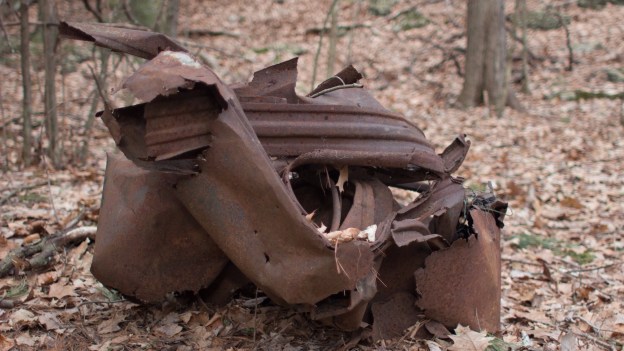
I went for a walk in the woods behind my house. There were all kinds of nice surprises waiting for me.
11 March 2017. Saturday. See also on Flickr.
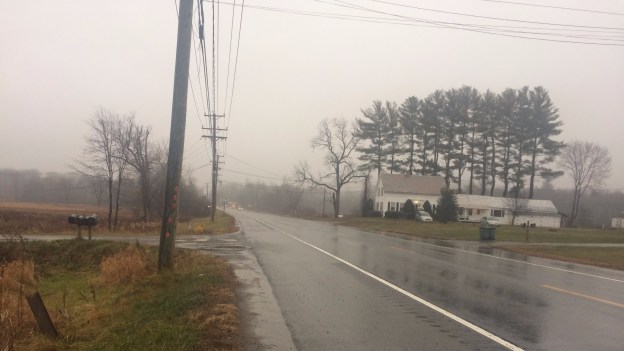
Yesterday in the car, driving along Route 47, my friend said, “Wow, Sunderland really is just a lot of land.”
As a student at a large state university, it is strange to think about my current home as being “rural”. Nevertheless, that is exactly what it is, don’t let the pizza place or the laundromat fool you. The stretch of land between routes 116 and 47 is farmland, when it’s been cultivated or put to use at all.
The definition is elusive for the reason that many things are in New England, unless you’re overlooking the ocean; it’s hard to see much of anything at all with all the hills and trees interrupting your vision. The university helps hide it as well. The migrant population of tens of thousands of young bodies is reason enough for a reasonably extensive public transit system and provides more than enough indenture to build and maintain any number of housing complexes, which cause little related businesses to sprout up to attend to the needs they create (like pizza and laundry).
Without thinking about the landscape at all I’ve been contemplating what it means to be a rural area. In a fit of frustration about the cost of our telecoms utilities, I started looking to see if there were alternatives to our current subscription.
In the process, I visited BroadbandNow, a site which bills itself as a consumer interest group, looking to provide information on the services and available to a person in every county in every state in the US. Of the three options in Franklin County, in Western MA, only one provider achieves the minimum download speed necessary for “broadband internet”. The FCC has set “broadband” speed as a minimum of 25 Mbps (megabits per second) download speed and a 3 Mbps upload speed. Xfinity by Comcast is your only choice if you want broadband internet. Their promotional first year rate is approximately $35/mo. if you keep their service for over a year, it goes up to nearly $90/mo.
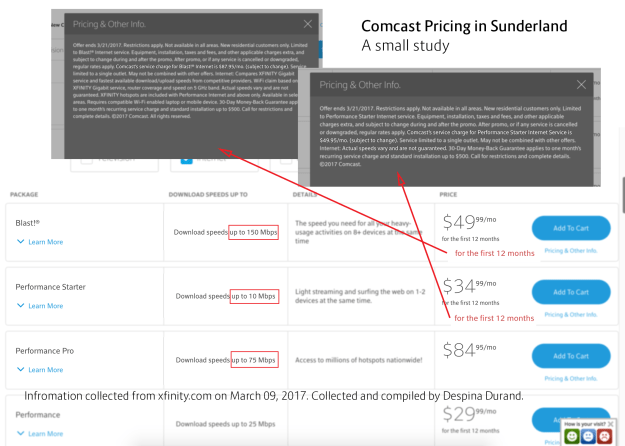
Graphic displaying promotional vs. actual internet subscription rates from Comcast.
The thing that got me stuck on this issue is from the little factoids that run along the side of the BroadbandNow website when you look up a particular region. There’s a little box there that reads, “Approximately 5,000 people in Franklin County don’t have access to any wired internet.” It’s unclear if the other number, 14,000, which is the number of people who don’t have access to internet with a speed of 25 Mbps or higher, is inclusive of the 5,000 who don’t have any wired internet at all. To a degree, I’m not entirely sure that it matters. What I can tell you, from looking at the maps of “underserved” or “unserved” towns, is that Wendell, MA, 33 minutes away from the University by car, has no cable or DSL at all. Leverett, 13 minutes away, and Shutesbury, 19 minutes away, have only partial DSL, and no cable internet at all.
If you overlay the maps of the underserved towns, over the map of wireless broadband access, you’ll see that most of Franklin County only has mobile wireless.
I don’t know for absolutely sure, but I imagine that this is what it means to feel left out of the political conversation. The Internet was supposed to be the wave of the future; this was going to connect everyone to everyone else, make us all equals in a massive interconnected conversation. But, in this, as in most things, it seems that some are more connected, and more equal, than others.
We have forgotten the true goal of terrorism. It can be difficult, especially in the aftermath of horrible events such as the one which occurred in Nice (or Dallas, or Orlando, or San Bernardino), as we prepared to bury the dead and do what we can to heal the wounded and care for all those who will never truly be whole again, that the goal of terrorism is not death. The goal of terrorism is in the name: terror; fear.
Every time we pick ourselves up and try and take stock of the damage and the pain, and allow ourselves to forget that what those who promote and execute these acts of violence are trying to generate is fear, we allow them to succeed.
Daesh would love to lay claim to the power to reach out and strike us there where it hurts the most. With every independent attack that is attributed to them, they have further proof that their reach is global, that they are able to infect our people with their poisons and use our people to hurt us. They take that power from our headlines, our speculating talking heads, our circumstantial analyses, and our political speeches.
Perhaps the man who struck out at the Queer Latinx community in Orlando justified his actions through the philosophy promoted by Daesh. Perhaps the man who drove a truck through a crowd in Nice came from Tunisia (where an overwhelming number of Daesh fighters hail from) and maybe he, too, justified his actions through their language.
That does not give Daesh the right to claim responsibility for their actions. Their power is not so great that they can reach across space and time and sow the seeds of their hate in the hearts of people who are thousands of miles away from them. These people are not molded by Daesh, they are molded at home, and their choices are their own, they can invoke Daesh in justification, but we do not have to believe them.
We can rob Daesh of their power. We have the power to make them lose the war abroad as they are losing the ground war in Syria and Iraq. Because when the perpetrators are dead—and they are all dead—there is no one left to speak for them. What we have to say about their origins and their motivations is as true as what Daesh has to say. When the Daeshi leadership learn about the attacks as we do, they are no more responsible for them than we are.
A generation of children already grew up with a boogeyman who lived in a cave in a desert most of them could not find on a map: his name was Osama bin-Laden. From September 2001 onward, children who were not yet old enough to comprehend what had happened in New York City and at the Pentagon knew his name and were afraid of him.
We can keep a new generation of children from knowing that fear. We can stop Daesh at the borders of their stolen territory, and their reach at the limits of their trained fighters and evil plots. We do not have to allow the words and tenets of their death cult to have the power of pandemic. We can acknowledge the violence it effects, and work to heal the wounds it leaves, and deny the infection a vector and the opportunity to spread.
Circumstance has returned me to a favored pursuit. I spent the last few months producing graphic art pieces for a 2D design foundations class at RISD, which had me stretching my creative limbs in the realms of pencil, paper, glue, and paint. The basics of design, other than practice, in the form of line, shape, space, color, pattern, repetition, and perspective were familiar strangers, and have since become intimate friends.
My cousin’s college graduation, and the prospect of a new commercial project, have returned me to the loving arms of photography. In the process I’ve developed a new (and psychologically more efficient) method of organizing my photography, and have extended my autodidact explorations into the open source software Darktable and studio lighting.


I’ve been playing with color editing and WB correction. Additionally I spent a significant quantity of time figuring out how to edit my little logo in Inkscape so that it would have the right kind of transparency when transformed into a watermark (as well as how to save a vector graphic into the right directory using the Terminal so as to be able to access the file in Darktable).
Much of the fun has just been in having a camera in my hands again. I said to Eric after our photoshoot, that really, all photographers have a fetishistic streak in them.


The photographer enjoys the simulated power of aesthetic creation. To take a photograph is to reproduce reality (badly) and to convey the aesthetic quality of a moment–I do not believe that the photographer has any real claim to the beauty of a photograph. Photographs can be either effective, affective, or forgettable. The power of the photographer is in that aspect. Though perhaps that is the entirety of what all artists can lay claim to. Words are beyond the individual command of one person, but placement is everything, in language.
In a roundabout way, I’m picking a fight with the concept that photographs are “made” rather than “taken”. The act of depressing the button that fires the shutter and the light captured in the split second is recorded–that is a process of taking a piece of reality and keeping it for yourself. That is the moment when someone’s soul is stolen–captured along with the light inside the camera. When you enter the developing room, or perhaps the editing software suite, when you begin cutting out bits of reality, adjusting the colors and contrast and the depths of reality, that is when you might begin to “make” a photograph.
I am not, however, a student of photography. I am a student of journalism. My approach to reproducing reality, to laying claim to the experience of the world, is to denounce ownership. My personal expectations are that should I have done my job well, the product looks like the world itself: recognizable, strange, complex, illuminated, and indistinct.
I also need to remember the most important rule of photography in the rest of my life: you can never capture the whole thing. The art of photography is the art of framing. It is pulling the audience along and standing them in a particular spot, and showing them something specific.
Let’s start a conversation with the Bechdel Test. Now I might be beating a dead horse here, but I’ve recently realized that knowledge of the Bechdel Test is not as widespread as I thought it was. I’ll drop it into conversation and people will suddenly look confused and I’ll have to backtrack and explain what it is.
The Bechdel Test, alternately called the Bechdel/Wallace Test, the Bechdel Rule, Bechdel’s Law, or the Mo Movie Measure, is a simple set of rules that creates a rudimentary set of standards for female representation in movies (personally, I apply it to television as well). It made it’s appearance in 1985 in Alison Bechdel’s comic Dykes to Watch Out For.

Dykes to Watch Out For, 1985.
It has three rules:
1. A movie must have 2 female characters
2. They must have a conversation.
3. About something other than a man.
In theory this shouldn’t be too difficult to achieve. I would like to invite you now to take a moment and think back on the last five movies you saw and see if they pass the Bechdel Test. Continue reading
 desert | ƨiƨɒo