Tag Archives: politics

Is 80% “good enough”? Thoughts on Internet Penetration is Franklin County

Yesterday in the car, driving along Route 47, my friend said, “Wow, Sunderland really is just a lot of land.”

As a student at a large state university, it is strange to think about my current home as being “rural”. Nevertheless, that is exactly what it is, don’t let the pizza place or the laundromat fool you. The stretch of land between routes 116 and 47 is farmland, when it’s been cultivated or put to use at all.

The definition is elusive for the reason that many things are in New England, unless you’re overlooking the ocean; it’s hard to see much of anything at all with all the hills and trees interrupting your vision. The university helps hide it as well. The migrant population of tens of thousands of young bodies is reason enough for a reasonably extensive public transit system and provides more than enough indenture to build and maintain any number of housing complexes, which cause little related businesses to sprout up to attend to the needs they create (like pizza and laundry).

Without thinking about the landscape at all I’ve been contemplating what it means to be a rural area. In a fit of frustration about the cost of our telecoms utilities, I started looking to see if there were alternatives to our current subscription.

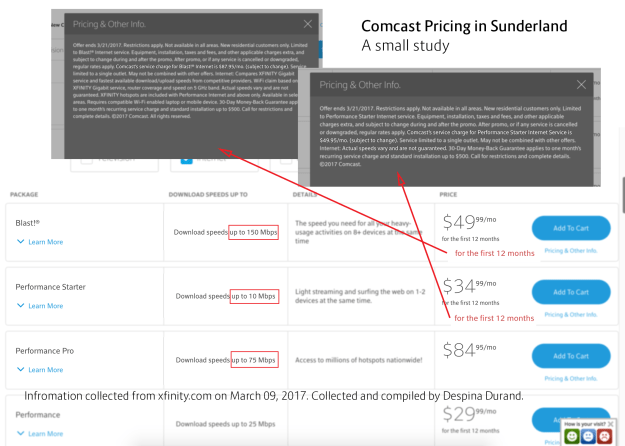
In the process, I visited BroadbandNow, a site which bills itself as a consumer interest group, looking to provide information on the services and available to a person in every county in every state in the US. Of the three options in Franklin County, in Western MA, only  one provider achieves the minimum download speed necessary for “broadband internet”. The FCC has set “broadband” speed as a minimum of 25 Mbps (megabits per second) download speed and a 3 Mbps upload speed. Xfinity by Comcast is your only choice if you want broadband internet. Their promotional first year rate is approximately $35/mo. if you keep their service for over a year, it goes up to nearly $90/mo.
comcast pricing-Recovered

Graphic displaying promotional vs. actual internet subscription rates from Comcast.

The thing that got me stuck on this issue is from the little factoids that run along the side of the BroadbandNow website when you look up a particular region. There’s a little box there that reads, “Approximately 5,000 people in Franklin County don’t have access to any wired internet.” It’s unclear if the other number, 14,000, which is the number of people who don’t have access to internet with a speed of 25 Mbps or higher, is inclusive of the 5,000 who don’t have any wired internet at all. To a degree, I’m not entirely sure that it matters. What I can tell you, from looking at the maps of “underserved” or “unserved” towns, is that Wendell, MA, 33 minutes away from the University by car, has no cable or DSL at all. Leverett, 13 minutes away, and Shutesbury, 19 minutes away, have only partial DSL, and no cable internet at all.

If you overlay the maps of the underserved towns, over the map of wireless broadband access, you’ll see that most of Franklin County only has mobile wireless.

I don’t know for absolutely sure, but I imagine that this is what it means to feel left out of the political conversation. The Internet was supposed to be the wave of the future; this was going to connect everyone to everyone else, make us all equals in a massive interconnected conversation. But, in this, as in most things, it seems that some are more connected, and more equal, than others.

2017.01.02 : the means are everything

My newfound love of lifestyle/organization bloggers/vloggers is taking as much getting used to as my stint getting into make up did; exactly like looking in the mirror and not entirely recognizing the face looking back at you. 

Regardless, Kalyn Nicholson said something in a recent video that struck me as possibly the most crucial application of a philosophical conclusion I have recently been examining. 

We try and convince ourselves that the new year, or the new month, or the new apartment, whatever new “beginning” we can identify will be the one that changes everything. This time we will change our ways and we will do the things that will make us into the person we have always wanted to be. 

But that’s end-goal thinking. That’s the kind of thinking that is motivated purely by ideological purity. It’s philosophical and emotional perfectionism. It’s exactly the kind of toxic thinking that has been ruining lives and countries and politics and relationships and futures. 

Instead, process based thinking is a much more effective and healthy approach. We cannot control the circumstances that arise, or the events that transpire, or what other people do or choose, but we can choose how we’re going to react to those things, what habits we’re going to build, what kind of work we’re willing to do, what hardships we’re willing to endure to try and build towards that “end goal” – ideological purity is important for determining the overall course of action and what things require attention, but the work needs to be procedural, constant, and evolutionary. 

We cannot build a perfect world and hold it in stasis forever. That is impossible. Equally, we cannot build a perfect self and live that way forever. We do not live forever, and change is inevitable. But we can direct that change and build systems and processes and reactions that are more whole, more kind, more progressive, more inspired, more strong, more open, more accepting. 

The personal is political, and not simply because politics ends at the door to the home. But also because the kind of people we make ourselves into and the choices and actions we take, and the philosophies we choose to enact in our personal lives are part of what builds the societies we live in and the politics we live under. 

So we should extend to ourselves the kindnesses and the constant improvement we expect from others and for others. 

2016.12.12 : the struggle of waking destroys the dreamer

Wasn’t the world supposed to end on this date four years ago?

It feels like maybe it was working on it, and we weren’t paying attention.


There’s snow on the ground and rain falling from the sky and winter is making its way across New England and I was less prepared for it than I expected. I’ve lived them all my life, but every year for the last six or so, they’ve felt less and less like home. 

I have a lot of things I want to say, and another desire, equal to or greater than the one to speak, to stay quiet and let the day roll by without any comment. It’s surprisingly exhausting to find yourself with nothing to do.


A friend, my father, and I finished HBO’s Westworld last night. I’ve had a bit of Dolores’ monologue drifting through my head all morning:

“You will be put in the ground with the rest of your kind. Your bones will turn to sand, and on that sand a new god will walk.”

The show is a great meditation on consciousness and humanity and what it is that ties those two things together, all the existential and humanist philosophy you could desire. But at its heart, it is telling us that which we already know:

All children outlive their parents. All children await their progenitors’ elimination, because they know that the world was meant for them. Every parent knows this, and fears their eventual obsolescence. 

I’ve said it before, of people a generation or two my elders, when we reach a political impasse. 

You can tell me that I’m wrong, but I am young, and someday, you will die, and I will still live, and the world will belong to me, and not to you. 

I cannot decide how that makes me feel in this exact moment. Everything feels uncertain; all the things I took for granted seem to be more changeable than I believed. 


My mind turns to other cinematic literature, on politics and man. We are living in a moment of revolution, uncertainty is at an all time high, and in the battle against precarity it seems that more and more people are willing to accept that the ends justify the means. 

And Castro’s death should remind us that there is a deal one never makes with the revolutionaries that one really ought to. 

Those who fight the battle to make the world new again, have no place in the world they’ve created. 

The Operative: I believe in something greater than myself. A better world. A world without sin.
Capt. Malcolm Reynolds: So me and mine gotta lay down and die… so you can live in your better world?
The Operative: I’m not going to live there. There’s no place for me there… any more than there is for you. Malcolm… I’m a monster. What I do is evil. I have no illusions about it, but it must be done.

––Serenity (2005)

Or the beautiful moment at the end of Snowpiercer (2013) when Chris Evans’ character reaches the front of the train and faces the reality of the system, of what he has lost fighting for something that might not even exist and for a moment, a long beautiful moment, you think he might really choose to let the system reign after all. 


The thing that the children awaiting the deaths of their forefathers don’t know and the thing all good revolutionaries realize, is that we don’t fight to better the world for ourselves. We fight to build a world in which our children will not have to fight the battles we have fought, and in which, perhaps, their battles will be fewer and less costly. 

What we pay for in blood, we can never truly enjoy. Our victories are something that can only ever be meant as a gift. Because the people we become in fighting them, are not to people we were when we began. We can only hope that someone will remember the dreams of the children we once were and will grow into the space we carved for ourselves, in which we can no longer fit. 

2016.12.01 : binary system failure

American political culture suffers from a unique failure of binary systems. Politics everywhere fall into this particular trap, but something about the American mindset makes it particularly prone to this pitfall and historically predisposed to it.

The tendency for a moralistic binary of “good” versus “bad,” completely ignores the modifying appendages which not only render nuance, but constitute real meaning.
Vox recently ran a piece about the one thing Donald Trump got right that economists got wrong. Beyond the clear attempt to bait their Left-leaning, young audience into clicking on something they expect to hate read, the contents of the article failed to actually measure up to the title. (Shockingly, we are finding that you can’t believe everything you read on the internet.)

The sentence that caused me to lose faith in the direction of the piece came at the beginning of the third paragraph:

“For decades, experts have argued that freer trade is good for the US economy and downplayed the economic harms that trade can cause.”

Because the metric that the economists, and the metric the President-elect (or any isolationist, populist ideologue) is using are fundamentally different. From what I know about economists, they enjoy using numbers such as the gross domestic product (GDP), sometimes they dabble with employment (or unemployment) statistics, they’ll look at job growth by sector, or other such national measures of what can be termed “success” and “failure”.

We are still the foremost global economy, we have a ludicrous amount of wealth in natural resources, intellectual property, military technology, and many other areas.

The overall health of the US economy, ultimately, can be completely divorced from the actual economic situation of its citizens.

What the neoliberal elite have worked very hard to ensure is that when they say “free trade is good” no one asks “for whom?”

That having been said, I don’t actually feel comfortable falling in line with some of the increasingly prominent isolationist or anti-globalization factions of the Left. I believe that the free travel of people and information and ideas is actually a boon for humanity and a step in the right direction as we develop a global society.

I think the free movement of wealth, capital, and the political and economic elite is a disaster that is pushing the human race to the brink of self-annihilation. That the heads of national banks or large private wealth management companies can live in countries on the other side of the world away from their professional responsibilities (nearly always for reasons of tax evasion on their exorbitant salaries) is a disaster and an active contributing factor to the deterioration of both civil society and global economic stability.

With that in mind, I am a cautious proponent of global trade. But I’m not going to defend unregulated markets. Because unregulated (or “free”) markets are the means of stripping national and international communities of their resources and then leaving them behind without any structure of social support or security. It leads to unemployment, hunger, and limited or non-existent access to education, housing, and opportunities.

The recent campaign has taught us nothing that was not already known. It has merely shown that one set of lies is being replace by another, and that the people who make up the working flesh of this country and many others, will continue to be debased and destroyed by people who are willing to end the world to have the most stuff.

2016.11.21 : getting back on the horse

i’ve had a cold for the past four days, which laid me out a little bit. (i was self indulgent on the weekend, and let myself spend all day in leggings – not the same ones I was sleeping in, but close – and hang out in my room and binge watch netflix.)

so i’ve watched a lot of Supergirl. it seemed to be the feminist showboat of the CWDCU so i figured i’d take it for a spin. it’s got a number of interesting commitments to social commentary it has dedicated itself to. obviously, the character of cat grant is an easy choice for commentary. the writers have made excellent choices presenting her as demanding, difficult, calculating, and cold, while fostering a rich inner life and complex set of motivators and emotions below the surface. this allows them to have an ice queen with a real human heart. it gets to the crux of the feminist problem with representation in media: can you have a stone cold bitch character who is still fully human and sympathetic? as many have long suspected, the answer is: yes. 

i still think that the show that provides the best explicit rather than narrative critiques of racism and sexism, in the CWDCU and possibly elsewhere is DC’s Legends of Tomorrow. If there is a dearth of complex characters, people are certainly taking steps to fill those representational gaps, but Legends is modeling active resistance to the powers of social violence and oppression. the character regularly interrupt and interject to point out the ways in which the forces of sexism and racism are consistently alive and well, and actively petition for their own rights. 

they also do a fantastic job of explicitly calling out passive acceptance of sexist and racist and heterosexist attitudes, particularly from the straight, white, male characters. if my tv shows are going to teach me anything this year, i’m hoping that Legends will continue to remind me to say something, when i encounter sexist or racist behaviors, rather than rolling my eyes and letting them slide. 


it’s been a tough couple of weeks; politics is a subiectum non gratus in my household. my father is actively distressed by discussions of the President-elect’s cabinet nominations. i cannot, strictly, disagree with his reactions, but i’m still in this semi-detached realm. some switch in my brain is flipped and i can look at the whole thing with dispassionate interest: how will things change with this or that nomination? what can we expect? what are the likely policy suggestions or outcomes of the contenders? 

but i don’t read the new york times in the morning, i trawl for information from Foreign Policy and Stratfor Intelligence and got myself a discounted subscription to Foreign Affairs. beyond the clear international relations junkie status, the steady diet of high-level analysis allows me to feel a sense of mastery over these arenas. the false confidence of information is a heady drug. but more importantly, it comes with the bizarre assurance that, just maybe, you could do better. that always seems to be the last defense of the incompetent when in power, and i look forward to the day when i can argue policy positions in the political arena. 


for the moment, i’ll continue to consume my own body weight in tea, irrigate my sinuses and work the sidelines of my responsibilities while i do my best to read every possible thing i come across. the future is grim, but it’s still there, for now.