Tag Archives: daily blog

2016.11.16 : Unity not complacency. Fight, not despair.

There are many important things that have occupied my thoughts lately, but at the moment where I set fingers to keyboard to try and sort them out, they disappear. 


I have an extreme backlog of reading (I shudder to think of how many browser tabs I currently have open) and plan to spend the day making my way through as many of them as I can.


I recall what I wanted to say:

Much talk has been bandied about lately about who needs to do which work, and what work needs to be done. What do we do with the legitimization of racism, sexism, homophobia, xenophobia, Islamophobia, misogyny, cronyism, violence, and impotent rage? Who is responsible for this outcome? How do we make sure the impact is minimized and the people who now have targets on their backs get through this with as little damage as possible?

Many people feel that speaking to, listening to, engaging with the people who put us here––with this President elect preparing to take office––is not only to ask for something that is impossible, but that is actively destructive. 

We don’t need to speak to these people, they say. These people want us dead. 

The easiest example is the back and forth argument about whether being a Trump supporter makes you racist or not. I am inclined to believe that it makes you a racist, in that his language did not immediately mark him as an illegitimate candidate. I do not think it means that you want to degrade and subjugate the people he spoke against. 

Such a distinction is trivial ultimately. 

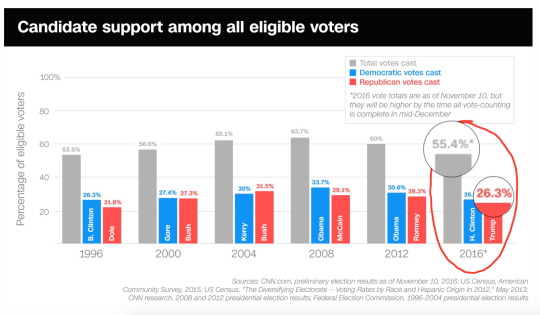
I do believe––strongly––that to denounce and vilify the quarter of the population who voted for Donald Trump would be a cataclysmic error. 
image

(graph from CNN, November 11.)

First, they are not necessarily a majority. They are a quarter of the population. One of our biggest concerns should be connecting with the other half the population, that did not feel it was necessary, important, or were unable to vote in this election. We need to determine what kept them from getting to the polls, and take action to remedy those inhibitors (be it voter suppression, political apathy, economic lack of access, whatever). If we believe that democracy and political freedom are important, we need to secure the rights necessary for those outcomes for the entire population, regardless of their political affiliation. 

Second, we need to connect with that other half of the population and determine how many of them share our concerns about the direction of the country under Donald Trump. He may be determined to turn this country into a demagogic kleptocracy on par with Russia (taking the future of the planet with it; environmentally, politically, and economically), but, at the expense of sounding like the Right and far too many member of the GOP lately, we do still have the Constitution, and this is still a country founded on the principle: By the people, for the people. 

Anyone who wants to point out that we have never lived up to that ideal is welcome to do so now. We still need to use every tool at our disposal. More importantly, we need to take action to make that ideal a reality. To borrow another slogan from the other side: freedom isn’t free. If we want a government for the people, by the people, we’re going to have to hold up our end of the bargain, and push for it. By the people

Third, we need to bridge the gap––social, economic, political––between the coasts and the middle of the country. The political response and the rhetorical and ideological alignments that Trump supporters have chosen to express their grievances are hostile and reprehensible. That does not mean that all of their grievances are baseless or based in racial anxiety. 

The social and economic dislocation that is occurring in the empty stretches of land between our borders is not all that different from the social and economic dislocation being experienced around the world as modernity and globalization fundamentally reshape and restructure our lives and livelihoods. This extremist wave is the backlash we saw once already when modernity and globalization first crept across the borders of Europe and the West, bringing to life fascism, futurism, nazism, and the first and second world wars. We are seeing it now on a larger scale in a more totalizing form. 

That dislocation must be addressed. It cannot be allowed to progress unfettered, and it is not a specter conjured in the minds of people with something to lose. It is a reality of people who are already losing what they cannot afford to do without.

That does not mean that everyone must shoulder that burden equally. This is the moment where the white citizens of America, who have lived with privilege that far outweighs their right, must prove themselves patriots, and true allies and fellow soldiers in the war for equality and community. 

We cannot allow the burden of speaking out against this hatred, and the work of building the bridges that will bring us, the majority, the disenfranchised, the precarious, together that we can aim our anger upward towards the targets deserving of it. 

We cannot afford to atomize and balkanize. To fall into pieces will be a death sentence and leave us at the doors of annihilation. Our only hope is to succeed where all our ancestors have failed, and build the coalition which sees us as dependent on one another and responsible for each other. 

We can only succeed together.

2016.11.15 : generative self-valorizing systems (the audacity of money)

Yesterday evening, in my graphic design class, we started talking about conceptual art. Our goal was to understand generative systems; systems that operate not as a complete, static organization of elements and/or information, but a set of rules that govern the organization of elements and/or information, allowing for variation, but also consistency. 

Nevertheless, we approached the question with examples from Sol LeWitt, who is known for his labor intensive conceptual art instillations. (Labor intensive, that is, for persons other than himself.) One of my classmates, who works as an illustrator, expressed her frustration and irritation with the popularity and financial success of conceptual artists. It seems unfair to her that she should expend the effort she does to achieve a high level technical and aesthetic achievement, and make no money, while these people or persons can write up instructions and take up rooms and wings of museums. 

I derailed the conversation by bringing up Damien Hirst. My opinion is split on him; I think he’s a money-grubbing, pretentious, no-talent dick, but I’ve also been greatly moved by at least one of his pieces

In the course of distraction, I came upon a sudden realization. 

The relationship between banking and art is generally recognized. I recommend this piece from The Believer, December, 2012, I believe it is the one that first introduced me Damien Hirst’s famous diamond encrusted skull

Currently, conceptual art is all the rage. I don’t think this is a mere side-effect of post-modernism. We have not exited the aesthetic age, and entered one dominated by the theoretical, nor is this a world of plastic ideas. The reason for the popularity of conceptual art lies with bankers.

We live in the age of finance capitalism. I have a penchant for Italian Marxists (Franco “Bifo” Berardi, Maurizio Lazzarato) whom I fully recognize are far enough out in left field to border on the incomprehensible. (Though I believe that their analyses and concerns are more discerning than most.) 

Finance capitalism is defined by perpetual valorization of non-material capital. The financial machine of the stock market, the one that invented the nihilistic derivative assets that blew a hole in the global economy, the one that consistently over-values enterprises with no clear means of profit production (Uber, Twitter, et. al.), is, literally, a market of ideas. 

They pour money into blackholes with everyone else’s money, and somehow transform that money into more money, until, suddenly, the bottom falls out from underneath them. (Then the money comes out of the real labor and real capital production and real earning power of the general populace, who run the rat race everyday to feed their families––no diamond encrusted skulls to be found.)

Of course finance capitalism spends its unspendable quantities of money on art that jumps, fully formed, from the head of the artist. The technical and physical labor that goes into the works are not the sources of value, and not the ones who will see the true profit. The money will go to the man with the gall to think he can sell such a thing to someone, and the children dying in the wars in Africa to bring us the diamonds and the gold and the shiny pieces that keep our entire immaterial infrastructures alive and beeping will see only hunger and death.

 The bankers know how the system really works––you don’t pay the farmer or the miner or the paint mixer. 

You pay only the broker. 

2016.11.14 : a heavy weight on the tongue

What I thought would be a quick poetry reading last night, ended up being a triple bill concert, with a number of other poets featured in addition to the friend I had come to see. 

The unexpected is asserting itself as the new normal. 

Meanwhile, I find myself having an old argument with a new person because all the people in my life think they understand the advising system of the University I attend that none of them knows anything about. I understand what other university systems are like, and I understand that what I’m describing sounds obviously flawed. But I have tried a number of variations in my approach to academic advising, from among a variety of resources available to me. 

The result is the same: the graduation rubric is on the academic management system, and your transcript fills the advising report in neatly as you take classes. All academic advisors use the same system I have access to, with a limited number of advanced privileges and print out the same report that I printed out this September. Their explanations have always felt muddled and uninspired. Furthermore, each advisor is firmly ensconced in their own little corner of the university, each department can advise nothing beyond their own department, and any interdisciplinary impulse on the part of the student is within the realm of their own initiative. 

The thing that has gotten me into the most amount of trouble with academic institutions since they started letting me make my own choices is that I am loathe to follow a linear course of study. Everything is relevant, and translation is the only thing that has ever really interested me. All I want is to ensure that the economists and the journalists and the political scientists and the biologists and the social theorists and the carpenters and teachers and the historians can speak to one another. I have failed to cultivate sustained attention.

So for each thing I have attempted to achieve, I have spread myself thin, and gone from room to room, speaking to each individual who might maybe be able to tell me what I need to know. No one sits me down and asks me, What do you want to do?

I’m left to my own devices and make do with what I find. 

Ravenous desperation has done the rest of the damage. 

I have picked the things that look like they would make me happy rather than those that would check the right little box, because I don’t want to do things because someone told me to, when I could do something that will change my world. Every scheduling conflict and external demand that has disrupted my intellectual gluttony has destroyed entire years of schooling. 

There is bitterness, year by year, for the things that had to be sacrificed in the name of progress, in the name of requirement, in the name of bigger and better things. 

It would be nice, if, now and again, people took me on faith. If they, those people whose time and energy and opinion I value, would put aside their worldly knowledge for the span of time it takes to ask me a question, or even let out a thoughtful hum, rather than instantly telling me that I must be doing something wrong. 

Right now, charity is hard to come by. Bitterness is all too accessible, and the weight of the expectations of past and future is heavy on all our shoulders. I’m trying to be open. I’m trying to be kind. But systems are always an uphill battle, and resentment will always be my weakness. 

2016.11.11 : the politics of multiplicity, a personal history.

It seems like the entire country is arguing about who is at fault for the recent election results. Who is more disconnected from America? Who is more self-righteous? Who understands the country least?

Meanwhile, I have been struggling to understand how ethnic or religious discriminatory rhetoric works. My go-to example has been the bankers. Why hate the bankers because “they’re Jewish” when you can hate them because they nearly destroyed the global economy? The first seems like a pathetic comparison to the latter. The latter cannot be denied and, more importantly, actively impacted every single person in this country in a negative fashion. 

I have long known that my experiences growing up where markedly different than the “average” American experience, or, more correctly phrased, the “average” experience of any “native national” citizen. 

I always begin with my elementary school education, but it begins before that; I grew up speaking two languages at home, Greek and English. And spent summers in a foreign country––one I nevertheless called “home”––amongst people who seemed to find me to be unheimlich, the familiar-strange. I did and didn’t speak like them, and looked and didn’t look like them, missing all the the wrong things to be the same, and all the right ones to be truly foreign. 

Then my parents sent me to a French-American school, where not only did I learn another language, but we began to learn how to be French. The French education system is a marvel, a perfectly calibrated colonial machine that can destroy borders and turn even native-born American citizens into tiny French nationalists. 

More importantly, of all the children in my class only two had parents who spoke only English, and of the “white” children, most came from families that would not be considered “American”. We were not diverse in racial distribution, but by age 8, I knew knew families hailing from more than one part of the Middle East, from a variety of places in north and west Africa, a Jewish family, a lesbian household, interracial parents, Muslim families, and any number of hyphenated Americans, and people who spoke more than English at home. 

I was floored when a friend told me he didn’t meet a Black person until after he finished elementary school. 

When I attempt to imagine getting to 18 without meeting someone Jewish, or Black, or bilingual, I am literally incapable of generating a workable facsimile of that experience. Never mind, living an entire lifetime like that. 

It seems stupid to say it, but just as there are people who have no framework for what a Jewish person is, or says, or does, besides what they see on TV or hear in church, I have no framework for having never met a Jewish person. My life is sheltered and devoid of much conflict and difficulty, but it has always been replete with individual variety. 

Growing up, my blond haired, blue eyed, male, English speaking, American best friend was the oddity. And I learned to get past it. Sure, it was odd that his parents couldn’t help him with his homework, and that they didn’t come from somewhere else, but people still learned to confuse us for siblings. 

I’ve always lived in the melting pot of America. I don’t know how to live somewhere else.