11.02.2016 : we caged the wrong bird, again

The month of October nominated me the political theater reviewer for Fathom magazine, a new critical theater review in Providence, RI. With the election looming, everything continues to concern itself with Donald Trump, like some kind of played out reality TV nightmare.

In my final semester of school at UMass Amherst, before my brief sabbatical from formal education I took a class on Art and Politics. My midterm paper had a portion dedicated to the performance of politics.

Specifically I was interested in the way sartorial standards and expectations (the politician’s costume, if you will) was wielded like a weapon against the Greek SYRIZA government. Their lack of ties and unorthodox dress made headlines, with the EU parliament and the European media happy to police neckwear standards and expectations rather than engage with the economic demands and policy plans put forth by the party.

(Ultimately, SYRIZA has proven to be an ineffectual rookie government, their willingness and ability to affect change and effectively manage the deluge of economic and humanitarian disaster pouring into the country as absent as their predecessors’.

Nevertheless, the IMF and economists around the world have reversed their position on the responsibility and utility of austerity to restore economic solvency. A fact that perhaps should have been addressed when the open-collared politicians stated it at the beginning.)

Meanwhile, American politics has reached the apotheosis of two decades where incremental changes have been made to the accepted performance of politics. Whether it was the moment that Newt Gingrich took over as speaker of the House in the 90s, or when the public accepted a fictitious pretext for a war that has lasted a decade, when the government was shut down for the first time, or the second time, or when in response to the unexpected and inexplicable massacre of school children elected officials explicitly chose to do nothing to mitigate the possibility of another occurrence, or perhaps it was Sarah Palin taking the stage as a Vice Presidential candidate and incoherently providing non-answers to questions posed at the debate.

It could have been any or all of these things, but we now have a man who has made sexually suggestive comments about his own daughter, and whose notoriety is built on fictions spun on both reality and news television.

We have given up on avoiding explicit racism, and forced news casters to come up with synonyms for the word “pussy”–which they felt unable to say, but none the less were obligated by political saliency to address (though perhaps not at the length with which they did). Until enough people got tired of skirting around the issue and made the word an expected part of political commentary.

All we have learned is that there are an infinite number of ways to avoid having to engage with economic and political realities, that social crises of violence against people of color and women and other marginalized communities can be swept aside with the swivel of a camera and that outrage is the least of the sorrows released from Pandora’s box.

How long ago it seems that we were holding onto that last beautiful gift from that same box? What wouldn’t we give for hope to seem like enough?

deselinord-photo:

Last night you went out and no one took your picture.

Seekonk, MA. October 27, 2016.

2016.10.27 : mechanics of knowledge, knowledge of mechanics

We’re fast approaching the end of October––one of my favorite months––and everything still seems like a rollercoaster. Today is already better than the entirety of the week the preceded it: I am awake, exercised, showered, dressed, and breakfasted and all before 9AM. 

I worry that I’m overdoing it; I signed up for a $10/mo. subscription to the intelligence analysis company Stratfor, which I probably can’t, technically, afford. But I’m a sucker for a good media subscription deal, and even more of a sucker for that foreign policy/global intelligence analysis. 

My list of newsletters and media outlets continues to grow. As does the number of tabs open in my browser of articles I would like to read, soon. (The riff ends up being something more akin to “How now is soon?”)


Meanwhile, I’m taking a design class, and we’re moving on to 3D objects this week. Having done a certain amount of playing/learning with an object of our choice (rendered into a silhouette in Illustrator, or your prefered vector graphics program). We must now design packaging for said object––three variations. To determine our approach, we must research the object, and develop a word (ideal) or phrase (acceptable) that conveys a thematic aspect of our object.

It turns out that researching the history of the gear, while interesting, is unlikely to provide the sort of information that will genuinely help me develop a thematic understanding of the part. The history of the gear dates back to the 4th c. BCE in Asia and approximately the year 150 BCE in Europe. It is one of the most basic and fundamental parts of mechanical engineering. But I want something more nuanced that “fundamental”. 

Ultimately, having spent no small amount of time learning about gear sizing. Specifically the importance and measurement of a gear’s “module” (read an expert explanation here) I think that “precision” is the gear’s most important and engaging thematic aspect. 


Gear sizing is determined at the level of its teeth. For two gears to work together, they must fit together. Therefore, their teeth must apply and react to pressure at the same point along their height. This place where pressure is exerted on and/or transferred to an object is known as the line of action, or line of pressure. On a gear tooth, it is at a point roughly at the center of the tooth height. 

This “center” of the gear tooth falls along what is known as the pitch diameter or pitch circle. This measurement is crucial to determining whether or not two gears will fit together. 

The gear module or modulus, which is designated as m, is the ratio of the pitch diameter (d) to the number of teeth on the gear (N). Also expressed as:

m = d/N

It is usually given with implied units; in SI those are millimeters (mm) and in BG those are inches (in). 

It can also be understood as the gear’s diametrical pitch, which is literally the number of teeth per mm (or whichever unit of measurement is being used) of pitch diameter. 

That is to say: an m of 10mm, means that each gear is 10 mm across at the height of the pitch diameter. 

Ultimately, this means that the number of teeth on a gear is fixed, because it is determined by the gear’s module (and therefore its pitch diameter) and its root diameter (how big the gear is). 

All of this is carefully designed, manufactured, and tested; in clean rooms, where not even a particle of dirt can throw off the measurements of a gear’s modulus.  

The Female Corps(e)

The dressing room has a brightly lit pedestal, and we look back at ourselves from three walls. We stand on it and twist our shoulders and hips, crane our necks, examining ourselves from all sides as infinite, increasingly crooked copies of ourselves list sideways and disappear into the murky darkness of the mirrored mirrored mirrored reflection.

We’ve all done it; fourteen-year-old girls and married women and middle aged women and old women do the anxious, preening dance that the mirrors inspire. But our gaze is always critical – how does the cloth fall? Does it show too much? Does it cover the right things? Is it really me?

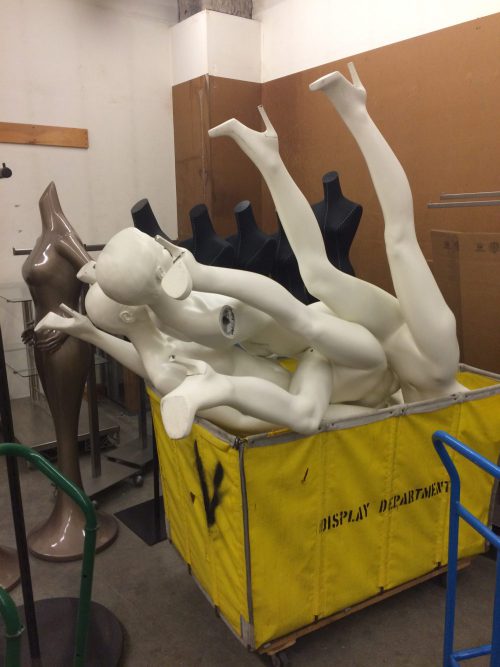
The perfected female form – handed down to us through fine art books and museums from the Ancient Greeks – is a sculpted, smooth, white body without a head.

IMG_1845

perfection, discarded.

This paragon of beauty reminds us that our bodies are just objects: mere vessels for that which truly makes us human.

The eyes are the windows to the soul – it is no wonder then that the mannequins in the storefront have smooth, anonymous faces.

But that’s no different than the statues in the museums, their features weathered away by time and rain and nature, making lepers of the ones that still have heads. Otherwise, smooth, marble shoulders sweep up into elegant stumps, and we make eye contact with empty space.

Historically, young English lords made off the easily carried heads of the statues in Greece—the pillage of the Classical by the Romantic—and doing so, took with them whatever expressions those statutes might have made, the rest of us have to make do with what was left.

Friends, family, sales associates are always quick to remind us: the lights in the dressing room are unnaturally unflattering. But the critical gaze, the self-critical gaze, the critical self-gaze, knows every imperfection. We seek them out and itemize them, exacerbate them, magnify them, and when we gives them voice, we are met with confusion and incomprehension from our audience. There is nothing that will more quickly imbue us with a sense of alienation, of insanity, than attempting to explain our physical imperfections. Our audience—those same friends, family, sales associates—will always assure us that our flaws are either not as noticeable as they might appear, or that they cannot see those things that are so obvious to us. But we know they are there.

One of the two, either the eyes or the audience, has to be lying. Which to trust?

We know to doubt our own vision of ourselves, just as we are not as smart as we think we are, as commanding as we hope to be, or as confident as we pretend, we must equally not be as ugly as we imagine. But if we are not ugly, then how come the clothes never fit? How come we cannot find pants or shirts or sweaters that flatter our bodies? Our audience must be lying, because clearly we were made wrong, a store full of clothes none of which fit like they should, someone must fit into them…

If only it were easy for the secret to reveal itself: we are all built wrong, or rather, our bodies, as imagined—smooth, white, hard, all angles and swooping curves, no softness, no quiet surrenders to gravity or time, limited by musculature and tendon flexibility—are beyond the alchemy of elastic underwear, liposuction, gym memberships, early morning work outs, calorie counting, and anorexia. Our pathetically human flesh can never compare to life-like marble. We can only glitter in the sun with the help of expensive, mass manufactured powders, salves and elixirs that promise that lit from within glow.

All we can do is catalogue all we see when we stand on that pedestal and hope for the time, money, and energy to manufacture our best selves; rigid, stony perfection, on a box, inside a little velvet rope enclosure with a sign that says Please, do not touch.


At least 70 people died when a suicide bomber attacked a group of mourners at a hospital in the Pakistani city of Quetta. Lawyers and journalists had gathered following the shooting of a prominent lawyer earlier on Monday. Both Jamaat-ur-Ahrar (a faction of the Pakistani Taliban) and Islamic State claimed responsibility.

— from The Economist Espresso, August 9, 2016

One of them is lying. (Possibly even both of them.) The perpetrator is dead—we have no way of knowing for sure. Why give either of them credit?