Is 80% “good enough”? Thoughts on Internet Penetration is Franklin County

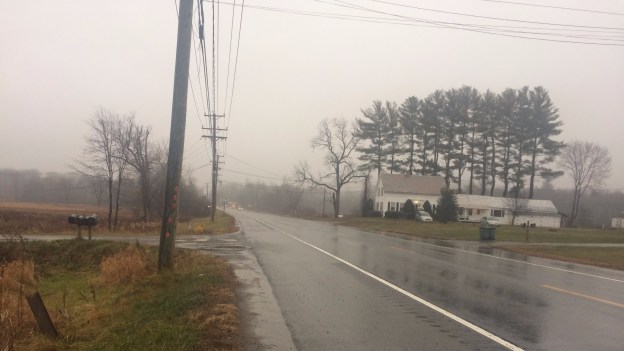
Yesterday in the car, driving along Route 47, my friend said, “Wow, Sunderland really is just a lot of land.”

As a student at a large state university, it is strange to think about my current home as being “rural”. Nevertheless, that is exactly what it is, don’t let the pizza place or the laundromat fool you. The stretch of land between routes 116 and 47 is farmland, when it’s been cultivated or put to use at all.

The definition is elusive for the reason that many things are in New England, unless you’re overlooking the ocean; it’s hard to see much of anything at all with all the hills and trees interrupting your vision. The university helps hide it as well. The migrant population of tens of thousands of young bodies is reason enough for a reasonably extensive public transit system and provides more than enough indenture to build and maintain any number of housing complexes, which cause little related businesses to sprout up to attend to the needs they create (like pizza and laundry).

Without thinking about the landscape at all I’ve been contemplating what it means to be a rural area. In a fit of frustration about the cost of our telecoms utilities, I started looking to see if there were alternatives to our current subscription.

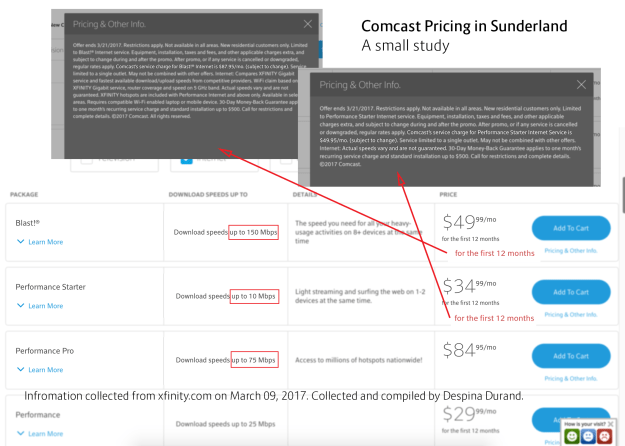
In the process, I visited BroadbandNow, a site which bills itself as a consumer interest group, looking to provide information on the services and available to a person in every county in every state in the US. Of the three options in Franklin County, in Western MA, only  one provider achieves the minimum download speed necessary for “broadband internet”. The FCC has set “broadband” speed as a minimum of 25 Mbps (megabits per second) download speed and a 3 Mbps upload speed. Xfinity by Comcast is your only choice if you want broadband internet. Their promotional first year rate is approximately $35/mo. if you keep their service for over a year, it goes up to nearly $90/mo.
comcast pricing-Recovered

Graphic displaying promotional vs. actual internet subscription rates from Comcast.

The thing that got me stuck on this issue is from the little factoids that run along the side of the BroadbandNow website when you look up a particular region. There’s a little box there that reads, “Approximately 5,000 people in Franklin County don’t have access to any wired internet.” It’s unclear if the other number, 14,000, which is the number of people who don’t have access to internet with a speed of 25 Mbps or higher, is inclusive of the 5,000 who don’t have any wired internet at all. To a degree, I’m not entirely sure that it matters. What I can tell you, from looking at the maps of “underserved” or “unserved” towns, is that Wendell, MA, 33 minutes away from the University by car, has no cable or DSL at all. Leverett, 13 minutes away, and Shutesbury, 19 minutes away, have only partial DSL, and no cable internet at all.

If you overlay the maps of the underserved towns, over the map of wireless broadband access, you’ll see that most of Franklin County only has mobile wireless.

I don’t know for absolutely sure, but I imagine that this is what it means to feel left out of the political conversation. The Internet was supposed to be the wave of the future; this was going to connect everyone to everyone else, make us all equals in a massive interconnected conversation. But, in this, as in most things, it seems that some are more connected, and more equal, than others.

2017.03.01 : a dinner party

The lights are indirect, but bright so that you can see everyone’s faces. Ideally, conversation is easy, clumped here and there, the table might be best to be round, for maximum interlocution and ability to eavesdrop, but in my head, it is nevertheless, an elongated dinner table, with rounded corners, allowing the carefully planned seating arrangements to take on their intended effect and group the guests into little clumps.

Eventually, I’m sure that Umberto Eco and Italo Calvino would switch to Italian to carry on their conversation, although hopefully, for some of it, if they stick to the topic of literature and history, will be poachable. Contemporaries they are, it seems most plausible, but chance to sit and overhear is the matter at hand.

Near them, although turned to her neighbor, Virginia Woolf is likely arguing with Audre Lorde. I cannot imagine that their politics share nearly enough to encourage an amicable relationship, but hopefully there is a sparkle and flame of interchange. Common ground is still hoped for, because the dream of an intersection feminism should absolutely be transhistorical, as well as interracial and trans-national/-cultural.

At the beginning I’d maybe like to have her to myself, because I don’t know her quite so well, but Phillis Wheatley sits across from them. Sharp eyed and sharp tongued, I’m sure that she has plenty to say, and I hope the comfort the say it. Listening to her and Ms. Lorde would surely be a revelation; an unprecedented discourse of the African-American identity.

My hope is that they would stay late into the night.

Currently reading: Six Memos for the New Millennium, by Italo Calvino.
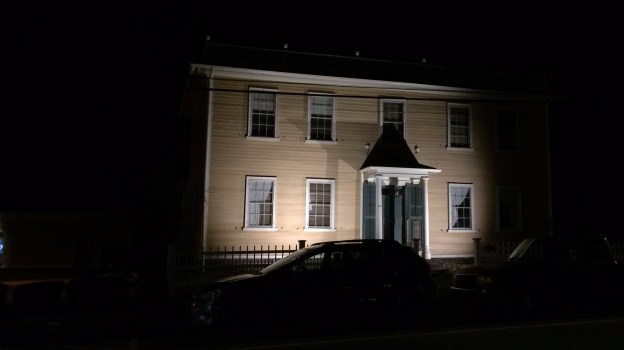
Photo: January 2017. Providence, RI.

2017.02.28 : hobbies: food.

8Sometimes we are Ouroboros; endlessly circling ourselves, unable to escape, trapped within the confines of our own thought-cycles.

Like a Lady in a Victorian novel, I’m lying in the dark, trying the calm the headache that has decided to take up residence between my temples. Exhaustion wars with boredom for the right to command my attention, and their bickering is, in itself, a trial. The trick is get them caught up in each other and to make one’s escape before either of them notice.

A surprise encounter with a friend became a pleasant extended lunch, an apology from serendipity for the absentminded abandonment of my homemade lunch. Instead of careful tupperware presentation—a single hardboiled egg cradled in a nest of salad leaves, waiting upon by squares of cheerful red pepper, on a pillow of baked sweet potato, resting on a bed of rice—I made do with the eco-recycled cardboard carry-out of a mass produced croque monsieur. The company was superior to the food, and allowed me to indulge in my distress at the unconcerned attitude towards digital privacy of a particular subset of my classmates and my favorite complaints about the election.

Today retraced old histories, starting sometime in the truly early hours of the morning, passed through a state of profound resolution, and is now slowly fading into the night in a state of ever increasing entropy.

But I met a cute dog named Luna, so not all is lost.

Currently reading: Six Memos for the New Millennium by Italo Calvino
Photo: Northampton, MA. 02.08.2017

2017.01.11 : being and doing

If you haven’t seen Jen Kirkman’s new special on Netflix Just Keep Livin’? you are seriously missing out. There is a lot of hubbub (always, but especially right now, it seems) about whether or not women are or can be funny. I’m not here to weigh in on that debate, because I know that I qualify as a woman in a certain number of circles and I happen to be hilarious.

I’m recommending Jen Kirkman because she is also hilarious, and the special opens with a great bit about meditation. 

 I bring up Ms. Kirkman because she touches on the question of street harassment in this new work. Street harassment is another topic that every seems to have an opinion on and require one from everyone else.

She brought up something that had been circling my thoughts as well, as I started to actually experience street harassment. 

(The shift had something to do with working out and dressing for my job selling women’s athletic wear. I’m sure that riding public transportation increased the probability of its occuring. But this is a digression.) 

 Kirkman does an excellent job of expressing why street harassment can make people (and by “people” we mean “women”) feel unsafe: any semi-complimentary statement about a body part could either be left at that, or could be a prelude to some kind of claiming of said body part. (“Nice ass” could be just that, or it could be followed by “How about I take that for a ride?”) 

She also covers why it makes people (and by “people” we mean “women”) feel uncomfortable: any comment about your body is a reminder that you have a body. Most of us live our lives trying to forget we have a body. Not out of self-hatred, or willful ignorance, but because when we are running to the bus stop, our biggest concern is whether or not our legs and our lungs will get us there before the bus, not whether our butt looks good in these pants. (She also incisively remarks that “nice ass” not only reminds us of our physical form, and our subjectivity, but also usually introduces the doubt “is that a real compliment? or a mockery?”) 

Finally, she provides a solution. Should you wish to say something nice to a stranger, try complimenting something they have done, rather than something they are. That is to say: compliment their outfit, their choice of shoes, their hairstyle, these all reflect choices this person has made in presenting themselves to the world. Acknowledge their effort.

This brings me to a quick story about how compliments work. Some number of years ago, when I was living in a dorm, I had exited my refuge of solitude and entered the common area to get some water. 

[unfinished]

2017.01.09 : a falsehood based on a falsehood based on a falsehood based on a falsehood based on the Bible

I’ve been racing through the last 300 or so pages of Umberto Eco’s Foucault’s Pendulum. Part of it is because I just want to be finished with it – not that it hasn’t been enjoyable – 600-page books are very, very heavy, and I’m tired of dragging it around with me, both psychologically and physically. The plot has also finally picked up speed, 400 pages in and the momentum has built enough to be palpable in the narrative. I’m on the home stretch of the last 100 pages now, and I’m fighting off the fear of finishing the book, the anticipation of catharsis and anxiety of being set adrift in reality conspiring to slow me down.

Talking with a friend last night I found myself describing how I managed to fight my way through more pages than I thought possible of material that is completely beyond the scope of my knowledge. 

In Foucault’s Pendulum, for those unfamiliar, Eco is retracing and reimagining – not so much inventing, as recombining – the literary history of Europe. Front and center are the occult mysteries of the Templars, the Rosicrucians, and then Francis Bacon, and the Freemasons, and on and on, passing through every possible text, historical moment. (My personal interests tend to reside not much earlier than the 20th century, which put me in the familiar position of letting each word of the story follow the next, without expectation or prediction, because each twist and clever allusion was entirely unexpected, hidden by ignorance.) 

Eco’s story hinges on a particularly sumptuous a form of literary magic. A story based in the writings – all real – of the great minds of Europe, each one obsessed and compelled by esoterica and mysticism, all embroiled in secret societies and public denunciations and a practice of publishing which sent texts crisscrossing and contradicting each other and helplessly interconnected across Europe, he makes up very little. Instead, he sets a stage like the one he found himself, and sets his characters up to do what he, himself, is doing: reading, reading, reading, reading, and re-positioning the puzzle pieces to create a new, fantastic picture of history. His protagonists believe in the reality of what they read as much as Eco’s reader, as much as Eco himself. That is to say, not at all. 

But slowly as they make their own fantastic story, they start to believe themselves. Each undergoes the transformation of the “psychiatrist who becomes fond of his patients, enjoying the balmy breezes that waft from the ancient park of his private clinic. After a while he begins to write pages on delirium, then pages of delirium, unaware that his sick people have seduced him.” (p. 370) But for the characters to weave a story that they can believe, Eco has to have woven that story. The book starts to cast its spell: if the fictitious characters begin to believe the story that they have written, has Eco begun to believe the story he has written? And what then of the audience? Are we, too, seduced by the tapestry that has been woven double before us?

Suddenly, where before we faced the soft focus of the reader cocooned in the story, we experience a dolly zoom and a momentary disassociation, watching ourselves read, Eco write, the protagonists scheme, and all the various and sundry of history believe. Unable to keep it in mind, the shot collapses back into itself and we turn the page.