Category Archives: Regular Mondays

The Panopticon Writings: democratic surveillance

Jeremy Bentham’s Inspection House plan, later known as the Panopticon Inspection House, and ultimately merely as the Panopticon was primed, through its meticulous planning and relegation to the imaginary, to transform into metaphor. In our evermore connected and documented way of life, it has only grown in both power and popularity in the imaginations of those who worry about surveillance. But that metaphor is a boogeyman, a monster under the bed, because it fails to preserve a few crucial elements of Bentham’s original vision. Those omitted details are the one’s which transform the Inspection House from a regime of surveillance into a radical democratization of power through visibility.
Bentham’s Inspection House operates on the premise that visibility constitutes a form of coersive power. He envisions a re/formative setting where, through the expectation of constant surveillance, those placed under inspection (be they prisoners or school children) modify their behavior to align with societal norms. Simultaneously, he envisioned a system whereby the jailer would be rendered as visible to society as those in the cells of the Inspection House are to him. He presents two forms of visibility in his letters to which the manager of the Panopticon would be subject; one direct, and the other indirect.

The first – the direct – form of visibility emerges through what one might imagine as “drop-in” visits. However, rather than limiting them to some form of official inspection, he presents a radical vision of openness regarding public buildings. He declares that the doors of the Inspection House should be open

“as […] the doors of all public establishments ought to be, […] to the body of the curious at large – the great open committee of the tribunal of the world.” 1

Here he is imagining a world where anyone can satisfy their curiosity about the treatment of the prisoners by visiting the prison, with no need for any reason, justification, or permission other than that curiosity. The scope of the statement is telling, because its implications extend beyond Bentham’s imagined establishment to the operation of all public institutions. While he acknowledges that the doors of public institutions are rarely found as inviting as he describes, he makes his implicit criticism explicit. He continues:

And who ever objects to such publicity, where it is practicable, but those whose motives for objection afford the strongest reasons for it? 2

Declaring that those in public office who wish to avoid visibility have something to hide is a bold declaration of a well-known truth.

Bentham’s second – indirect – form of visibility is through documentation. He states that the person contracted to operate the Inspection House, in return for all profit to be gained through its operation, should maintain and publish a full account of the prison’s operation.

I will then require him to disclose, and even to print and publish his accounts – the whole process and detail of his management – the whole history of the prison. 3

This publication is also to be available to all who desire to read it. This indirect form of visibility adds to the pressure for conformity to standards. Bentham also sees a productive outcome to this record keeping, for those unmoved by the moral argument. If full and complete records are kept, even a failed Inspection House becomes an opportunity for knowledge

From the information thus got from him, I derive this advantage. In the case of his ill success, I see the causes of it, and not only I, but every body else that pleases, may see the cause of it… 4

This, he explains, means that future ventures on the Inspection House model will have the chance to see and avoid the failures which beset their predecessors.

He makes two further demands on the warden which would be revolutionary in any prison system. The first is the existence of a ledger which documents all instances of punishment – not unreasonable, and a rule broadly applied. What is more telling is his vision for its usage.

A correction-book might be kept, in which every instance of chastisement, with the cause for which it was administered upon record: any the slightest act of punishment not entered to be considered as a lawless injury. 5

In the contemporary moment, when we are embroiled in a national debate regarding the use of force by law enforcement officers and other members of the security apparatus, the classification of violence on incarcerated and condemned bodies by agents of the state as illegal violence because of its indefinable or absent justification is truly radical.

His other requirement is a punitive measure to ensure the well-being of the prisoners. He says,

I would make him pay so much for ever one that died, without troubling myself whether any care of his could have kept the man alive. 6

He acknowledges that some of that cost would be covered in the original contract between the state and the private contractor running the prison. Nevertheless, this kind of broadly applied punitive measure is one which demands careful consideration. It declares, without exception, that all lives are valuable, and underwrites that assertion with a monetary value. Perhaps a distasteful premise, but one which might have enough sway to produce real change in the treatment of persons deemed inconsequential or less valuable in some social environments or interactions with the state.

At this juncture I invite you to imagine a prison whose doors are open, that “the great open committee of the tribunal of the world” may evaluate the treatment of its prisoners. One whose books and ledgers, the histories of an institution, are available to that same “body of the curious at large.” This is a vision where the state security apparatus watches its citizens, but where they watch back. In a world that recognizes the coersive power of visibility, looking upwards, demanding and seeking visibility of our public institutions is a radical democratic act. One which Jeremy Bentham was always pointing out to us.

  1. Bentham, J. The Panopticon Writings. Verso: London. 1995. p. 47-8. Letter IX 
  2. p. 48 
  3. p. 52. Letter IX 
  4. p. 53 
  5. p. 64. Letter XII 
  6. ibid

Is 80% “good enough”? Thoughts on Internet Penetration is Franklin County

Yesterday in the car, driving along Route 47, my friend said, “Wow, Sunderland really is just a lot of land.”

As a student at a large state university, it is strange to think about my current home as being “rural”. Nevertheless, that is exactly what it is, don’t let the pizza place or the laundromat fool you. The stretch of land between routes 116 and 47 is farmland, when it’s been cultivated or put to use at all.

The definition is elusive for the reason that many things are in New England, unless you’re overlooking the ocean; it’s hard to see much of anything at all with all the hills and trees interrupting your vision. The university helps hide it as well. The migrant population of tens of thousands of young bodies is reason enough for a reasonably extensive public transit system and provides more than enough indenture to build and maintain any number of housing complexes, which cause little related businesses to sprout up to attend to the needs they create (like pizza and laundry).

Without thinking about the landscape at all I’ve been contemplating what it means to be a rural area. In a fit of frustration about the cost of our telecoms utilities, I started looking to see if there were alternatives to our current subscription.

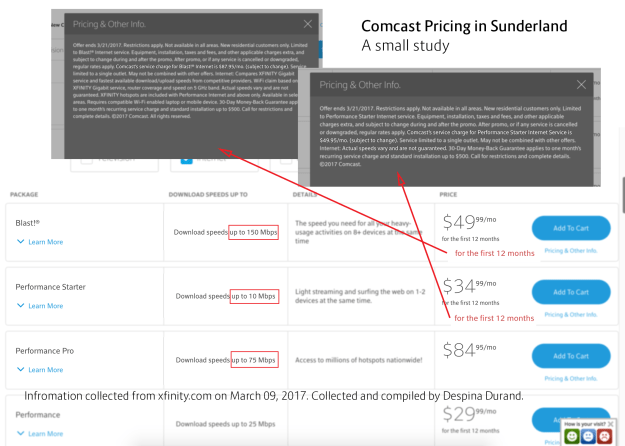
In the process, I visited BroadbandNow, a site which bills itself as a consumer interest group, looking to provide information on the services and available to a person in every county in every state in the US. Of the three options in Franklin County, in Western MA, only  one provider achieves the minimum download speed necessary for “broadband internet”. The FCC has set “broadband” speed as a minimum of 25 Mbps (megabits per second) download speed and a 3 Mbps upload speed. Xfinity by Comcast is your only choice if you want broadband internet. Their promotional first year rate is approximately $35/mo. if you keep their service for over a year, it goes up to nearly $90/mo.

comcast pricing-Recovered

Graphic displaying promotional vs. actual internet subscription rates from Comcast.

The thing that got me stuck on this issue is from the little factoids that run along the side of the BroadbandNow website when you look up a particular region. There’s a little box there that reads, “Approximately 5,000 people in Franklin County don’t have access to any wired internet.” It’s unclear if the other number, 14,000, which is the number of people who don’t have access to internet with a speed of 25 Mbps or higher, is inclusive of the 5,000 who don’t have any wired internet at all. To a degree, I’m not entirely sure that it matters. What I can tell you, from looking at the maps of “underserved” or “unserved” towns, is that Wendell, MA, 33 minutes away from the University by car, has no cable or DSL at all. Leverett, 13 minutes away, and Shutesbury, 19 minutes away, have only partial DSL, and no cable internet at all.

If you overlay the maps of the underserved towns, over the map of wireless broadband access, you’ll see that most of Franklin County only has mobile wireless.

I don’t know for absolutely sure, but I imagine that this is what it means to feel left out of the political conversation. The Internet was supposed to be the wave of the future; this was going to connect everyone to everyone else, make us all equals in a massive interconnected conversation. But, in this, as in most things, it seems that some are more connected, and more equal, than others.

2017.02.28 : hobbies: food.

8Sometimes we are Ouroboros; endlessly circling ourselves, unable to escape, trapped within the confines of our own thought-cycles.

Like a Lady in a Victorian novel, I’m lying in the dark, trying the calm the headache that has decided to take up residence between my temples. Exhaustion wars with boredom for the right to command my attention, and their bickering is, in itself, a trial. The trick is get them caught up in each other and to make one’s escape before either of them notice.

A surprise encounter with a friend became a pleasant extended lunch, an apology from serendipity for the absentminded abandonment of my homemade lunch. Instead of careful tupperware presentation—a single hardboiled egg cradled in a nest of salad leaves, waiting upon by squares of cheerful red pepper, on a pillow of baked sweet potato, resting on a bed of rice—I made do with the eco-recycled cardboard carry-out of a mass produced croque monsieur. The company was superior to the food, and allowed me to indulge in my distress at the unconcerned attitude towards digital privacy of a particular subset of my classmates and my favorite complaints about the election.

Today retraced old histories, starting sometime in the truly early hours of the morning, passed through a state of profound resolution, and is now slowly fading into the night in a state of ever increasing entropy.

But I met a cute dog named Luna, so not all is lost.

Currently reading: Six Memos for the New Millennium by Italo Calvino
Photo: Northampton, MA. 02.08.2017

2017.01.09 : a falsehood based on a falsehood based on a falsehood based on a falsehood based on the Bible

I’ve been racing through the last 300 or so pages of Umberto Eco’s Foucault’s Pendulum. Part of it is because I just want to be finished with it – not that it hasn’t been enjoyable – 600-page books are very, very heavy, and I’m tired of dragging it around with me, both psychologically and physically. The plot has also finally picked up speed, 400 pages in and the momentum has built enough to be palpable in the narrative. I’m on the home stretch of the last 100 pages now, and I’m fighting off the fear of finishing the book, the anticipation of catharsis and anxiety of being set adrift in reality conspiring to slow me down.

Talking with a friend last night I found myself describing how I managed to fight my way through more pages than I thought possible of material that is completely beyond the scope of my knowledge. 

In Foucault’s Pendulum, for those unfamiliar, Eco is retracing and reimagining – not so much inventing, as recombining – the literary history of Europe. Front and center are the occult mysteries of the Templars, the Rosicrucians, and then Francis Bacon, and the Freemasons, and on and on, passing through every possible text, historical moment. (My personal interests tend to reside not much earlier than the 20th century, which put me in the familiar position of letting each word of the story follow the next, without expectation or prediction, because each twist and clever allusion was entirely unexpected, hidden by ignorance.) 

Eco’s story hinges on a particularly sumptuous a form of literary magic. A story based in the writings – all real – of the great minds of Europe, each one obsessed and compelled by esoterica and mysticism, all embroiled in secret societies and public denunciations and a practice of publishing which sent texts crisscrossing and contradicting each other and helplessly interconnected across Europe, he makes up very little. Instead, he sets a stage like the one he found himself, and sets his characters up to do what he, himself, is doing: reading, reading, reading, reading, and re-positioning the puzzle pieces to create a new, fantastic picture of history. His protagonists believe in the reality of what they read as much as Eco’s reader, as much as Eco himself. That is to say, not at all. 

But slowly as they make their own fantastic story, they start to believe themselves. Each undergoes the transformation of the “psychiatrist who becomes fond of his patients, enjoying the balmy breezes that waft from the ancient park of his private clinic. After a while he begins to write pages on delirium, then pages of delirium, unaware that his sick people have seduced him.” (p. 370) But for the characters to weave a story that they can believe, Eco has to have woven that story. The book starts to cast its spell: if the fictitious characters begin to believe the story that they have written, has Eco begun to believe the story he has written? And what then of the audience? Are we, too, seduced by the tapestry that has been woven double before us?

Suddenly, where before we faced the soft focus of the reader cocooned in the story, we experience a dolly zoom and a momentary disassociation, watching ourselves read, Eco write, the protagonists scheme, and all the various and sundry of history believe. Unable to keep it in mind, the shot collapses back into itself and we turn the page.

2017.01.06 :

There are so many big and important things to say, but I’ve been sick for the last three days, and don’t necessarily show that much sign of getting markedly better any time soon. Today I spent swaddled up to my ears in warm clothing and blankets, with my nose buried in Umberto Eco’s Foucault’s Pendulum, of which I understand remarkably little, but am enjoying very much.

In cleaning out some bits of our third floor (what we consider the attic, but which is a fully furnished living space with a crawlspace above), we determined that it was finally time to send a paper model of a magic castle that I had “helped” my father construct at some young age on its final journey. I found myself confessing to my mother that I had found the castle underwhelming as a child because it was inert. Some part of me expected the paper magic castle to come to life and was wholly disappointed when it did not.

I have since come to understand that the pleasure to be found with models of any kind is in the building. I’m not sure that I will ever develop a taste for it, if that is the case, as I do not believe I have entirely lost the expectation of independent motion from my creations.

It’s tough to describe, because as a dyed in the wool atheist materialist, I am not a believer in the occult, the spiritual, or the fantastic. Yet nevertheless, a healthy diet of fantasy novels in my childhood meant that I have lived with the expectation that at any moment books will move about or rearrange their contents or their characters will leap fully formed from the page, or that the darkness in my closet hides some terrible lurking beast or secret which I can almost see when the lights are out, or in fact, that all houses have secret doors which open into new, magical, terrifying places.

As an only child, my best companions were the ones I couldn’t see: be they story book characters or colorful personas that would parade through my mind, given life through my flesh or the bodies of my dolls and toys. I remember terrifying myself with a demon slaying epic I composed to a early 2000s European trance song. I played it out with a friend, and to this day wonder if he felt the bite of anxious urgency and real danger that flooded through me.

I believe and don’t believe, or rather, in the words of the famous X-Files mantra: I want to believe. I have always wanted to believe, and have very nearly managed it by letting myself get completely carried away by the words that make up the stories that paint vivid, damn near tangible images in my head.

Reading Cornelia Funke’s Inkheart as a child was so desperately bittersweet: I always knew my father had the kind of voice that would be able to bring characters out of the pages of a book and into real life. He’d very nearly succeeded with The Hobbit and Alice in Wonderland and the early Harry Potter books because I remembered those places, knew the faces of all those people, had walked with them and heard them, and gone on fantastic adventures with them. I could still remember what that was like. But never had any of the characters sat with me, or spoken with me, sitting on my bed, in my room, like Dustfinger did.

Her novels were the moment where I stepped back from fantasy, and distanced myself from reading, because it had started to hurt. I think I’ve only read The Thief Lord once, because the adventure was so good, and the characters so vibrant and engaging that I couldn’t bear the thought of visiting them again, only to have to part ways at the end of the book.

My mother and I have a long standing disagreement about the nature of books, and stories. She says the the end of any book is immaterial, because you can start over from the beginning, when no one as died, no adventures have been had, nothing is over, you can just do it all again, and again, and again. But I say that this isn’t true. Once the book is read all the way through, the ending is always the same. If you start over, the adventures have already been had, and the ending is written; those who will die, will die and have already died, and those who will live have already lived and already suffered.

I can’t remember, now, if my little fantasy worlds offered the chance of redemption. I know I spun narrative threads and kept them going as long as someone wanted to play, but I don’t remember if some endings were set in stone: if you could play through the European trance epic and slay all the demons, or if you, the hero, had to perish as the bass throbbed and the synthesizer​ faded out. My stories have always tended towards the cyclical and the fated. I have never been surprised that all roads lead to destiny, because prophesy is merely the art of reading the final chapter of the story before the hero has gotten there.