Category Archives: Personal

2017.02.28 : hobbies: food.

8Sometimes we are Ouroboros; endlessly circling ourselves, unable to escape, trapped within the confines of our own thought-cycles.

Like a Lady in a Victorian novel, I’m lying in the dark, trying the calm the headache that has decided to take up residence between my temples. Exhaustion wars with boredom for the right to command my attention, and their bickering is, in itself, a trial. The trick is get them caught up in each other and to make one’s escape before either of them notice.

A surprise encounter with a friend became a pleasant extended lunch, an apology from serendipity for the absentminded abandonment of my homemade lunch. Instead of careful tupperware presentation—a single hardboiled egg cradled in a nest of salad leaves, waiting upon by squares of cheerful red pepper, on a pillow of baked sweet potato, resting on a bed of rice—I made do with the eco-recycled cardboard carry-out of a mass produced croque monsieur. The company was superior to the food, and allowed me to indulge in my distress at the unconcerned attitude towards digital privacy of a particular subset of my classmates and my favorite complaints about the election.

Today retraced old histories, starting sometime in the truly early hours of the morning, passed through a state of profound resolution, and is now slowly fading into the night in a state of ever increasing entropy.

But I met a cute dog named Luna, so not all is lost.

Currently reading: Six Memos for the New Millennium by Italo Calvino
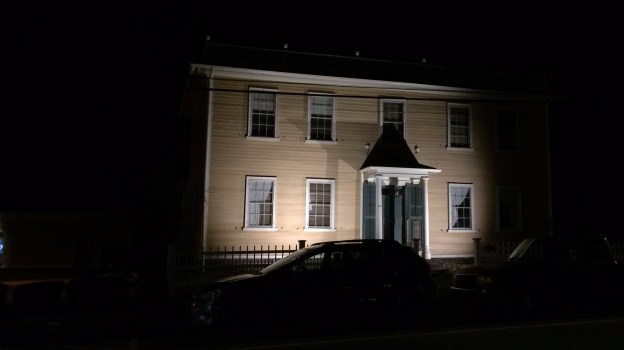
Photo: Northampton, MA. 02.08.2017

2017.01.11 : being and doing

If you haven’t seen Jen Kirkman’s new special on Netflix Just Keep Livin’? you are seriously missing out. There is a lot of hubbub (always, but especially right now, it seems) about whether or not women are or can be funny. I’m not here to weigh in on that debate, because I know that I qualify as a woman in a certain number of circles and I happen to be hilarious.

I’m recommending Jen Kirkman because she is also hilarious, and the special opens with a great bit about meditation. 

 I bring up Ms. Kirkman because she touches on the question of street harassment in this new work. Street harassment is another topic that every seems to have an opinion on and require one from everyone else.

She brought up something that had been circling my thoughts as well, as I started to actually experience street harassment. 

(The shift had something to do with working out and dressing for my job selling women’s athletic wear. I’m sure that riding public transportation increased the probability of its occuring. But this is a digression.) 

 Kirkman does an excellent job of expressing why street harassment can make people (and by “people” we mean “women”) feel unsafe: any semi-complimentary statement about a body part could either be left at that, or could be a prelude to some kind of claiming of said body part. (“Nice ass” could be just that, or it could be followed by “How about I take that for a ride?”) 

She also covers why it makes people (and by “people” we mean “women”) feel uncomfortable: any comment about your body is a reminder that you have a body. Most of us live our lives trying to forget we have a body. Not out of self-hatred, or willful ignorance, but because when we are running to the bus stop, our biggest concern is whether or not our legs and our lungs will get us there before the bus, not whether our butt looks good in these pants. (She also incisively remarks that “nice ass” not only reminds us of our physical form, and our subjectivity, but also usually introduces the doubt “is that a real compliment? or a mockery?”) 

Finally, she provides a solution. Should you wish to say something nice to a stranger, try complimenting something they have done, rather than something they are. That is to say: compliment their outfit, their choice of shoes, their hairstyle, these all reflect choices this person has made in presenting themselves to the world. Acknowledge their effort.

This brings me to a quick story about how compliments work. Some number of years ago, when I was living in a dorm, I had exited my refuge of solitude and entered the common area to get some water. 

[unfinished]

2017.01.09 : a falsehood based on a falsehood based on a falsehood based on a falsehood based on the Bible

I’ve been racing through the last 300 or so pages of Umberto Eco’s Foucault’s Pendulum. Part of it is because I just want to be finished with it – not that it hasn’t been enjoyable – 600-page books are very, very heavy, and I’m tired of dragging it around with me, both psychologically and physically. The plot has also finally picked up speed, 400 pages in and the momentum has built enough to be palpable in the narrative. I’m on the home stretch of the last 100 pages now, and I’m fighting off the fear of finishing the book, the anticipation of catharsis and anxiety of being set adrift in reality conspiring to slow me down.

Talking with a friend last night I found myself describing how I managed to fight my way through more pages than I thought possible of material that is completely beyond the scope of my knowledge. 

In Foucault’s Pendulum, for those unfamiliar, Eco is retracing and reimagining – not so much inventing, as recombining – the literary history of Europe. Front and center are the occult mysteries of the Templars, the Rosicrucians, and then Francis Bacon, and the Freemasons, and on and on, passing through every possible text, historical moment. (My personal interests tend to reside not much earlier than the 20th century, which put me in the familiar position of letting each word of the story follow the next, without expectation or prediction, because each twist and clever allusion was entirely unexpected, hidden by ignorance.) 

Eco’s story hinges on a particularly sumptuous a form of literary magic. A story based in the writings – all real – of the great minds of Europe, each one obsessed and compelled by esoterica and mysticism, all embroiled in secret societies and public denunciations and a practice of publishing which sent texts crisscrossing and contradicting each other and helplessly interconnected across Europe, he makes up very little. Instead, he sets a stage like the one he found himself, and sets his characters up to do what he, himself, is doing: reading, reading, reading, reading, and re-positioning the puzzle pieces to create a new, fantastic picture of history. His protagonists believe in the reality of what they read as much as Eco’s reader, as much as Eco himself. That is to say, not at all. 

But slowly as they make their own fantastic story, they start to believe themselves. Each undergoes the transformation of the “psychiatrist who becomes fond of his patients, enjoying the balmy breezes that waft from the ancient park of his private clinic. After a while he begins to write pages on delirium, then pages of delirium, unaware that his sick people have seduced him.” (p. 370) But for the characters to weave a story that they can believe, Eco has to have woven that story. The book starts to cast its spell: if the fictitious characters begin to believe the story that they have written, has Eco begun to believe the story he has written? And what then of the audience? Are we, too, seduced by the tapestry that has been woven double before us?

Suddenly, where before we faced the soft focus of the reader cocooned in the story, we experience a dolly zoom and a momentary disassociation, watching ourselves read, Eco write, the protagonists scheme, and all the various and sundry of history believe. Unable to keep it in mind, the shot collapses back into itself and we turn the page.

2017.01.06 :

There are so many big and important things to say, but I’ve been sick for the last three days, and don’t necessarily show that much sign of getting markedly better any time soon. Today I spent swaddled up to my ears in warm clothing and blankets, with my nose buried in Umberto Eco’s Foucault’s Pendulum, of which I understand remarkably little, but am enjoying very much.

In cleaning out some bits of our third floor (what we consider the attic, but which is a fully furnished living space with a crawlspace above), we determined that it was finally time to send a paper model of a magic castle that I had “helped” my father construct at some young age on its final journey. I found myself confessing to my mother that I had found the castle underwhelming as a child because it was inert. Some part of me expected the paper magic castle to come to life and was wholly disappointed when it did not.

I have since come to understand that the pleasure to be found with models of any kind is in the building. I’m not sure that I will ever develop a taste for it, if that is the case, as I do not believe I have entirely lost the expectation of independent motion from my creations.

It’s tough to describe, because as a dyed in the wool atheist materialist, I am not a believer in the occult, the spiritual, or the fantastic. Yet nevertheless, a healthy diet of fantasy novels in my childhood meant that I have lived with the expectation that at any moment books will move about or rearrange their contents or their characters will leap fully formed from the page, or that the darkness in my closet hides some terrible lurking beast or secret which I can almost see when the lights are out, or in fact, that all houses have secret doors which open into new, magical, terrifying places.

As an only child, my best companions were the ones I couldn’t see: be they story book characters or colorful personas that would parade through my mind, given life through my flesh or the bodies of my dolls and toys. I remember terrifying myself with a demon slaying epic I composed to a early 2000s European trance song. I played it out with a friend, and to this day wonder if he felt the bite of anxious urgency and real danger that flooded through me.

I believe and don’t believe, or rather, in the words of the famous X-Files mantra: I want to believe. I have always wanted to believe, and have very nearly managed it by letting myself get completely carried away by the words that make up the stories that paint vivid, damn near tangible images in my head.

Reading Cornelia Funke’s Inkheart as a child was so desperately bittersweet: I always knew my father had the kind of voice that would be able to bring characters out of the pages of a book and into real life. He’d very nearly succeeded with The Hobbit and Alice in Wonderland and the early Harry Potter books because I remembered those places, knew the faces of all those people, had walked with them and heard them, and gone on fantastic adventures with them. I could still remember what that was like. But never had any of the characters sat with me, or spoken with me, sitting on my bed, in my room, like Dustfinger did.

Her novels were the moment where I stepped back from fantasy, and distanced myself from reading, because it had started to hurt. I think I’ve only read The Thief Lord once, because the adventure was so good, and the characters so vibrant and engaging that I couldn’t bear the thought of visiting them again, only to have to part ways at the end of the book.

My mother and I have a long standing disagreement about the nature of books, and stories. She says the the end of any book is immaterial, because you can start over from the beginning, when no one as died, no adventures have been had, nothing is over, you can just do it all again, and again, and again. But I say that this isn’t true. Once the book is read all the way through, the ending is always the same. If you start over, the adventures have already been had, and the ending is written; those who will die, will die and have already died, and those who will live have already lived and already suffered.

I can’t remember, now, if my little fantasy worlds offered the chance of redemption. I know I spun narrative threads and kept them going as long as someone wanted to play, but I don’t remember if some endings were set in stone: if you could play through the European trance epic and slay all the demons, or if you, the hero, had to perish as the bass throbbed and the synthesizer​ faded out. My stories have always tended towards the cyclical and the fated. I have never been surprised that all roads lead to destiny, because prophesy is merely the art of reading the final chapter of the story before the hero has gotten there.

2017.01.02 : the means are everything

My newfound love of lifestyle/organization bloggers/vloggers is taking as much getting used to as my stint getting into make up did; exactly like looking in the mirror and not entirely recognizing the face looking back at you. 

Regardless, Kalyn Nicholson said something in a recent video that struck me as possibly the most crucial application of a philosophical conclusion I have recently been examining. 

We try and convince ourselves that the new year, or the new month, or the new apartment, whatever new “beginning” we can identify will be the one that changes everything. This time we will change our ways and we will do the things that will make us into the person we have always wanted to be. 

But that’s end-goal thinking. That’s the kind of thinking that is motivated purely by ideological purity. It’s philosophical and emotional perfectionism. It’s exactly the kind of toxic thinking that has been ruining lives and countries and politics and relationships and futures. 

Instead, process based thinking is a much more effective and healthy approach. We cannot control the circumstances that arise, or the events that transpire, or what other people do or choose, but we can choose how we’re going to react to those things, what habits we’re going to build, what kind of work we’re willing to do, what hardships we’re willing to endure to try and build towards that “end goal” – ideological purity is important for determining the overall course of action and what things require attention, but the work needs to be procedural, constant, and evolutionary. 

We cannot build a perfect world and hold it in stasis forever. That is impossible. Equally, we cannot build a perfect self and live that way forever. We do not live forever, and change is inevitable. But we can direct that change and build systems and processes and reactions that are more whole, more kind, more progressive, more inspired, more strong, more open, more accepting. 

The personal is political, and not simply because politics ends at the door to the home. But also because the kind of people we make ourselves into and the choices and actions we take, and the philosophies we choose to enact in our personal lives are part of what builds the societies we live in and the politics we live under. 

So we should extend to ourselves the kindnesses and the constant improvement we expect from others and for others.