Category Archives: Personal

“Do the Right Thing” **

I have struggled recently to take in and understand what is happening in the United States right now. Not because it seems out of line or out of nowhere, but because I’m on the other side of the Atlantic Ocean when my country is tearing itself apart in the quest for change and for justice and I have never felt so far away from the things and the people that matter, right now, to me.

I am very lucky that I do not have to explain why this outrage exists and why it is being expressed the way it is , for the most part, because I am in a country which has been through riots and through massive political upheaval only recently, and who look at the actions of the police in America and are horrified by what they see.

But I have been called on to try to explain how all this came about. The daily struggle for black people and black citizens in America to be seen and perceived as a worthy and respected membership in the American community has not been visible outside our borders to the extent which it is now. It has taken the near total collapse of the international political and economic infrastructure due to a global pandemic for America’s founding sin, which echoes throughout the present day and has done so without interruption since those earliest of days, to make headlines around the world.

That any number of people have thought to say to me, “We thought you’d moved past this,” was and is shocking to me. When my first thought when I heard that George Floyd said the words, “I can’t breathe,” was “Not again.” This wasn’t just the murder of another black man at the hands of police it was the reminder that since Eric Garner was murdered by police nothing has changed and those who claim to “protect and serve” felt comfortable repeating a murder in such a fashion that the victims must repeat their pleas for the most basic of mercies.

I don’t know, entirely, how to start this conversation over again from the beginning. Starting the marathon of rhetoric over again from the beginning, the same one we’ve been running at home for years and decades and centuries, sometimes threatens to take my feet out from under me.

Because this discussion is everything. This is about how we talk, and what we say, and what we mean; but it’s also about the structure of statistical information. It’s about the performance of identity and anger in public, and it’s about the confluence of structural inequalities.

This is a matter of life and death. This is a matter of honor and a moment of truth. We cannot look away and we cannot be silent.


** Spike Lee

A Geometry of Chaos

Athens is a funny place, architecturally speaking. In the U.S., the boom in funding of development projects, particularly in the area of public works, in the 1960s and 1970s in such places as Massachusetts, led to the blooming of Brutalist Modernism in government buildings and educational facilities (see: the University of Massachusetts, especially UMass Amherst and UMass Dartmouth).

Exposed, indecent concrete

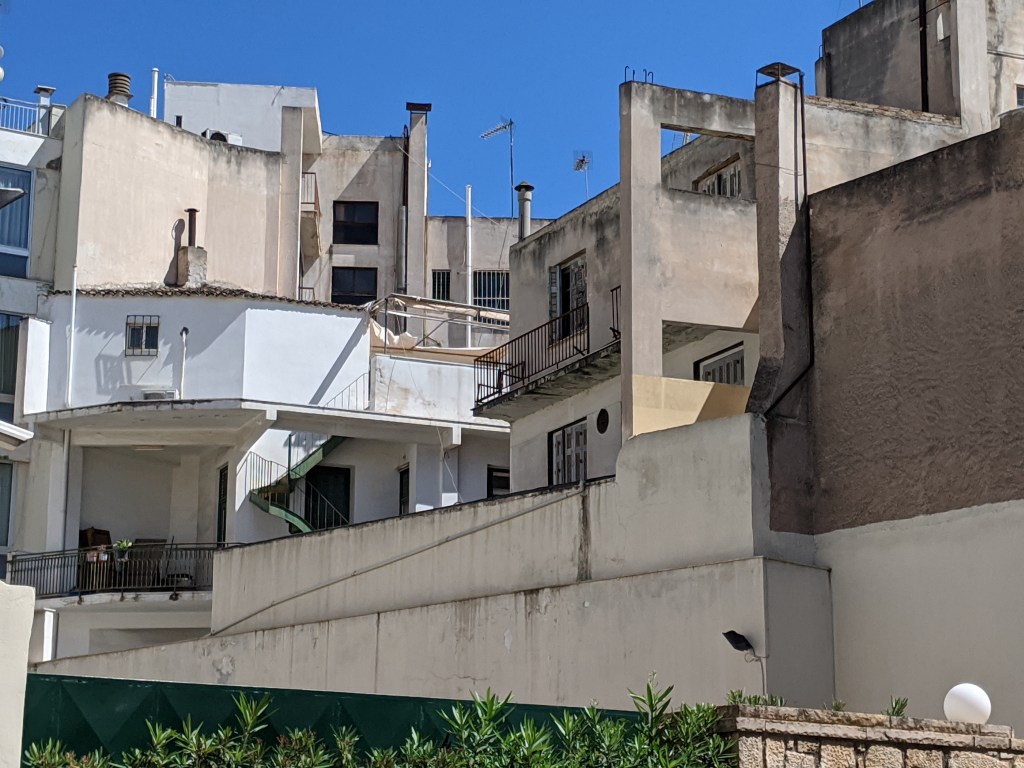
Athens had a similar boom in the 60s, but it didn’t result in the now-passé futurism of daringly uninterrupted planes of concrete (the béton brut, of Brutalism), it just resulted in empty spots of nothing where then-new multistory apartment buildings (πολυκατοικίες) randomly abut the empty air of empty lots and parking lots and the undeveloped airspace above older buildings.

Athens is a place of layered history, each year accumulates dirt and dust and the bottoms of the buildings become lower and lower, so that the late 19th century sits a little below the modern era, the Byzantine structures sit a foot or two below the current ground level, the classical period some five to ten feet below the surface. And looking upwards, the same thing is mirrored into space, with the buildings getting taller, and filling in what space they can, where physics and building permits allow.

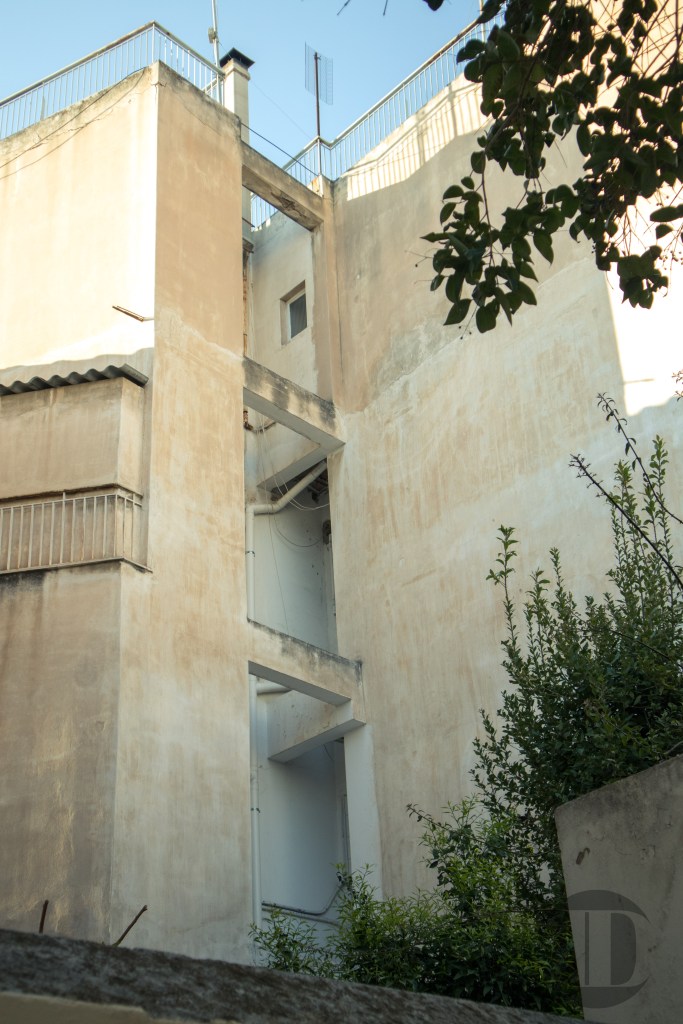
A mess of planes and angles

It’s like the city got so excited about the opportunity to grow and develop that it overtook itself, tripping and flailing as it expanded. But the walls mirror the streets in meandering and intersecting one another until they give life to new, exciting shapes and experiences.

Having grown up familiar with the New England cities whose roads were laid down on cowpaths, summers in Athens still felt like home, with streets that run in parallel, except where they intersect. It’s got none of New York City’s careful, methodical approach to wayfinding and orientation.

When the opportunity arises to see Athens from above, such as from the Acropolis or some other height (after all, it has seven hills, as all proper cities should), little concrete blocks fill your vision in all directions like a rolling, constructed, pillared ocean, frozen for a split second in its heaving.

Rendering successful… Please enjoy Athens-2020.exp

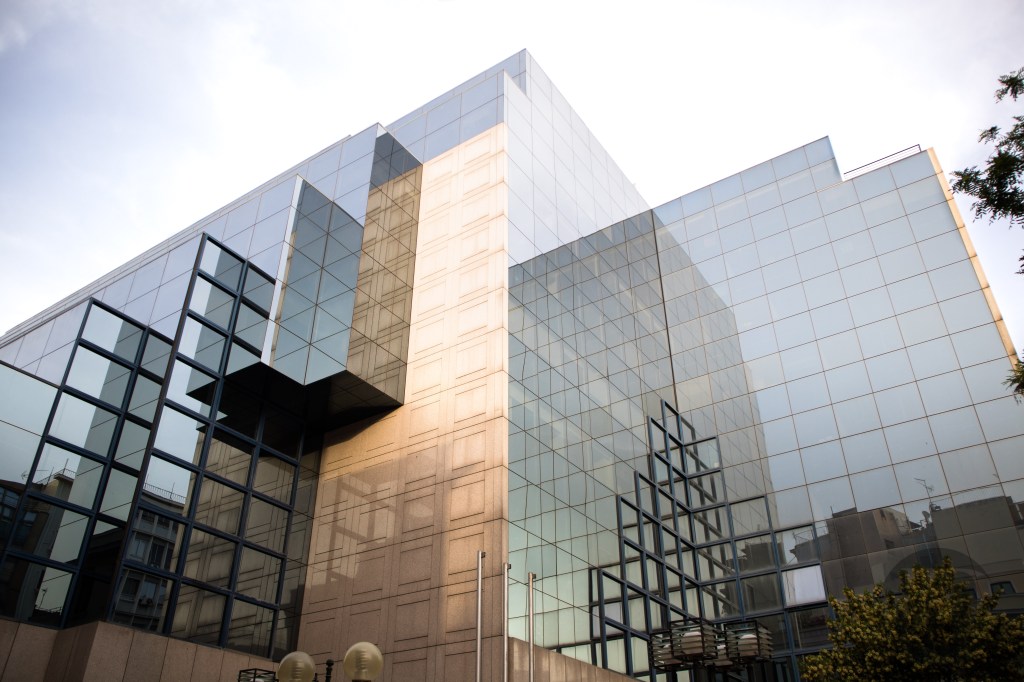
Now Athens is displaying more modern tendencies, able to reflect current trends in architecture, all glass and polished stone, reflecting itself and its surrounding back and back until passers by are dizzied by the sun hitting back into their eyes.

But even here, the overwhelming intersection of planes is retained, though more restrained and deliberate, the sudden shock of intersecting lines is still given life here.

Magical Thinking: The Hermit in quarantine

I’ve been discussing tarot interpretations with a friend who had decided to pull a card a day and then re-create it with items in her house during quarantine. The very first card she pulled was The Hermit.

“Just pulled a tarot card that hit a bit close to home,” she messaged me.

Indeed, pulling the Hermit as a card during forced isolation can feel a bit like the universe is laughing at you. Even those of us generally disinclined to go out and and live it up are chafing under the strict imposition of social distancing. It’s important, but not going outside was a lot more fun when it was a choice.

Yet, even enforced hermitage can learn something from IX of the Major Arcana. After all, the most pressing question the Hermit poses to us when we draw it is “Why are you pulling away from the world?” or “What do you hope to achieve with your isolation?”

The Hermit is a very spiritual card, not in the same way as the High Priestess or the Moon, but because it is a card which represents the work of spiritual practice. A traditional hermitage, the kind pursued by monks, saints, and other holy persons is a drawing away from the bustle of daily affairs and the material world in an attempt to access a higher, inner plane of being. Whether you are persuing mediation, prayer, or even the simple act of drawing a card once a day and carrying its meaning with you; the goal is to pull away from the riptide of quotidian tribulation to really assess oneself and ones place in the grand scheme of life.

Often, if the card appears reversed or negatively aspected within a spread, the Hermit can serve as a warning. We often tell ourselves when we pull away from those around us and the questions and concerns of the every day that we are doing it to achieve something elevated, but that is not always the case. Instead, it can be out of fear — that we will be hurt or overwhelmed — or laziness — a “spiritual” isolation is inviolable by sciences and philosophy with which we might disagree — or confusion — we don’t know when or how to make a decision so we decide to do or be nothing. These are not worthy reasons to pull away from the mass and hubub of life.

So, in one way, the Hermit can be a warning about examining carefully and honestly why we have pulled away from those around us. Are we genuinely pursuing something greater, or are we attempt to slip our duties to those around us.

In mandated isolation (and we are all isolated right now, whether we are required to go into work or not, the form and shape of life has been drastically and significantly altered for all of us), the Hermit is also a reminder of what we hope to gain when we choose isolation and contemplation instead of action. The work of self-knowledge, spiritual awakening, or intellectual elevation is not something we can achieve if we go into it with purely selfish intentions. The law of spiritual feeling is one of universal love, an expansion of the ego until it is ultimately destroyed and we are able to recognize a universal totality of which we are but a tiny, insignificant, shining piece.

Why should this particular aspect of the Hermit matter when we are all as close to locked away as we can get? Because it is the reminder that we are not doing this for ourselves or to be alone. We are doing it because we belong to a wider, greater whole. And while we are unable to be close to one another, unable to hold one another or sit together, we are not retreating from the world. We must find new ways of sharing of ourselves with one another, new ways of being and of supporting one another. We can still elevate ourselves and each other, without physically lifting one another (so to speak).

We have an opportunity for quiet, for contemplation, for self-examination, and self-improvement (and I don’t mean, necessarily, learning a new instrument or finishing your novel, or even getting through your back log of reading to catch up to where you have always imagined wanting to be; the barriers which have inhibited those actions are likely still present, be they work, time, or anxiety). So now it is up to us to recognize that this a moment where we can reckon with ourselves about what we cherish and what we need to feel our best selves.

When I left for Athens, I decided (for once in my life) to pack less than I expected to need. So my hermitage has become not only a test of moderate social isolation, but also one of asceticism. The question has very much become, can I stand living with two pairs of pants, six black t-shirts, and a week’s worth of underwear? How many pens and pads do really need? How many pairs of shoes do I need?

I’ve realized that I wish I had brought more of my make up with me, I miss having a second pair of shoes, and that not being near my personal library is utterly disorienting. Also I can apparently play Animal Crossing on the Nintendo Switch for about six hours every day, making it my primary activity (both leisure and otherwise). My natural circadian rhythm is 10 AM to 3 AM, and I really don’t like eating first thing when I wake up.

Some of these things I already knew, like the breakfast thing, but others have been surprising, like the make up. And the fact that I wish I had slightly more variety in the types of socks I had brought with me.

I haven’t been able to do too much reading, because the things which have been holding me back, most notably a particular intellectual restlessness, continue unabated (perhaps even exacerbated) in quaratine. But I have been able to write more, as this very blog post evidences, because I’ve managed to maintain my most productive social relationships (and even expanded them to include people I have been unable to see as much or as often as I might like) without having to submit to those interpersonal exchanges I find the most draining and least helpful.

In short, the Hermit is a reminder that we can learn much about ourselves and where we position ourselves in the world by cutting back or cutting away at those things which are a given in the normal course of life. We may not have chosen the social and physical distancing which we are now experiencing, but that does not mean we cannot find ways to make use of it, seek within and beyond ourselves that which will make the here and the now bearable.

Zelda, Calamity, and Living Beyond The End

I have a much longer, much more theory oriented post which I imagine no one will read in the works, but instead I want to take some time today to talk to you about playing video games under quarantine.

While Animal Crossing: New Horizons dropped four days ago and I’ve already sunk almost 19 hours into the game (sorry, Mama), the game I bought to keep me company on the plane and fill some of the downtime while I am here is Zelda: Breath of the Wild. I played it on the plane and in the airport and during my unexpected seven hour layover in Munich (I also took a nap), and I’ve played it while trying not to completely lose my mind cooped up in a house by myself except for my several hundred tiny wingèd roommates whose demise I plot with increasing vigor with every passing day.

AC:NH has been a pleasant way to remain connected to the idea of Outside –– it has bugs and sunshine and weather and fishing and running around and changing outfits (with the exception of the first one I have almost none of those things) –– but BotW has been the most philosophically and narratively poignant choice.

A rough outline of the game’s plot/setting for those who might be unfamiliar:

In BotW you play a newly awakened swordsman, Link, who has been in some kind of mago-technical suspended animation for the last 100 years. He was mortally wounded in battle against a malignant magical entity named Calamity Ganon while defending the princess Zelda of Hyrule as she attempted to banish Calamity Ganon with magic. You take your unclothed self out of the stasis chamber, acquire some pants and another mago-technical device (which, somehow, reminds one of a Nintendo Switch) and go out into the world to discover your fate. (Spoiler alert: Your fate seems to be saving the world from the increasingly powerful, though still contained, Calamity Ganon.)

More importantly, for this moment in time, you step out into a world in ruins. Literally, the first thing you encounter is the Temple of Time, which is in shambles. It’s falling down and falling apart, and you pick through its crumbling bones for arrows and small arms. As you come down off the plateau where the temple sits, you are met with ever more evidence of a civilization, and empire, which did not survive that which befell it.

There are big open fields of grass, dotted with trees, and moss covered, tumble down walls. Wooden structures poke out of the hills like they’ve forgotten they aren’t overgrown stalks of grass. Tattered cloths with faded heralds hang dirtied and limp amongst the ruins.

At the same time, the world teems with life. The plains of Hyrule are largely devoid of humanoid habitation, given over to monsters and history, but wild horses cavort, and everywhere you walk you are serenaded by a million tiny insect orchestras. The natural resources are bountiful and you learn to cook what you can find to restore Link to the picture of health and to aid him on his journeys. Once you get beyond the area given over to a state of nature, overshadowed, as it is, by the swirling malignancy of Calamity Ganon where he-it teems around Hyrule Castle, you quickly realize that you are far from alone.

Beyond that immediate desolation and its ghosts, the rest of the world is populated with entrepreneurial spirits, adventurers, travelers, inventors, villagers, and fanatics. They tell you how their communities and their peoples suffered as a result of the Calamity, 100 years ago (a little less than the average lifespan of the people of this world), but how things have returned to a slightly uneasy peace since then. Every village has children, it has young and old people and they all have stories to tell and little problems for you to solve.

In short, though they live in proximity to ruins, they nevertheless live.

A part of me quickly pulled up the simplistic explanation; I’m sure you’ll think of it – it’s an easy one for American liberal guilt and uncritical, cookie cutter analyses of Japanese culture. All of Japanese popular media can be condensed into the atomic bomb if only the West tries hard enough. And maybe the generational gap between the young adults and the elders who remember the calamity can be paralleled by the generational gap between those who remember the war and those, like me, who make up the main part of gaming’s target market.

But it seems unfair, not only to the Japanese who have surmounted any number of calamitous events both before and since the U.S. dropped its bombs on Hiroshima and Nagasaki, but to the rich world which has so carefully and painstakingly been built and rolled out in the game. Given that BotW is also another installment in an already extensive (though famously convoluted) narrative universe, and the names repeat (Zelda, Link, and Ganon are staples of every game in the series), one gets the impression that by this point the lessons and metaphors can be allowed to function within their own, self-made space.

There is, from a player perspective, a Sisyphean quality to Link’s existence. He has been carried through time on multiple occasions for the purpose of saving Hyrule from Ganon and yet every time a new game comes out, Ganon returns in some new and horrible form. In BotW in particular the veneer of humanity has been eradicated from Calamity Ganon, transmuting him into a magical infection which poisons the land, bubbling up in places where his control is strongest, creating glowing, pulsating growths that injure you when you touch them. He’s no longer the dark wizard who might be familiar from Super Smash Bros. but instead he is a disease, a pollutant, something which has embedded itself into and become a part of the environment rendering the natural world hostile.

Perhaps it whispers of the reactor meltdown in Fukushima. But again, the one-to-one analogy is bitter and unfulfilling after this sumptuous feast of a game.

To put it another way, this is a game where if you sneak up closely enough, you can ride a deer. The detail and care put into it, the number of hours of coding and sound mixing and rendering and writing and translating and acting, makes it impossible to simplify into historical analogy. But that doesn’t mean that we can’t take something from it. (And I don’t just mean the soothing lullaby of the sound design.) I think what we should do our best as we face our own calamitous times to remember the villagers and the travelers. Far from being populated exclusively by those who would see Calamity Ganon freed and bring an annihilating waste to what’s left of life in the territories surrounding Hyrule (though there are always some), there are people who did more than survive. They built towns and families and lives. They planted trees and loved each other and their children and recognized that for all the chaos and uncertainty of calamity, it’s not really that much more uncertain than life itself.

So, be cautious, for now. Wash your hands well and often, avoid touching your face, cover your mouth and nose when you sneeze and try to keep a healthy physical distance from others. But don’t forget to love one another, don’t forget to plan for the future, don’t forget to lean out your window and breath in the fresh air, listen to the night sounds, and remember that uncertainty is just another facet of living. It is no different from trying new foods, telling someone you love them for the first time, or unexpectedly hearing a beautiful song.

Week in Review 008

Reading:

  • Broken Stars by Ken Liu, ed.
  • Your Favorite Band Cannot Save You by Scotto Moore.
  • European Identity and Citizenship: between Modernity and postmodernity by Sanja Ivic

Listening…

  • The Magnus Archives

Watching:

Movies:

  • Plaire, Aimer, et Courir Vite (2018)
  • Le Livre D’Image (2018)

TV Shows:

  • AP Bio
  • Russian Doll
  • The Marvelous Ms Maisel
  • Deadly Class

I’m exhausted. I can’t believe it’s been only a week, possibly because the last few days have felt like an entire week just by themselves.


On Saturday, I had the absolutely unparalleled good fortune to meet Patton Oswalt. He was in Providence to perform a comedy show at the Veterans Memorial Theater, and he graciously accepted our invitation to visit the Lovecraft Arts & Sciences Council. I cannot thank him enough for taking the time to visit us, and it was such an absolute privilege to make his acquaintance in person.

We swapped reading recommendations. Mr. Oswalt suggested “WET PAIN” by Terence Taylor which can be found Whispers in the Night: Dark Dreams III co-edited by Tananarive Due and Brandon Massey. He said he learned of it from Ms. Due who, in addition to her work as an author and editor, executive produced Horror Noire: a history of Black horror (2019) which can be streamed online through Shudder. We discussed Lovecraft’s “The Horror at Red Hook” briefly and so I recommended (as ever) Victor LaValle’s The Ballad of Black Tom.


The latter half of my Friday was spent pleasantly with a friend in Boston. We visited the MFA to see the Bauhaus exhibit. There is also an exhibit of Bauhaus works up at the Harvard museum, which we will hopefully have the opportunity visit.

This year is the centennial of the founding of the Bauhaus School (1919). There are times I lament my passion for their particular modernist style, if only because it can seem conventional, bordering on the cliché. Nevertheless, the way Moholy-Nagy creates a sense of a three dimensional interaction and interrelation of objects in his abstract paintings will never cease to delight me. In one of the paintings of his they have on display, the transparency of the paint where two of his shapes overlap makes it seem—as my friend so eloquently phrased it—as if one were a fabric appliqué.

I was also quite taken with the Kandinsky pieces they had on display. It feels as though I shouldn’t have been surprised at how much white space his drawings contained, but I was. I could happily have spent all evening in front of his “Little World” pictures trying to figure out how he achieved such balance in an otherwise random-seeming distribution of elements.

Mostly, what I love about the Bauhaus is the way the work of these artists fills me with a sense of possibility. Every time I have the opportunity to steep myself in their abstract geometries, I can feel the edges of a new language pressing up against me. Movement and essence are made concrete, not something that can be pinned down, but something inherent which can be expressed with lines on a page.

(Other design movements which make me feel this way are Russian Constructivism and Punk/DIY collage.)


This week, I accidentally got into it on Twitter with the MAG fandom. Shockingly, 280 characters is not really enough space to adequately convey nuance and context. I found being accused by strangers on the internet of wanting to censor people or command moral authority to be extremely insulting.

I work in a front-facing position within a dedicated fan space, in a fandom defined by a serious controversy. My personal and professional experiences have lead me to believe that “fandom,” far from being a space insulated from disagreement and political and cultural debate, must be a place where people are able to engage critically with the mores, biases, personal and historical narratives, and other foundations and assumptions which are inherited from the original work or developed within the surrounding community.

I work at an organization dedicated to H.P. Lovecraft.

If there is one thing I’ve learned, it’s that sometimes the only thing you can say in response to another fan’s interpretation is, “I disagree strongly – possibly to the point of considering your position to be harmful – and this is why.” Because it is only in that moment where we are part of the same community – as fans – that we can have this discussion as people who share in something bigger than ourselves.

But I don’t wish to linger on this topic; it is exhausting, unproductive, and has already claimed too much of my time.


Ideally, I’ll have a little something up this week about Broken Stars, the second collection of contemporary Chinese SF translated and edited by Ken Liu. I adored Invisible Planets, which I cannot recommend strongly enough. (Upon finishing it, I immediately bought two copies to give as gifts, and pre-ordered Broken Stars. I have also leant out my copy of the first collection so that the people in my life can share in its wonders.) Go read both of them!