Category Archives: Other Writing

2017.04.25 : black holes

At dinner, an unexpectedly personal affair, we were discussing the differences in our ages. The conversation took a turn on the phrase “I have a body, like Adonis.” (Consider the placement of the comma.) Which quickly shifted us to discussing the nameless quality which goes by “sex appeal” or “fire” or … And the term settled upon was gravity.

Women are like black holes, he says. If you have a group of women in the room, and you can see the social space spread out around them, some of them will have more gravity and will pull the space in towards themselves.

Suddenly, all I can imagine is the gravity wells; at which point have people traveled far enough that they cannot escape? How do you measure the gravity of human being?

We’re used to comparing people to stars: they light up a room, people revolve around them, they sit at the heart of entire systems.

Black holes rotate entire galaxies. All theories of time travel and universal travel are posited on black hole theory because they mark the place where gravity has ripped a hole in space-time itself. What kind of a person has enough weight to rend the very fabric of reality?

The metaphor pulls me in:

A good friendship, a pleasant evening with a potential partner, all exist with some form of quantum uncertainty or relativity analogies. Time passes in uncertain ways, the entire universe can re-orient beneath your feet, things exist in simultaneous and contradictory states, sometimes it seems like the very atoms between two people are mirrored images of each other, knowing and known––

But none of this matters. Physics is not the language of romance or poetry. The mathematics are too complicated, and the uncertainty of the observable is all too parallel between the two. The game is no fun when it is this obvious.

But how do you measure the gravity of a human being? Can you recognize the moment you become trapped in the gravity well of their presence? Is there any choice other than to be crushed under the weight of it, until you travel beyond the moment you left behind, and discover what exists beyond the unanswerable question?

2017.03.23: “THIS IS AWESOME”

Last night I watched 6 or so episodes of El Rey Network’s Lucha Underground. I have never watched wrestling before. l pretty much decided to give Lucha Underground a shot because of my intense respect and love for Robert Rodriguez .

I’m still trying to decide what I think of the show. I have no idea how it compares to wrestling generally, but even as a contained entity I am struggling to identify and categorize my opinions.

One part of me wants immediately to write about the folding chair as an image of betrayal, unconstrained violence, and evidence of a lack of honor. At the same time, I am not familiar with the role of props in the unfolding of narrative morality in wrestling in general. I am vaguely aware that prop usage is a part of wrestling, because of the way it is lampooned in other cultural documents. There is also a continuity of wrestling history and character evolution which I can only be aware of missing; the color commentary is designed to compensate for audience ignorance but I get the sense that some of the narrative is intended to recast familiar actors / characters in new ways.

Another part of me wonders if something can be understood about the American psyche – especially politically – from this popular pageantry. Much is being made of the difference between performance action and real intent currently in politics. Wrestling is a crash course in per formative action. No one is supposed to be seriously injured, people aren’t necessarily even really being hit in to face. Not to mention that a good bad guy is as necessary as an honorable hero. Rehashing old grudge matches and communicating a continuity of character and personality through opposition and through one’s opponents is an integral part of generating and maintaining narrative in the ring.

Finally, I wonder about how the Mexican aspect of Lucha Underground creates a complex politics within a medium known for its popularity, on American television, with white, rural and working class people. Here, mistrust is built through ceceo and honor is conveyed and conferred through machismo and everything pays respect to the tradition of lucha which goes back to the Aztecs. Not to mention the luchadores hailing from outside the United states introduced with the full description of their cities and states in Mexico. Every thing is made bilingual, multicultural, and political. Will the Mexican fighters get their visas to enter the country legally to compete? What about the barriers of wrestling as a historic and cultural institution and the lucha that so many people fight every day in the streets? How should women be treated when they step into the ring?

I don’t know if my new engagement with this is the first step on the road to matching the WWE or if this is another blip in the long list of new media artefacts that I have explored in the past year. Mostly, I hope that Prince Puma makes it through and that Chavo Guerrero Jr gets knocked down hard – preferably with a folding chair.

The Female Corps(e)

The dressing room has a brightly lit pedestal, and we look back at ourselves from three walls. We stand on it and twist our shoulders and hips, crane our necks, examining ourselves from all sides as infinite, increasingly crooked copies of ourselves list sideways and disappear into the murky darkness of the mirrored mirrored mirrored reflection.

We’ve all done it; fourteen-year-old girls and married women and middle aged women and old women do the anxious, preening dance that the mirrors inspire. But our gaze is always critical – how does the cloth fall? Does it show too much? Does it cover the right things? Is it really me?

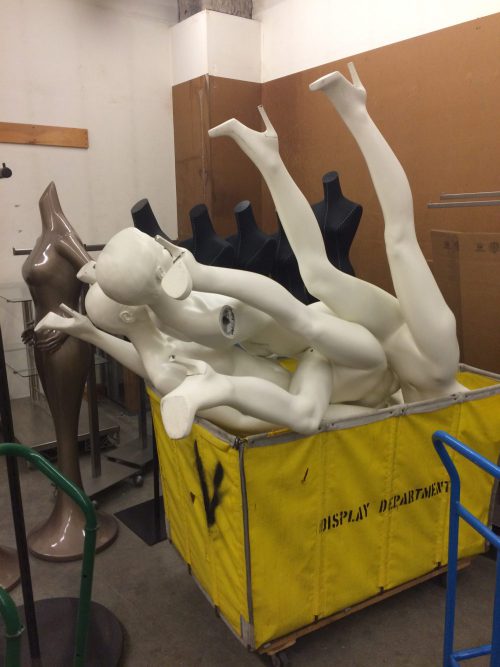
The perfected female form – handed down to us through fine art books and museums from the Ancient Greeks – is a sculpted, smooth, white body without a head.

IMG_1845

perfection, discarded.

This paragon of beauty reminds us that our bodies are just objects: mere vessels for that which truly makes us human.

The eyes are the windows to the soul – it is no wonder then that the mannequins in the storefront have smooth, anonymous faces.

But that’s no different than the statues in the museums, their features weathered away by time and rain and nature, making lepers of the ones that still have heads. Otherwise, smooth, marble shoulders sweep up into elegant stumps, and we make eye contact with empty space.

Historically, young English lords made off the easily carried heads of the statues in Greece—the pillage of the Classical by the Romantic—and doing so, took with them whatever expressions those statutes might have made, the rest of us have to make do with what was left.

Friends, family, sales associates are always quick to remind us: the lights in the dressing room are unnaturally unflattering. But the critical gaze, the self-critical gaze, the critical self-gaze, knows every imperfection. We seek them out and itemize them, exacerbate them, magnify them, and when we gives them voice, we are met with confusion and incomprehension from our audience. There is nothing that will more quickly imbue us with a sense of alienation, of insanity, than attempting to explain our physical imperfections. Our audience—those same friends, family, sales associates—will always assure us that our flaws are either not as noticeable as they might appear, or that they cannot see those things that are so obvious to us. But we know they are there.

One of the two, either the eyes or the audience, has to be lying. Which to trust?

We know to doubt our own vision of ourselves, just as we are not as smart as we think we are, as commanding as we hope to be, or as confident as we pretend, we must equally not be as ugly as we imagine. But if we are not ugly, then how come the clothes never fit? How come we cannot find pants or shirts or sweaters that flatter our bodies? Our audience must be lying, because clearly we were made wrong, a store full of clothes none of which fit like they should, someone must fit into them…

If only it were easy for the secret to reveal itself: we are all built wrong, or rather, our bodies, as imagined—smooth, white, hard, all angles and swooping curves, no softness, no quiet surrenders to gravity or time, limited by musculature and tendon flexibility—are beyond the alchemy of elastic underwear, liposuction, gym memberships, early morning work outs, calorie counting, and anorexia. Our pathetically human flesh can never compare to life-like marble. We can only glitter in the sun with the help of expensive, mass manufactured powders, salves and elixirs that promise that lit from within glow.

All we can do is catalogue all we see when we stand on that pedestal and hope for the time, money, and energy to manufacture our best selves; rigid, stony perfection, on a box, inside a little velvet rope enclosure with a sign that says Please, do not touch.


At least 70 people died when a suicide bomber attacked a group of mourners at a hospital in the Pakistani city of Quetta. Lawyers and journalists had gathered following the shooting of a prominent lawyer earlier on Monday. Both Jamaat-ur-Ahrar (a faction of the Pakistani Taliban) and Islamic State claimed responsibility.

— from The Economist Espresso, August 9, 2016

One of them is lying. (Possibly even both of them.) The perpetrator is dead—we have no way of knowing for sure. Why give either of them credit?

Articulate in the face of Absurdity

In 2011, I heard Billy Collins read a poem about the word like, it was called “What She Said”. This, at the Dodge Poetry Festival in Newark, NJ, was after I had heard Michael Cirelli, a Rhode Island native, read “Dead Ass” about discovering new slag. The contrast between the tones—superior and celebratory, respectively—couldn’t have been more different.

Lately, I’ve wondered about the phrase I can’t even. Which is more appropriate? Mockery or consideration?

It is fair to criticize its abrupt construction, which robs it of both specificity and substance, means that it functions through familiarity; its meaning is contextually and idiosyncratically imparted.

Having emerged from the unreliable and overwhelmingly multifaceted depths of the internet, it is met with distrust by grammarians and the other vanguards of the English language. Whatever inherent meaning might have existed within the aborted structure was further eroded by use in the regressively repetitive reblog threads on tumblr.

But we live in a world dominated by the absurd.

In the country boasting the strongest economy and largest military force on the planet, a reality TV star is running for president against a former Secretary of State and First Lady, after after the two of them beat out an avowed Democratic Socialist, and a man so fundamentally lacking in charisma that a large swath of the public is willing to believe his is the Zodiac Killer, regardless of temporal impossibility. Meanwhile, policemen with military grade equipment shoot unarmed citizens in the streets. While children and families go hungry, Congress shuts down the government out of spite, and the people drown in debt after bailing out bankers facing no new regulation despite nearly creating a financial apocalypse.

Meanwhile, globally, the field is dominated by radicalism, terror, slowing economic growth, and environmental disaster. In a new era of demagoguery, the death of nuance seems both inevitable and potentially absolute. Our political discourse is reduced to emotion rooted in personal truths and we have accepted the dissolution of a collectively structured reality. With the banishment of facts, concensus reality is abolished and events already past can be re-imagined out of existence (Vladimir Putin will not invade Crimea).

A system without rationality can hardly be called a system. It becomes difficult to rely on language, which is a system, composed of atomized concepts and consistent rules, as a means of expression. We resort to other means. Our subjectivity—the production of the self—is given over to the front-facing camera. We situate ourselves within the social, physical, and political world through selfies taken on vacations, with friends, at rallies, and in the presence of our heroes and idols. The camera lens and the portable screen eloquently communicate where we stand on issues, with which candidates, in which cities, and in front of which works of art.

Yet we cannot avoid words: you open the newspaper, or a browser window, or an app and read that the government is refusing to do their constitutionally mandated job, and that, furthermore this comes as no surprise, and that a nation produced a vote which not even the politicians who lobbied for it can support, and that we cannot get the data to know how many people are killed each year by cops, or how many firearms are sold in the country, or how much money is secreted away in off-shore accounts. The words are concrete and undeniable (except by the newly greased escape hatch out of concensus reality) and finding a word to respond, one that encapsulates the emotional state developed under long term absurdity, can feel impossible.

Perhaps one exists within those linguistic traditions which survived the Soviet empire. But even there concensus reality existed, two of them, in parallel. The reality of the state and the reality of the people, spoken and whispered. English—the language of empire, of capitalism, of finance—lacks the appropriate philosophical and linguistic tools.

Beyond its near impossibility, it feels like defeat to attempt to express the entire cycle of horror-distress-incomprehention-frustration-disappointment-anger—and ultimately—complete lack of surprise, never mind cobbling together a framework of rationalized acceptance.

Instead, I reach for the only tool developed to express the whole of our collective emotional disorder: I can’t even.