Author Archives: Despina Durand

Unknown's avatar

About Despina Durand

part-time goth, full-time critic

2016.11.28 : pipe dreams

Thanksgiving is come and gone. 

It has been hard not to think of William S. Burroughs’ Thanksgiving Prayer, especially the last line:

Thanks for the last and greatest betrayal
of the last and greatest
of human dreams.

(Content Warning for the poem: racial slurs, anti-gay slurs. Un-varnished representations of America.) 


I read some good bits of advice for weathering the new political climate, both are making the rounds, but a little extra time spent on them won’t be wasted:

Annalisa Merelli’s piece for Quartz, regarding what the US body politic and the US media can learn from Italy’s experiences with Silvio Berlusconi. Namely, that fighting the man does little good, because as Trump has said: All publicity is good publicity. (And the man is a reality TV star, he surely knows what he’s talking about.) We need to refocus away from a critique of his personal or moral foibles and failures, and re-engage with what matters. That means it’s time to (finally) talk policy. 

The other is from Nic Dawes, appeared in the Columbia Journalism Review and made the rounds, at least in the arenas I’m familiar with (it’s all algorithmic and doubtlessly intended to keep me deep in my comfort zone). Dawes is concerned with preparing American journalists for a level of hostility and restricted access they have never encountered before. The freedom of the Press and, more importantly, the importance of the Press is something that has been taken for granted in this country, and ostensibly enshrined in our founding document. It has weathered difficult times and difficult moments before, but never has it faced the total rejection and defamation that is being put forth by the President-elect and his political entourage. 


On the matter of the press, part of me despairs. The calcification of the federal government was at least periodically tempered by the actions of the Press (though not with anything near the level of effectiveness that was necessary). Without any voices playing even nominally playing the role of dissenting opinion or considered criticism, I fear we face a necrotic rather than a merely ailing infrastructure of governance. 


Most of all, fear is what keeps me up at night. If this shock, this pain, this anger continues as it is, and fear sets in long term, we will be lost. The forces of power need us divided and overwhelmed. We must imagine new ways of being, and living, and speaking that will allow us to push back against those instincts to circle the wagons and protect our own. 

Maybe I’ve been watching too much Supergirl lately, but it seems like this moment––when things are dark and bleak and uncertain––is when we must hold out our hands and try and help each other stand. 

2016.11.21 : getting back on the horse

i’ve had a cold for the past four days, which laid me out a little bit. (i was self indulgent on the weekend, and let myself spend all day in leggings – not the same ones I was sleeping in, but close – and hang out in my room and binge watch netflix.)

so i’ve watched a lot of Supergirl. it seemed to be the feminist showboat of the CWDCU so i figured i’d take it for a spin. it’s got a number of interesting commitments to social commentary it has dedicated itself to. obviously, the character of cat grant is an easy choice for commentary. the writers have made excellent choices presenting her as demanding, difficult, calculating, and cold, while fostering a rich inner life and complex set of motivators and emotions below the surface. this allows them to have an ice queen with a real human heart. it gets to the crux of the feminist problem with representation in media: can you have a stone cold bitch character who is still fully human and sympathetic? as many have long suspected, the answer is: yes. 

i still think that the show that provides the best explicit rather than narrative critiques of racism and sexism, in the CWDCU and possibly elsewhere is DC’s Legends of Tomorrow. If there is a dearth of complex characters, people are certainly taking steps to fill those representational gaps, but Legends is modeling active resistance to the powers of social violence and oppression. the character regularly interrupt and interject to point out the ways in which the forces of sexism and racism are consistently alive and well, and actively petition for their own rights. 

they also do a fantastic job of explicitly calling out passive acceptance of sexist and racist and heterosexist attitudes, particularly from the straight, white, male characters. if my tv shows are going to teach me anything this year, i’m hoping that Legends will continue to remind me to say something, when i encounter sexist or racist behaviors, rather than rolling my eyes and letting them slide. 


it’s been a tough couple of weeks; politics is a subiectum non gratus in my household. my father is actively distressed by discussions of the President-elect’s cabinet nominations. i cannot, strictly, disagree with his reactions, but i’m still in this semi-detached realm. some switch in my brain is flipped and i can look at the whole thing with dispassionate interest: how will things change with this or that nomination? what can we expect? what are the likely policy suggestions or outcomes of the contenders? 

but i don’t read the new york times in the morning, i trawl for information from Foreign Policy and Stratfor Intelligence and got myself a discounted subscription to Foreign Affairs. beyond the clear international relations junkie status, the steady diet of high-level analysis allows me to feel a sense of mastery over these arenas. the false confidence of information is a heady drug. but more importantly, it comes with the bizarre assurance that, just maybe, you could do better. that always seems to be the last defense of the incompetent when in power, and i look forward to the day when i can argue policy positions in the political arena. 


for the moment, i’ll continue to consume my own body weight in tea, irrigate my sinuses and work the sidelines of my responsibilities while i do my best to read every possible thing i come across. the future is grim, but it’s still there, for now. 

2016.11.18 : Dirty Little Secrets and the Duke’s Bastard Son

I can’t remember where I picked up the term consensus reality. I know only that it appeared in my lexicon sometime in the last 2 years, and that it has become one of my foremost tools when trying to explain and understand our current political moment.

Consensus reality is a term to describe the communal reality: things are understood to be a particular way by the majority of human beings and those points of agreement between that majority create a thing we call “reality” which may coincide or may differ from an objective reality but is nevertheless verifiable outside of individual experience. It exists between a solipsistic reality, in which individual experience and understanding is the only basis with which one parses and manages “reality,” and objective reality

Consensus reality is the reason that you can hear things that aren’t there. It is impossible to say whether someone who hears voices that no one else hears is living in a solipsistic reality experience, or whether they have the means to interface with objective reality in a way that the rest of us cannot. Consensus reality merely describes this unique experience as a divergence from the reality that is experienced by the majority. 

I don’t want to take the time to defend, philosophically, any of these positions, because it is one of the elements of philosophy I do not have the patience for. Ultimately, consensus reality seems like the only functional method of engaging with reality, in a social, political, and communal way. Maybe this is a solipsistic universe, and everything is a construct of my imagination; some incredibly detailed dream that I will wake from into a different reality, or I am some slumbering god, imagining each instance from within it. It seems more like an excuse to escape responsibility than a real engagement with universal uncertainties, since I will still have to navigate consensus reality.

Likewise, it is entirely possible that ghosts are real, and some people can see them, but it is impossible for me, at this time, to verify that knowledge, with the tools at hand.

This is where consensus reality and scientific opinion begin to complement each other. 

Scientific opinion is just another name for consensus reality. Scientific opinion is formed when enough people have reproduced or otherwise verified a particular outcome of a particular set of actions or interactions through a variety of methods and have produced a particular result. Scientific opinion is a definition of some aspect of reality, derived from (ideally) rigorous, meticulous study and experimentation, reproduced and verified at a large scale resulting in the agreement of a majority of the scientific community (or subset of the scientific community) that certain conclusions are consistent. That consistency is otherwise known as “being true”. 

But there are other aspects of consensus reality. Because consensus reality is a tool that can be applied far and wide, and not merely to things that are verified quantitatively. Consensus reality is at its strongest (and, sometimes, most ambiguous) in the social sphere. 

There are two kinds of being out of sync with consensus reality, where the strain of bridging the lived and understood realities is at its highest.

The first one I call, 

The Duke’s bastard son:

The Duke’s bastard son is a linguistic aberration of consensus reality. A bastard is defined as

adj. [archaic or derogatory] born of parents not married to each other; illegitimate: a bastard child.

As an illegitimate child, a bastard son is not considered an heir to whatever inheritance might be claimed upon the death of the Duke. In all public record, the bastard son will be renounced and placed firmly outside the sphere of the family of the Duke. The bastard son is without political power.

Nevertheless, the Duke may well extend a measure of charity towards the bastard son. There is no reason to treat him badly, and, in fact, there is a measure of social value to be gained in avoiding ill-will with one’s illegitimate children. If the bastard son is allowed to exist within the Duke’s estate, it is almost guaranteed that everyone will know that the bastard son is the Duke’s. 

Simultaneously, no one will openly acknowledge that he is the Duke’s bastard son. 

Here, consensus reality contains the contradiction: everyone knows one thing to be true, but no one will say it. 

This type of consensus reality is familiar to anyone who has lived under a repressive regime; be it within a household, in a community, or a country. Something that is common knowledge, is systematically disavowed. 

The other aberration is 

The Dirty Little Secret:

This one is familiar to anyone who has ever been someone’s “side piece” or has suffered abuse or listened to a multitude of popular songs, including The All-American Rejects’ Dirty Little Secret

This is the place where solipsistic reality, objective reality, and consensus reality coalesce at can create total breakdowns of communication and affect. 

Some might be familiar with the question: “If a tree falls in a forest, and no one is around to see it, does it make a sound?” Consensus reality says, yes. Solipsistic reality says, no. Objective reality is impossible to ascertain. 

The Dirty Little Secret asks: “If you are in the forest and break your arm, and no one is around to see it, did you fall or were you pushed?” 

Or my personal favorite: “Three may keep a secret, if two of them are dead.” 

The Dirty Little Secret is when some action, cause or effect, is prohibited from consensus reality. 

Secrets are the biggest barrier to consensus reality. I don’t necessarily consider the Duke’s Bastard Son to be a problem, although the recent election is changing my mind about that. (R.I.P. Facts) But I have never liked secrets. Sometimes, I think that is the number one reason I tend towards journalism: because only establishing and maintaining consensus reality, and thus dismantling the Dirty Little Secret allows people to make informed decisions. If you don’t tell people the things they need to know, there is no way to make sure that we can move in the same direction; or even disagree about which direction we should be moving. 

2016.11.16 : Unity not complacency. Fight, not despair.

There are many important things that have occupied my thoughts lately, but at the moment where I set fingers to keyboard to try and sort them out, they disappear. 


I have an extreme backlog of reading (I shudder to think of how many browser tabs I currently have open) and plan to spend the day making my way through as many of them as I can.


I recall what I wanted to say:

Much talk has been bandied about lately about who needs to do which work, and what work needs to be done. What do we do with the legitimization of racism, sexism, homophobia, xenophobia, Islamophobia, misogyny, cronyism, violence, and impotent rage? Who is responsible for this outcome? How do we make sure the impact is minimized and the people who now have targets on their backs get through this with as little damage as possible?

Many people feel that speaking to, listening to, engaging with the people who put us here––with this President elect preparing to take office––is not only to ask for something that is impossible, but that is actively destructive. 

We don’t need to speak to these people, they say. These people want us dead. 

The easiest example is the back and forth argument about whether being a Trump supporter makes you racist or not. I am inclined to believe that it makes you a racist, in that his language did not immediately mark him as an illegitimate candidate. I do not think it means that you want to degrade and subjugate the people he spoke against. 

Such a distinction is trivial ultimately. 

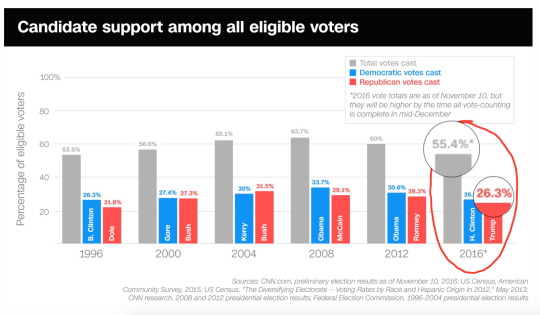
I do believe––strongly––that to denounce and vilify the quarter of the population who voted for Donald Trump would be a cataclysmic error. 

image

(graph from CNN, November 11.)

First, they are not necessarily a majority. They are a quarter of the population. One of our biggest concerns should be connecting with the other half the population, that did not feel it was necessary, important, or were unable to vote in this election. We need to determine what kept them from getting to the polls, and take action to remedy those inhibitors (be it voter suppression, political apathy, economic lack of access, whatever). If we believe that democracy and political freedom are important, we need to secure the rights necessary for those outcomes for the entire population, regardless of their political affiliation. 

Second, we need to connect with that other half of the population and determine how many of them share our concerns about the direction of the country under Donald Trump. He may be determined to turn this country into a demagogic kleptocracy on par with Russia (taking the future of the planet with it; environmentally, politically, and economically), but, at the expense of sounding like the Right and far too many member of the GOP lately, we do still have the Constitution, and this is still a country founded on the principle: By the people, for the people. 

Anyone who wants to point out that we have never lived up to that ideal is welcome to do so now. We still need to use every tool at our disposal. More importantly, we need to take action to make that ideal a reality. To borrow another slogan from the other side: freedom isn’t free. If we want a government for the people, by the people, we’re going to have to hold up our end of the bargain, and push for it. By the people

Third, we need to bridge the gap––social, economic, political––between the coasts and the middle of the country. The political response and the rhetorical and ideological alignments that Trump supporters have chosen to express their grievances are hostile and reprehensible. That does not mean that all of their grievances are baseless or based in racial anxiety. 

The social and economic dislocation that is occurring in the empty stretches of land between our borders is not all that different from the social and economic dislocation being experienced around the world as modernity and globalization fundamentally reshape and restructure our lives and livelihoods. This extremist wave is the backlash we saw once already when modernity and globalization first crept across the borders of Europe and the West, bringing to life fascism, futurism, nazism, and the first and second world wars. We are seeing it now on a larger scale in a more totalizing form. 

That dislocation must be addressed. It cannot be allowed to progress unfettered, and it is not a specter conjured in the minds of people with something to lose. It is a reality of people who are already losing what they cannot afford to do without.

That does not mean that everyone must shoulder that burden equally. This is the moment where the white citizens of America, who have lived with privilege that far outweighs their right, must prove themselves patriots, and true allies and fellow soldiers in the war for equality and community. 

We cannot allow the burden of speaking out against this hatred, and the work of building the bridges that will bring us, the majority, the disenfranchised, the precarious, together that we can aim our anger upward towards the targets deserving of it. 

We cannot afford to atomize and balkanize. To fall into pieces will be a death sentence and leave us at the doors of annihilation. Our only hope is to succeed where all our ancestors have failed, and build the coalition which sees us as dependent on one another and responsible for each other. 

We can only succeed together.

2016.11.15 : generative self-valorizing systems (the audacity of money)

Yesterday evening, in my graphic design class, we started talking about conceptual art. Our goal was to understand generative systems; systems that operate not as a complete, static organization of elements and/or information, but a set of rules that govern the organization of elements and/or information, allowing for variation, but also consistency. 

Nevertheless, we approached the question with examples from Sol LeWitt, who is known for his labor intensive conceptual art instillations. (Labor intensive, that is, for persons other than himself.) One of my classmates, who works as an illustrator, expressed her frustration and irritation with the popularity and financial success of conceptual artists. It seems unfair to her that she should expend the effort she does to achieve a high level technical and aesthetic achievement, and make no money, while these people or persons can write up instructions and take up rooms and wings of museums. 

I derailed the conversation by bringing up Damien Hirst. My opinion is split on him; I think he’s a money-grubbing, pretentious, no-talent dick, but I’ve also been greatly moved by at least one of his pieces

In the course of distraction, I came upon a sudden realization. 

The relationship between banking and art is generally recognized. I recommend this piece from The Believer, December, 2012, I believe it is the one that first introduced me Damien Hirst’s famous diamond encrusted skull

Currently, conceptual art is all the rage. I don’t think this is a mere side-effect of post-modernism. We have not exited the aesthetic age, and entered one dominated by the theoretical, nor is this a world of plastic ideas. The reason for the popularity of conceptual art lies with bankers.

We live in the age of finance capitalism. I have a penchant for Italian Marxists (Franco “Bifo” Berardi, Maurizio Lazzarato) whom I fully recognize are far enough out in left field to border on the incomprehensible. (Though I believe that their analyses and concerns are more discerning than most.) 

Finance capitalism is defined by perpetual valorization of non-material capital. The financial machine of the stock market, the one that invented the nihilistic derivative assets that blew a hole in the global economy, the one that consistently over-values enterprises with no clear means of profit production (Uber, Twitter, et. al.), is, literally, a market of ideas. 

They pour money into blackholes with everyone else’s money, and somehow transform that money into more money, until, suddenly, the bottom falls out from underneath them. (Then the money comes out of the real labor and real capital production and real earning power of the general populace, who run the rat race everyday to feed their families––no diamond encrusted skulls to be found.)

Of course finance capitalism spends its unspendable quantities of money on art that jumps, fully formed, from the head of the artist. The technical and physical labor that goes into the works are not the sources of value, and not the ones who will see the true profit. The money will go to the man with the gall to think he can sell such a thing to someone, and the children dying in the wars in Africa to bring us the diamonds and the gold and the shiny pieces that keep our entire immaterial infrastructures alive and beeping will see only hunger and death.

 The bankers know how the system really works––you don’t pay the farmer or the miner or the paint mixer. 

You pay only the broker.